
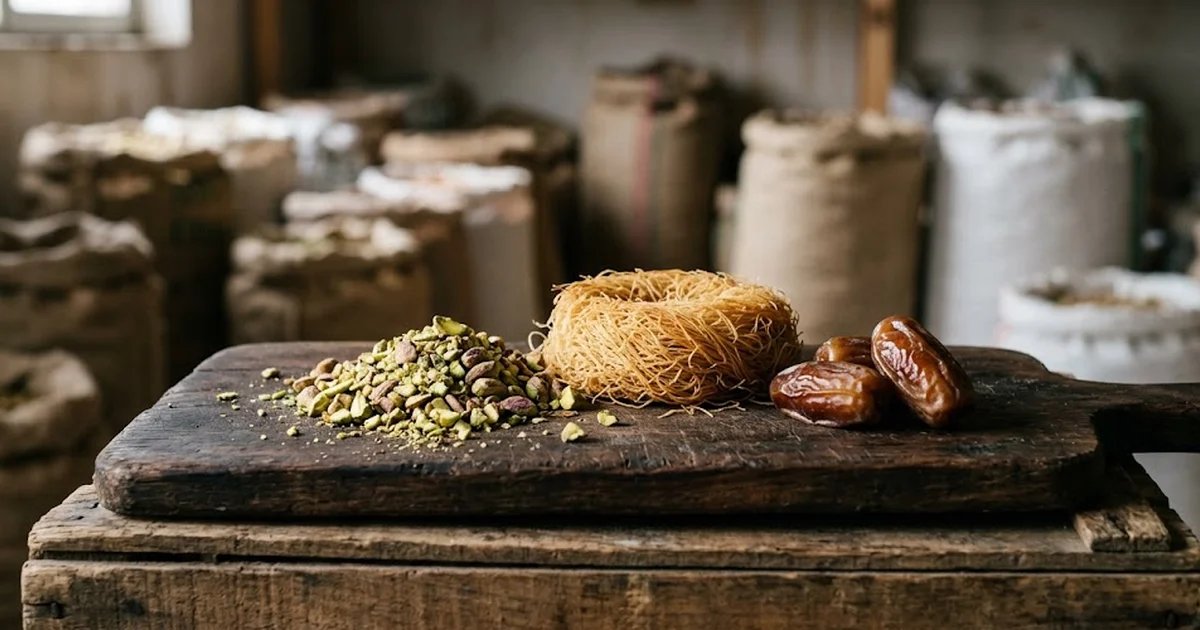
Salon de thé et pâtisserie orientale : la commande type
Almonds, pistachios, dates, kadaif, honey: weekly volumes, professional formats, and French logistics to build the standard order for an oriental patisserie.
An oriental tea room or a patisserie specialising in Maghreb and Middle Eastern delicacies does not operate with one-off purchases. The menu revolves around a core of recurring ingredients—almonds, pistachios, dates, kadaif, honey, and floral waters—ordered weekly in sufficient volumes to maintain production without disruption. This article details a realistic standard order, item by item, with the appropriate professional formats and useful stock rotation benchmarks for a foodservice establishment or an artisanal patisserie.
What an oriental tea room or patisserie orders every week
Weekly recurrence is the cornerstone of procurement in this sector: the production of baklava, gazelle horns, makroud, or loukoum never stops, and dry ingredients lend themselves well to a regular ordering rhythm rather than emergency purchases.
- Almonds (powder, flaked, crushed): between 15 and 40 kg per week depending on the size of the workshop
- Pistachios (powder, crushed, whole shelled): between 5 and 15 kg per week, a more costly item and thus more closely monitored
- Dates (clustered or in bulk): from 10 to 30 kg per week depending on seasonality (peak during festive periods)
- Kadaif: 5 to 10 kg per week for a medium-sized workshop
- Honey and flavoured sugar syrups: 5 to 15 litres per week
- Orange blossom and rose waters: 2 to 5 litres per month, slower consumption
- Dried decorative fruits (whole pistachios, whole almonds, grated coconut): a few kilos per week, as a supplement
These volumes justify professional formats, from buckets to bulk bags, consistent with the operations of a B2B wholesaler, and a consolidated ordering approach rather than sourcing from multiple suppliers.
Almonds and pistachios: powder, crushed, flaked—the formats that keep production moving
Nuts represent the highest volume and most technical category in terms of formats. An oriental patisserie rarely uses a single grade: powder is used for fillings and creams, crushed for decoration and coating, and flaked for visible finishes. Choosing the right format avoids waste and saves time in the kitchen—a topic covered in detail in our guide on almond formats: blanched, flaked, and powdered.
| Ingredient | Common format | Main use | Indicative weekly volume |
|---|---|---|---|
| Almond powder | 5-10 kg bag | Frangipane, fillings, pastry cream | 10-25 kg |
| Flaked almonds | 5 kg bag | Decoration, visible finish | 3-8 kg |
| Crushed almonds | 5-10 kg bag | Coating, crunch | 5-10 kg |
| Pistachio powder | 5 kg bag | Pistachio cream, fillings | 3-8 kg |
| Crushed pistachios | 5 kg bag | Baklava decoration, sprinkling | 2-5 kg |
For establishments looking to reduce costs without compromising taste, a trade-off exists between pure almond powder and more economical alternatives: we have covered this in detail in our article on substituting almond powder while controlling costs. The almonds section of the catalogue brings together all available grades and pack sizes to build this part of the order in a single line item.
Dates, kadaif, honey, and syrups: the sweet pillars of oriental patisserie
The date remains the signature ingredient of the oriental tea room, used both as a filling for makroud and as a display item. Clustered dates, more expensive but visually superior, often coexist with bulk dates reserved for processing. The clustered Algerian date in 12x1 kg cartons, for example, can cover both display and production needs in a single easy-to-manage format.
Kadaif, on the other hand, is not consumed alone: it is almost always paired with pistachio cream, particularly in trendy recipes like Dubai-style chocolate. These two ingredients have each been the subject of dedicated articles on this blog, which we will not revisit here:
- our comprehensive guide on using and dosing pistachio cream in patisserie
- our professional recipe for Dubai-style chocolate with kadaif and pistachio cream
- our dedicated storage guide for Medjool dates in professional use
The dates section of the catalogue allows you to compare available origins and grades based on the intended use (display, filling, decoration).
Floral waters, decorative dried fruits, and Oriental flavour selection
Orange blossom and rose waters are consumed in small volumes but are essential: they flavour syrups, marzipan, and certain creams. Their rotation is slower than that of nuts, which requires particular attention to the opening date and storage away from light, otherwise the aromas evaporate quickly. These products, along with spice blends and tapenades, are featured in our Oriental Flavours section, designed for professionals creating a menu with a strong Maghrebi or Middle Eastern identity.
The range of sweet decorations does not stop at dried fruits: loukoum and nougat often accompany the menu of a tea room, either on display or as an accompaniment to mint tea. The Loukoum & Nougats section allows you to complete this offering without multiplying suppliers. For an overview of the oriental range in the catalogue, our article professional oriental products: wholesale world flavours range details the available product families beyond nuts.
For precise uses of orange blossom water in patisserie and its equivalents in Mediterranean cuisine, the technical sheet published by the FAO Codex Alimentarius is a useful reference for professionals concerned with framing the use of natural flavours in products intended for sale.
Building your standard order: weekly volumes, formats, and French logistics
A standard order efficiently consolidates all the above items into a single delivery, leveraging free delivery thresholds to avoid multiple shipping costs. This is a point we regularly emphasise to establishments starting their business.
At Palimex, we see many new oriental patisseries ordering in small, scattered quantities, fearing overstock. Often, the opposite is more costly: between repeated delivery fees and stockouts during order preparation, a consolidated weekly order on a pallet format is almost always more cost-effective than multiple small orders. — The Palimex Team
- Consolidate almonds, pistachios, dates, and oriental spices into a single weekly order
- Anticipate production peaks (Ramadan, Eid, year-end holidays) by increasing volumes 2 to 3 weeks in advance
- Check the free delivery threshold before finalising the order to avoid unnecessary shipping costs
- Prioritise pallet delivery for high-turnover items (almond powder, bulk dates)
The rules for free delivery and pallet delivery thresholds are explained in detail in our dedicated guide on free delivery and pallet delivery in bulk orders. Establishments equipped to collect their orders themselves at Rungis or Bordeaux can also use the Drive & Collect page, a practical option for urgent orders between scheduled deliveries.
Storage, stock rotation, and HACCP management in oriental patisserie
Proper storage of nuts and oriental patisserie ingredients directly impacts the quality of the finished product and the food safety of the establishment. Poor rotation leads to rancidity in oilseeds, moisture absorption in kadaif, or premature crystallisation of syrups.
- Store almond and pistachio powder in a dry place, away from light, ideally in an airtight container after opening
- Keep kadaif in its original packaging until use, in a dry place to prevent the strands from sticking together
- Monitor the best-before date of clustered dates, which are more sensitive to ambient humidity than vacuum-packed bulk dates
- Label each opened batch with its receipt date to apply a strict first-in, first-out rotation
- Adjust ordering frequency to the actual consumption rate observed in the kitchen rather than a theoretical estimate
Our general guide on storing dried fruits details shelf life by product family and recommended storage conditions in a professional environment. For establishments also looking to customise their display presentation, the page dedicated to custom-branded dried fruit sachets can complement a strategy for brand image in a tea room.
Summary: Building a reliable order for an oriental tea room or patisserie
The standard order for an oriental tea room or patisserie is based on a limited number of recurring items—almonds and pistachios in various formats, dates, kadaif, honey, syrups, and floral waters—ordered in regular weekly volumes rather than one-off purchases. Structuring this order around a single supplier, with professional formats and logistics designed for free delivery, simplifies stock management and secures production. Vigilance on storage and rotation remains the final essential step to ensure consistent taste and texture, week after week.
Frequently asked questions
Everything you need to know about this topic.
A question?
Get in touch directly.

Marketing & Communications Manager — Palimex / Meyva
As Marketing & Communications Manager at Palimex / Meyva, Aude Moyne leads the company's communications and digital marketing strategy: editorial content, email campaigns and the promotion of its product ranges. Her experience at Palimex, a specialist in dried fruit, nuts, olives and spices for professionals, has given her in-depth knowledge of the products, their origins and uses, and the expectations of food-industry professionals. The blog articles are written or supervised by her, in collaboration with Palimex's sales and product teams whenever a topic calls for specific expertise.
Our advice related to Grocery & Recipes
 Grocery & Recipes
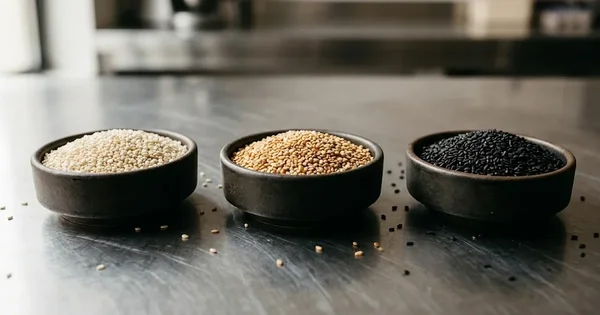
Sésame en gros : blanc, noir, grillé, et leurs usages
Guide pro du sésame en gros : blanc, complet, noir ou grillé. Usages culinaires, cuisson, prévention du rancissement et approvisionnement B2B chez Palimex.
 Grocery & Recipes
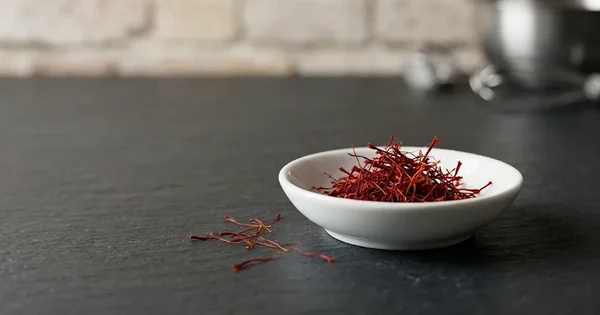
Safran en CHR : lire le grade, doser et repérer une falsification
Guide safran CHR : distinguer filaments et poudre, repérer les falsifications, réussir l'infusion et maîtriser le coût matière par portion en cuisine pro.
 Grocery & Recipes
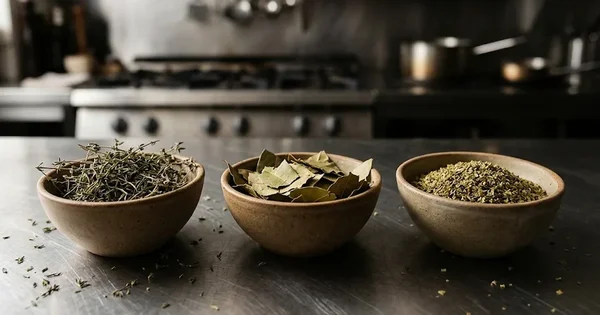
Herbes aromatiques séchées : rendement face au frais et conservation en réserve
Rendement herbes séchées vs frais, équivalences de cuisson, tolérance au séchage et stockage en réserve CHR : guide technique et logistique pour les pros.