

Available products
47 references · page 1 / 2









Looking for a wholesale dried fruit supplier?
I'm Jessica, your dedicated wholesale account manager.
Direct sourcing — Rungis and Bordeaux.
- ✓Direct sourcing from producers
- ✓Quality controlled (shelf-life, calibre, origin)
- ✓Next-day delivery in Île-de-France
- ✓Bulk, custom packaging, co-packing
- ✓B2B account with pricing tiers
B2B delivery & packaging
Rungis pickup
Pick up your order at our Rungis market depot. By appointment Monday through Friday.
Nationwide delivery
Delivery within mainland France and major European cities. Indicative lead time 24-48h.
Professional packaging
Bulk, 5 to 10kg buckets, 200g to 1kg bags
Frequently asked questions
Overview
An offer built around the production station, not the retail shelf
A pastry workshop does not buy like a grocery store. It buys a consistent grade, packaging that keeps pace with output, and a shelf life compatible with its rotation. That is the logic behind this range: every reference is described by variety, grade and case format, so the production manager knows what is inside before opening it. Families covered run from whole nuts to powders, including diced dried fruit and ready-to-use pastes.
Packaging and grades by family
The table below lists the formats most requested by workshops. Weights refer to original case packing; 5 kg Meyva buckets are the entry format for workshops with slower rotation.
| Family | Sample reference | Case | Typical use |
|---|---|---|---|
| Cashew | W240 | 22.68 kg | Praline, roasting, garnish |
| Brazil nut | Medium | 20 kg | Chopped, bars, biscuits |
| Macadamia | Raw | 11.34 kg | Cookies, entremets, decoration |
| Hazelnut | Blanched 12/14 | Case / 5 kg bucket | Powder, financier, praline |
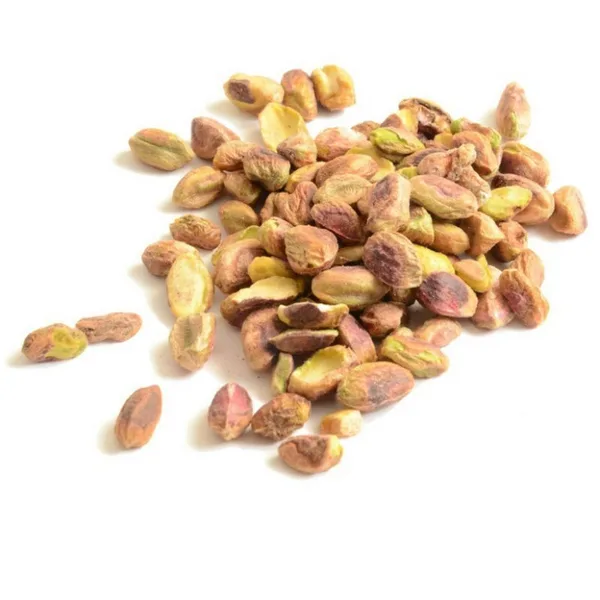
| Pistachio | Peeled Grade S | Case / 5 kg bucket | Decoration, paste, glazing |
| Dried apricot | 10×10 mm dice | Case | Cake, viennoiserie, filling |
| Pistachio paste | Ready to use | 6×200 g | Flavour base, ganache |
Matching grade to production station
Grade is not a cosmetic detail: it drives yield and consistency. An Extra France walnut kernel earns its place on a visible garnish, where breakage shows; in a ground filling it is a cost with no return. The same reasoning applies to hazelnuts: blanched 12/14 yields an even powder, whereas a scattered grade lengthens grinding time and heats the material. Buyers who standardise on a single grade across every station usually overpay on one line and underperform on another.
- Visible garnish — favour regular grades and Extra classifications; breakage tolerance must stay low.
- Fillings and pralines — irregular grades are fine, grinding erases shape.
- In-house powders — start from a tight grade to limit grinding time and heat build-up.
- Decoration — colour comes first; Grade A peeled pistachio holds its shade better than raw roasted in-house.
- Fillings — calibrated 10×10 mm dice ensure even distribution when slicing.
We recommend trialling a reference across a full production run before switching an annual volume: how a nut behaves in the workshop depends as much on your process — temperature, grinding time, batter hydration — as on its technical sheet.
Powders, pastes and semi-processed formats
Between whole fruit and finished product, intermediate formats save hours of workshop time. An extra-fine almond powder removes in-house grinding and the risk of heat build-up that makes oil seep out and ruins the texture of a macaron. Calibrated dice remove manual cutting. Ready-to-use pastes bring a consistent flavour base from one production run to the next — a real advantage when several people take turns at the same station. The decision rests on a simple trade-off: does the labour time saved offset the difference in price per kilo? For a workshop producing in series, the answer usually leans towards semi-processed formats; for one-off, signature production, whole fruit keeps the upper hand. Many workshops end up running both, reserving whole nuts for the visible work and powders for volume lines.
Storage, rotation and traceability
Nuts are prone to oxidation: storage control matters as much as purchasing quality. A dry, temperate room away from light remains the rule, and opened cases are better resealed airtight than left in open bins. Powders, with a far greater exchange surface, degrade faster than whole fruit: they belong at the front of the rotation.
Every delivery carries its lot and best-before markings, to be recorded in your food safety plan. On labelling and consumer information obligations for foodstuffs, the DGCCRF publishes the reference doctrine — particularly useful on allergen declaration, since tree nuts are directly concerned.
Ordering wholesale: volumes, quotes and logistics
Catalogue access is restricted to professionals holding a business registration number, in professional formats from retail bags sold by the case to bulk sacks, with pallet or carriage-paid shipping depending on volume. Prices are quoted on request: the price structure of a 22.68 kg case bears no comparison with a 5 kg bucket, and the annual volume committed is part of the negotiation. For a first listing, state your target grades and expected throughput: that is what allows us to arbitrate between an entry format and original case packing.
Artisans working to a season — yule logs, galettes, Advent calendars — benefit from placing orders ahead of the peak: the most regular grades are also the first to tighten on the market. Our team has supported this planning since 1984 alongside workshops, caterers and fine grocers.