
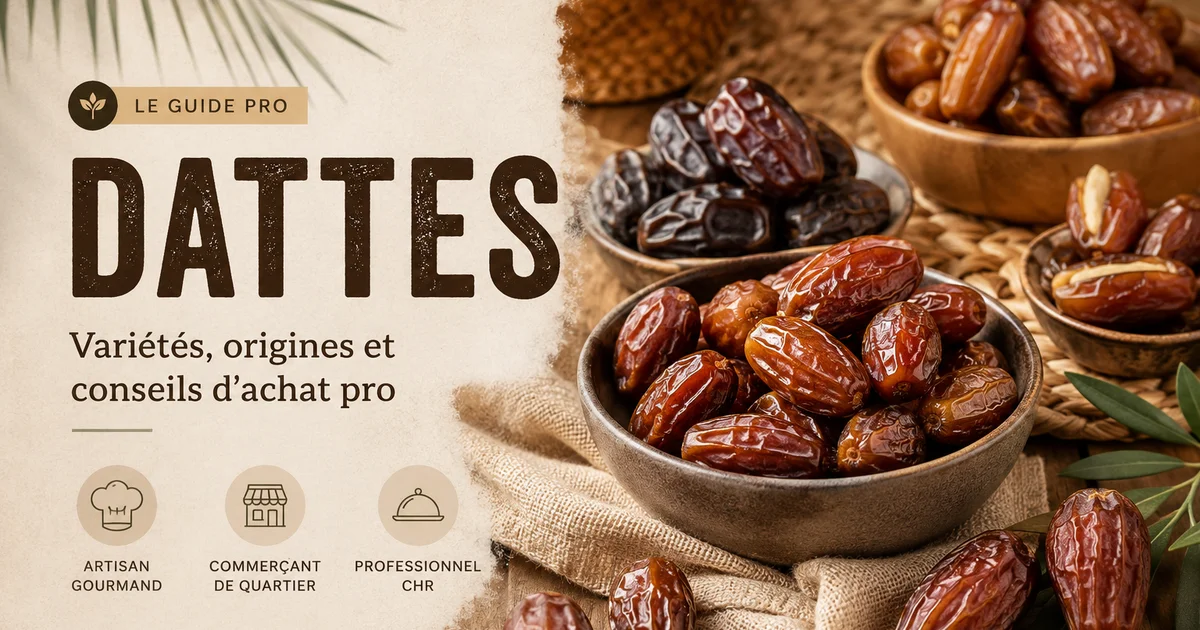
Wholesale dates: varieties, origins and buying tips for pros
Professional guide to wholesale dates: Medjoul, Deglet Nour and Mazafati varieties, origins, storage and professional packaging at Palimex, wholesaler.
Since 1984, Palimex has supported food professionals — delicatessens, restaurateurs, caterers and HoReCa outlets — in their sourcing of dried fruits, dehydrated fruits, spices and olives. Among our ranges, the date holds a central place: a strong seasonal product (end-of-year festivities, Ramadan), but also a year-round shelf staple for Middle Eastern grocery shops, caterers and pastry chefs. This guide covers varieties, origins, professional formats and best storage practices to help you build a solid wholesale date offering.
The date, an essential staple of B2B dried fruit shelves
The date is the fruit of the date palm (Phoenix dactylifera), a palm tree cultivated for millennia in the arid regions of the Maghreb and the Middle East and, more recently, in certain tropical areas. Dried or semi-dried depending on the variety, it stands apart from other dried fruits through its natural richness in sugars and its texture, which varies considerably from one variety to another: soft and melt-in-the-mouth for some, firmer and drier for others.
For a professional point of sale, the date serves multiple uses: a draw product in Middle Eastern grocery shops, a premium HoReCa platter, an ingredient for pastry and confectionery, a base for healthy snacking (energy balls, aperitif mixes), or a gift item during festive periods. This versatility makes it, like the cashew, a fast-turnover product that deserves a structured range rather than a single reference.
Origins and provenance: where wholesale dates come from
Geographic sourcing directly determines the variety, texture and size of the date. The main global production regions are located in the Middle East and North Africa, with different roles depending on the country.
| Producing country | Estimated production (tonnes/year) | Flagship varieties |
|---|---|---|
| Egypt | approx. 1,500,000 t | Local varieties, soft texture |
| Iran | approx. 1,200,000 t | Mazafati, Piarom |
| Algeria | approx. 1,200,000 to 1,400,000 t | Deglet Nour, branch dates |
| Saudi Arabia | more than 1,000,000 t | Sukkari, Ajwa |
| Iraq | more than 600,000 t | Local varieties |
| Palestine | smaller-scale production, high added value | Medjoul |
Palimex works with traceable origins — Algeria, Palestine, Iran, Saudi Arabia — selected according to the variety and intended use. For a professional buyer, requesting the precise origin and batch number for every order remains the best guarantee of consistency, particularly when several harvests follow one another during the year depending on the production area.
Understanding the varieties: Medjoul, Deglet Nour, Mazafati, Sukkari, Ajwa
Not all dates are equal in the kitchen or in retail. The choice of variety should be guided by the intended end use as much as by budget.
| Variety | Typical origin | Texture | Recommended professional use |
|---|---|---|---|
| Medjoul | Palestine, Jordan | Large, fleshy, soft, caramel-like flavour | HoReCa platters, premium per-unit sales, corporate gifts |
| Deglet Nour (branch) | Algeria, Tunisia | Firm, regular size, good structure | Middle Eastern grocery shops, 1 kg cartons, branch presentation |
| Mazafati | Iran | Very moist, melt-in-the-mouth, fragile | Chilled preparations for quick turnover, cold chain required |
| Sukkari | Saudi Arabia | Sweet, slightly crisp, pale skin | Premium gift boxes, fine food shops, premium halal products |
| Bouquet date | Premium selection | Even size, refined presentation | Gourmet hampers, corporate gifts |
In practice, for a dessert menu or a HoReCa platter, the Medjoul Jumbo is the benchmark choice: its fleshy texture holds up well when plated and its size makes a strong visual impact. The Mazafati, softer and more moist, should instead be offered in chilled preparations and sold quickly, as its texture deteriorates faster at prolonged room temperature.
A Palimex sourcing tip: never confuse "large date" with "Medjoul". The variety name should always appear on the technical data sheet and the delivery note, just as size does for in-shell nuts — it is the only guarantee of receiving the product actually ordered.
Professional formats and packaging at Palimex
Palimex's date range covers several formats suited to different professional buyer profiles:
- Medjoul Jumbo Palestine Dates — 5 kg format, for per-unit sales or premium HoReCa platters.
- Mazafati Iran Dates — cartons of 12x500g, for quick use in fresh preparations.
- Branch Dates Algeria — cartons of 12x1 kg, traditional on-the-branch presentation for Middle Eastern grocery shops.
- MEYVA Extra Premium Régime Dates Algeria — 3 kg format, our own brand for a well-balanced quality-price ratio.
- Jenna Sukkari Premium Dates — cartons of 10x600g, for a premium, high-value halal offering.
- Bouquet Premium Dates — cartons of 12x800g, sized for gourmet hampers and gift boxes.
- Smart Energy Ball Range — date and dried fruit mixes (almond-morello cherry, cocoa-orange, peanut butter-pistachio-blueberry) in a 4x1.2 kg snacking format, to meet the growing demand for healthy on-the-go snacks.
This variety of formats allows every professional — neighbourhood grocery shop, gourmet artisan, HoReCa outlet — to build a date offering consistent with their positioning, from an accessible draw product to a premium signature item.
Nutritional composition: a sales argument worth knowing
The date is naturally rich in sugars, making it a concentrated source of energy widely used in healthy snacking and no-added-sugar products. Below are the reference values for 100 g of dried dates.
| Nutrient (per 100 g) | Value |
|---|---|
| Energy | approx. 282 kcal |
| Carbohydrates | approx. 75 g |
| Protein | approx. 2.5 g |
| Fat | less than 0.5 g |
| Fibre | approx. 7 to 8 g |
| Potassium | approx. 650 to 700 mg |
This richness in fibre and potassium, combined with the absence of added fats, makes for a strong commercial argument for fine food shops and wellness-oriented retailers, particularly on plain, no-added-sugar ranges such as Deglet Nour or Régime dates.
Storage, best-before dates and stock rotation
Unlike walnuts and almonds, the date is barely exposed to rancidity since it contains very little fat. Its storage nonetheless raises specific challenges linked to its moisture content and its richness in sugars.
- Store in a dry, cool place, away from direct heat, to limit the natural crystallisation of sugar on the surface (the "white bloom", harmless but often perceived as a defect by the end customer).
- Maintain the recommended cold chain for the more moist varieties (Mazafati, fresh soft Medjoul), which are more prone to mould development.
- Keep cartons in their original packaging until opened, to preserve the product's moisture level.
- Apply strict FIFO rotation and track best-before dates batch by batch, particularly for the most fragile formats.
- Anticipate seasonal demand peaks (Ramadan, end-of-year festivities) by ordering well in advance, as supply lead times can lengthen during these periods.
For the driest formats (branch Deglet Nour, Régime dates), the shelf life is considerably longer than for the softer varieties, making them a good year-round shelf staple. Our Storage & preservation section details the recommended protocols for dried fruits as a whole, in addition to the HACCP requirements applicable in professional kitchens.
Professional uses by trade
Depending on the type of establishment, the date is showcased differently:
- Middle Eastern grocery shops and halal butchers: branch Deglet Nour in 12x1 kg cartons for sale by weight, Sukkari and Ajwa in gift boxes for festive periods.
- HoReCa and caterers: Medjoul for premium platters and desserts, Mazafati in fresh preparations to be consumed quickly.
- Pastry chefs and artisans: date paste for fillings and confectionery centres, stuffed dates (almond, walnut kernel) for direct sale.
- Fine food shops and gourmet hampers: premium bouquet dates, corporate gift boxes for the end of the year.
- Snacking and takeaway sales: the Smart Energy Ball range, date and dried fruit mixes to meet the demand for healthy snacks.
This segmentation by trade allows every professional buyer to build a coherent offering without unnecessarily multiplying stock references. Our Recipes section offers ideas for showcasing the date on the menu or on the shelf, while the Middle Eastern flavours section explores traditional culinary uses in more depth.
Choosing the right wholesale date supplier
Beyond the price per kilo, several criteria are worth checking before listing a date supplier:
- The ability to provide a precise technical data sheet (variety, origin, size, best-before date) for every batch delivered.
- Full traceability back to the country of production, essential for premium varieties such as Medjoul.
- Consistent supply throughout the year, including outside periods of high demand.
- Consistency between the packaging offered (branch, carton, tray, bulk) and the establishment's sales pace.
- The availability of a full range — plain, stuffed, as paste, in snacking mixes — to simplify order management.
At Palimex, this approach is part of a broader offering of dried fruits and ranges and packaging designed for professionals, with support on volumes, pallet logistics and product advice. Labelling and compliance information applicable to wholesale sales falls under DGCCRF regulations, to be consulted in case of doubt on a specific matter. Our B2B Guides section brings together other useful resources for structuring dried fruit purchasing.
A question?
Get in touch directly.
Our advice related to Dried-fruits
 dried-fruits
Seau, carton, sac de 25 kg : le conditionnement décide de la rotation
Bucket, carton, or 25 kg bag: which packaging to choose based on your actual turnover in professional kitchens. Palimex advice for foodservice, grocers, and pastry chefs.
 dried-fruits
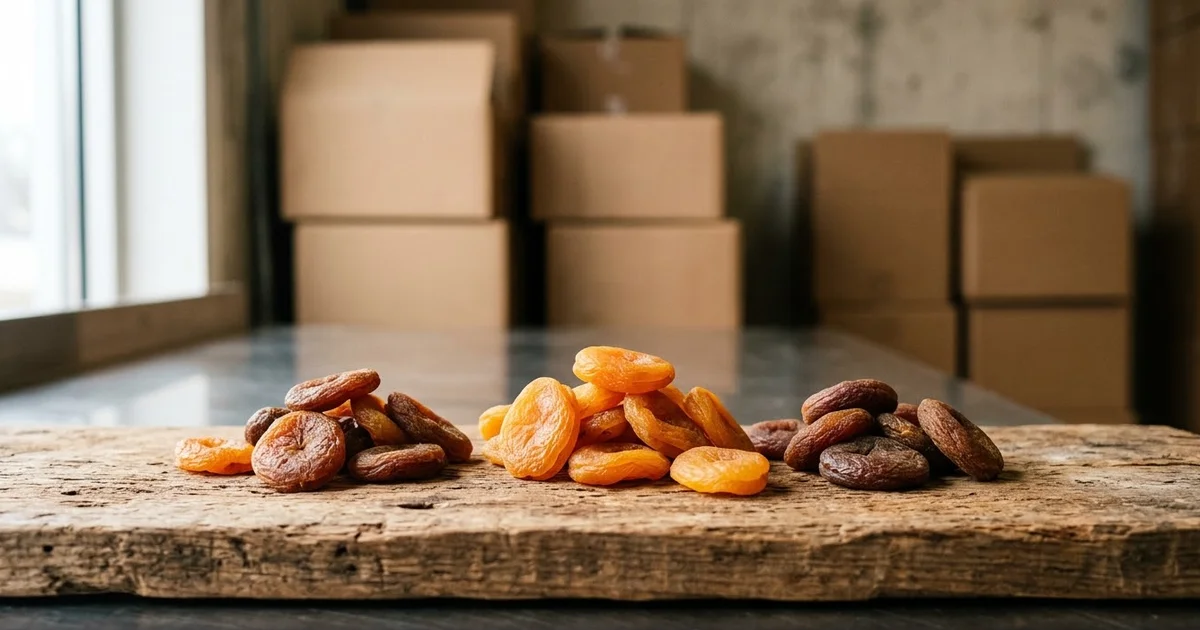
Abricot sec : lire un calibre n°1 à n°4, soufré ou non
How to read size grades No.1 to No.4 for dehydrated apricots, and choose between sulphured and unsulphured based on professional kitchen use. Buyer’s guide for foodservice, pastry chefs, and specialty grocery stores.
 dried-fruits
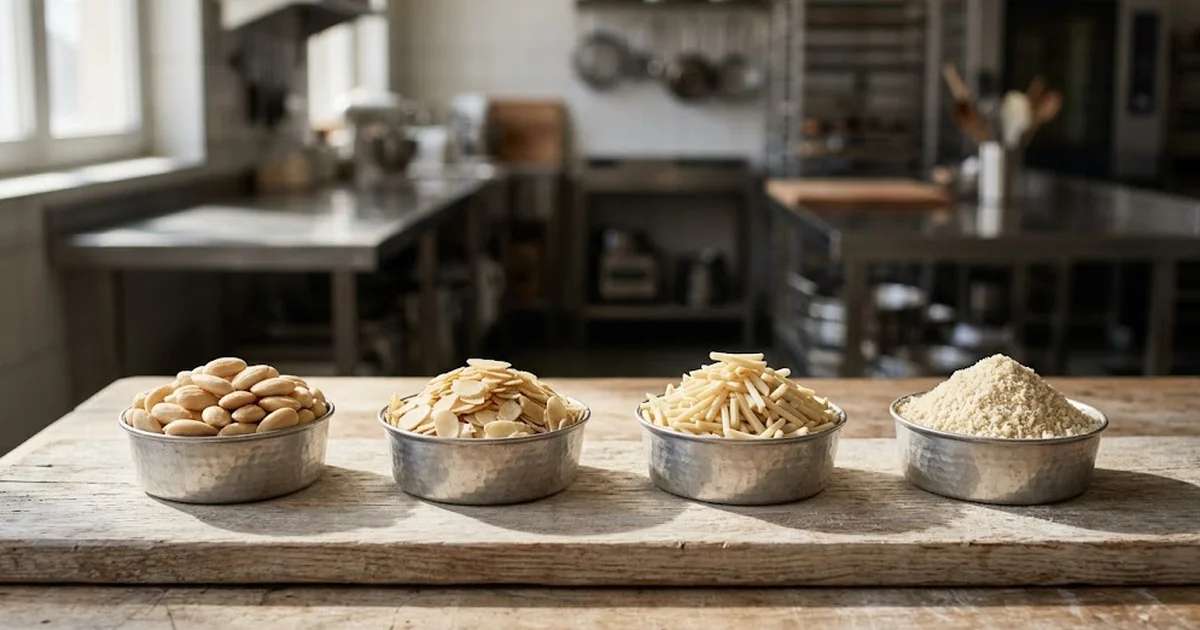
Amande émondée, effilée, bâtonnet, poudre : quel format pour quel usage
Professional guide: uses, cooking performance, and storage of blanched almonds, flaked, slivered, and powdered. Procurement and B2B logistics tips from Palimex.