
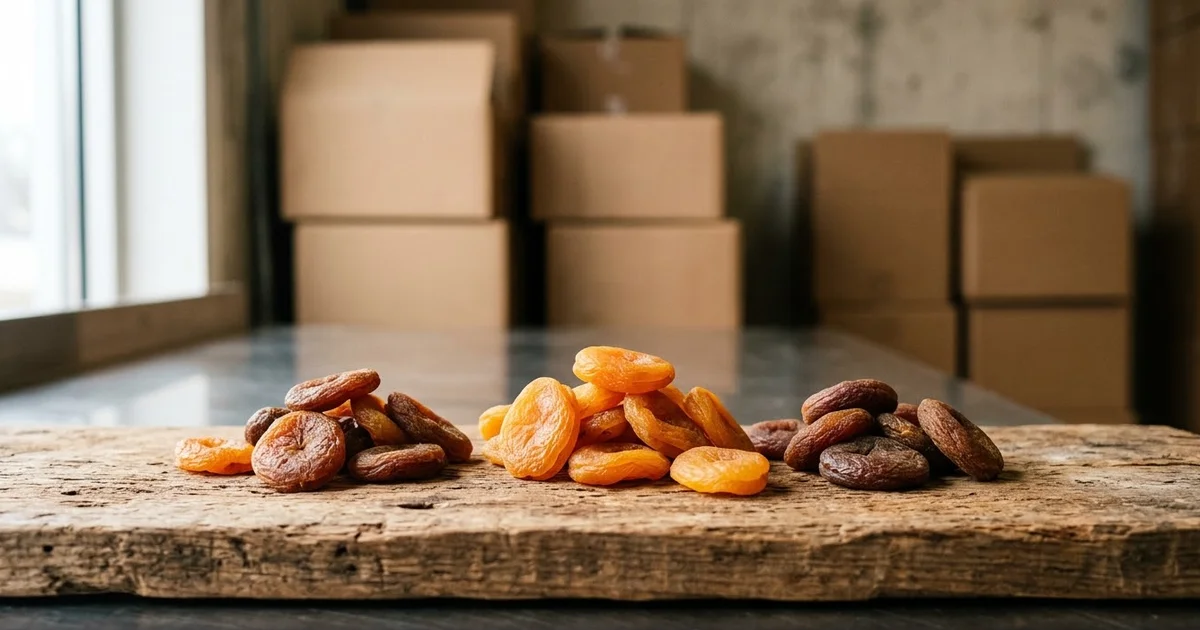
Abricot sec : lire un calibre n°1 à n°4, soufré ou non
How to read size grades No.1 to No.4 for dehydrated apricots, and choose between sulphured and unsulphured based on professional kitchen use. Buyer’s guide for foodservice, pastry chefs, and specialty grocery stores.
On a technical data sheet or delivery note, the term “dehydrated apricot size No.2, unsulphured” means nothing to those unfamiliar with the sector’s vocabulary. Yet these few words determine the price per kilogram, the texture achieved in cooking, the display colour, and the shelf life in storage. For a professional buyer—foodservice, pastry chef, or specialty grocery store—knowing how to read a size grade and distinguish between sulphured and unsulphured avoids unpleasant surprises upon receipt and during plating. This article decodes these key indicators to guide your bulk orders based on actual kitchen use.
Dehydrated apricot sizing: decoding grades No.1 to No.4
The size grade of a dehydrated apricot refers to its size, indicated by a number typically ranging from No.1 (largest) to No.4 (smallest), depending on origin and available batches. This number is not a quality rating: a No.4 grade is not “inferior” to a No.1; it is simply smaller and intended for different uses. Sizing is based on mechanical or manual sorting that standardises fruits within the same batch, a critical factor for consistency in professional kitchen preparations.
| Grade | Indicative size | Appearance | Typical professional use |
|---|---|---|---|
| No.1 | Large fruit, thick flesh | Round, uniform, attractive presentation | Plating, display, foodservice baskets, premium snacking |
| No.2 | Standard size | Homogeneous, good flesh-to-price ratio | Pastry, viennoiserie, aperitif mixes |
| No.3 | Small to medium | Irregularities tolerated | Compotes, coulis, fillings, long cooking |
| No.4 | Small fruit or sorted pieces | Reduced size, sometimes fragmented | Industrial processing, fine chopping, dough incorporation |
Grade selection should always start with the end use, not the other way around. Ordering a larger grade than required by the recipe results in paying a premium for visual appeal that will be masked by cooking or blending.
Sulphured vs. unsulphured: colour, shelf life, and mandatory labelling
Sulphur treatment (sulphur dioxide) is applied during drying to preserve the apricot’s bright orange colour and slow oxidation. A sulphured apricot retains a vibrant hue and a softer texture longer; an unsulphured apricot naturally darkens to brown and has a firmer texture, sometimes drier on the surface. This distinction is not merely aesthetic: it triggers labelling requirements and directly impacts shelf life in storage.
- Colour: bright, uniform orange for sulphured; amber to dark brown for unsulphured.
- Texture: prolonged softness for sulphured; more pronounced firmness for unsulphured.
- Shelf life: sulphur treatment limits mould growth and extends product stability when stored in bags or cartons.
- Labelling: the presence of sulphites above the regulatory threshold requires the corresponding allergen declaration on labels and documents provided to professional buyers.
- Kitchen use: unsulphured appeals to short supply chains or customers sensitive to sulphites; sulphured remains preferred for colour stability in plating and display.
For precise details on thresholds and major allergen classification, the DGCCRF allergen fact sheet is a useful reference to consult before sharing information with end consumers.
At Palimex, we regularly receive orders where the grade is not specified—just “dehydrated apricots.” For a batch intended for compote or cooked filling, this approximation has no consequences. For a tray display or basket sold as-is, it can ruin the presentation. Our field advice: always specify the end use when placing an order, and we’ll recommend the appropriate grade and treatment rather than the lowest price.
Which grade for which use: from plating to compote
Grade selection directly depends on the intended kitchen transformation. A pastry chef, caterer, or restaurateur does not face the same constraints as a grocery store selling the fruit as-is by weight.
- Plating and display (grade No.1): dried fruit baskets, welcome trays, cut-to-order presentation where the customer’s eye assesses fruit uniformity.
- Pastry and viennoiserie (grade No.2): incorporation into yeast doughs, cakes, fruitcake mixes, where the fruit remains identifiable but does not need to be the largest grade.
- Compotes, coulis, and sauces (grade No.3): the fruit is intended for cooking, blending, or reduction: size becomes irrelevant, only flesh and yield matter.
- Fine processing and incorporation (grade No.4 or pieces): chopping, internal fillings, stuffings, snack mixes where the fruit is cut before serving.
This hierarchy of use allows for budget optimisation without sacrificing quality perceived by the end customer: it is better to reserve grade No.1 for display and use grade No.3 in the kitchen rather than a single oversized grade for all purposes.
Price differences between grades: what you actually pay per kilogram
The price gap between grade No.1 and grade No.4 is explained by sorting yield: the larger and more uniform the fruit, the lower the proportion of compliant fruits from the same harvest, increasing sizing costs. For unsulphured apricots, higher storage loss risk is often reflected in the price.
| Factor | Impact on price | Buyer’s key consideration |
|---|---|---|
| Higher grade (No.1-No.2) | Higher price per kilogram | Justified only if the use enhances size (plating, retail sale) |
| Lower grade (No.3-No.4) | More affordable price per kilogram | Ideal for cooking, compote, processing—no impact on perceived quality |
| Unsulphured | More demanding storage and rotation costs | Check the best-before date and rotation frequency before ordering large volumes |
| Sulphured | Extended colour and texture stability | Verify mandatory labelling before resale |
For professionals managing multiple dried fruit SKUs, it is often more cost-effective to create a grade assortment based on internal uses rather than standardising all orders on the most visually premium grade.
Storage, stock rotation, and best-before date management in professional kitchens
Dehydrated apricot storage depends directly on treatment (sulphured or unsulphured) and storage conditions. Poorly planned rotation leads to avoidable losses, particularly for unsulphured batches more sensitive to ambient humidity.
- Store away from direct light and moisture, in a temperature-controlled area compliant with your establishment’s HACCP requirements.
- Follow first-in, first-out (FIFO) rotation, especially for unsulphured cartons with faster turnover.
- Systematically check the best-before date on each batch upon receipt and record it in your internal traceability system.
- Repackage in airtight containers immediately after opening the original carton to limit moisture absorption in the kitchen.
- Anticipate seasonal consumption peaks (end-of-year holidays, pastry season) to adjust order volumes without overstocking.
Effective stock rotation also optimises sourcing from your wholesaler: regular orders tailored to actual needs ensure batch availability over time, particularly for best practices for storing dried fruits in professional storage.
Bulk ordering: packaging, sourcing, and logistics for professionals
Beyond grade and treatment, bulk ordering involves B2B-specific logistical constraints: minimum order quantities, pallet delivery, and alignment between ordered volumes and actual kitchen or shop rotation.
- Minimum order of 5 kg per SKU, tailored to the needs of foodservice, specialty grocery stores, or pastry workshops.
- Delivery by pallet or free carrier based on volumes, to be planned according to your storage capacity.
- Grade selection to be specified at the time of order to avoid discrepancies between intended use and delivered batch.
- Batch traceability available for direct integration into your HACCP documentation.
To expand your supply beyond dehydrated apricots, the full range of dried and dehydrated fruits for professionals allows you to create a coherent assortment for your culinary uses. Buyers focused on pastry or bakery may also find it useful to compare apricot grades with those of other dried fruits in our bulk guide for pastry chefs and artisans, while foodservice professionals can directly consult the foodservice selection of dried fruits, spices, and olives to build a consolidated order.
Summary: how to read a grade before placing an order
A grade from No.1 to No.4 never indicates higher or lower quality: it designates a size, to be chosen based on the end use—plating, pastry, compote, or processing. The sulphured or unsulphured treatment determines colour, texture, and shelf life, with mandatory labelling requirements if the regulatory sulphite threshold is exceeded. By cross-referencing these two criteria with your actual stock rotation, it becomes possible to optimise purchasing budgets without ever compromising kitchen or display results. Before any bulk order, always specify the intended use to your supplier: this ensures you receive the grade and treatment truly suited to your professional activity.
A question?
Get in touch directly.
Our advice related to Dried-fruits
 dried-fruits
Seau, carton, sac de 25 kg : le conditionnement décide de la rotation
Bucket, carton, or 25 kg bag: which packaging to choose based on your actual turnover in professional kitchens. Palimex advice for foodservice, grocers, and pastry chefs.
 dried-fruits
Amande émondée, effilée, bâtonnet, poudre : quel format pour quel usage
Professional guide: uses, cooking performance, and storage of blanched almonds, flaked, slivered, and powdered. Procurement and B2B logistics tips from Palimex.
 dried-fruits
Macadamia en gros : calibres, origines et prix au kilo
B2B guide to macadamia nuts: origins, sizing, price per kilogram variations, and fat preservation. Order from 5 kg, pallet delivery for foodservice professionals.