
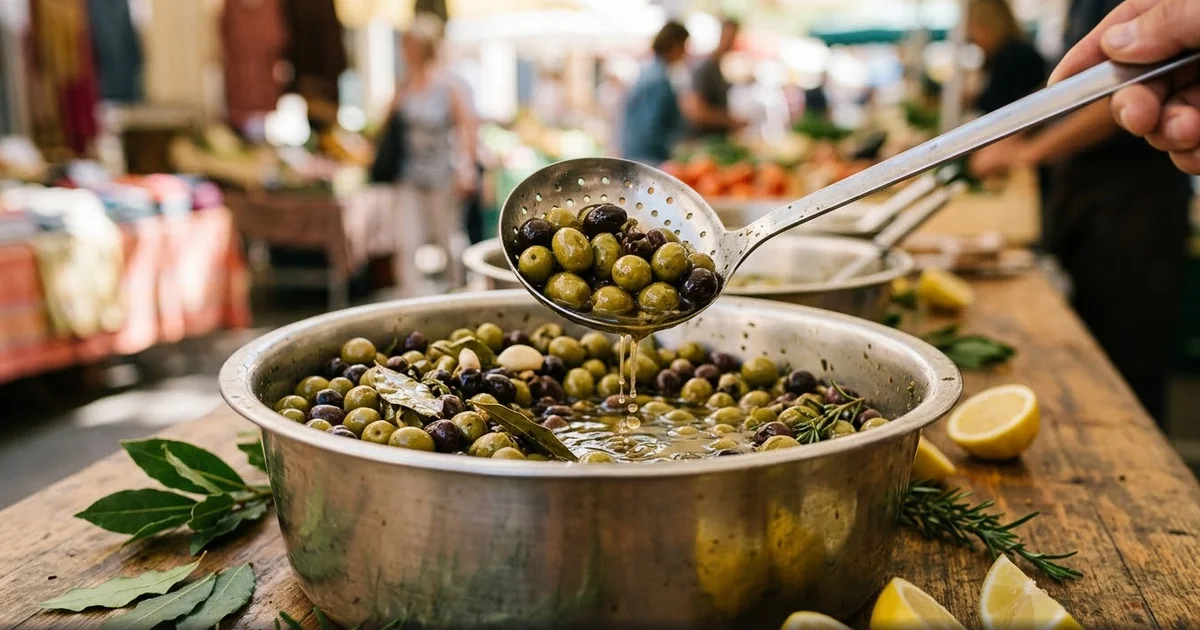
Bulk Olives Wholesaler: Buckets & Brine for Foodservice
Bulk olives for foodservice professionals: varieties, sizes, brine, storage, and 2/5/10 kg buckets. The Palimex wholesaler guide to ordering right.
The olives section has been one of the cornerstones of the Palimex catalogue since 1984, yet a reference guide for our professional clients was still missing. Between varieties, sizes, buckets, and storage rules after opening, navigating this range is not always straightforward for a chef, a fine grocer, or a foodservice purchasing manager. This article provides a comprehensive overview of buying bulk olives for the foodservice industry, with a clear objective: to help you order accurately, reduce waste in the kitchen, and optimise your stock rotation.
Why bulk remains the benchmark for foodservice professionals and fine grocers
Unlike retail sales in jars, bulk purchasing allows professionals to control their ingredient costs, adapt volumes to their actual activity, and reduce single-use packaging. This is a direct margin issue for a restaurateur serving olives as an aperitif, for a caterer incorporating them into trays, or for a fine grocer offering them by weight.
- Price per kilo significantly lower than individual packaging
- Order flexibility based on size and intended use (bar, appetizer, hot cuisine)
- Reduction in packaging waste, an argument increasingly valued by end customers
- Ability to create custom assortments from multiple varieties
This approach, however, requires a good understanding of varieties, sizes, and storage rules; otherwise, stock management can quickly become complex. This is the focus of the following sections.
Olive varieties for professionals: Kalamata, Picholine, Beldi, Halkidiki
The choice of variety determines culinary use, display appearance, and pricing. Each origin has its own texture, flavour, and resistance to preservation in brine.
- Kalamata (Greece): elongated black olive, firm flesh, fruity and slightly tangy flavour. An essential reference for Mediterranean trays and Greek salads.
- Picholine (france, Mediterranean basin): crunchy green olive, slightly bitter and salty notes. Highly sought after for aperitifs and bar service due to its mouthfeel.
- Beldi (Morocco): wrinkled black olive, naturally candied, melting texture. Used in hot cuisine, tajines, and slow-cooked dishes, but also appreciated as a high-end appetizer.
- Halkidiki (Greece): large green olive, fleshy, often pitted or stuffed. A showcase product for fine grocers and catering corners.
For a coherent foodservice assortment, it is common to combine a crunchy green variety (Picholine or Halkidiki) with a black variety that is rounder in the mouth (Kalamata or Beldi), to cover all uses, from the bar to hot cuisine. Discover all these references in our Olives & Spreads catalogue.
Olive sizes and numbering: reading a technical sheet without mistakes
Olive size numbering is often the least understood point for non-specialist buyers, yet it directly determines kitchen yield and the real cost per portion. Olives are classified by the number of fruits per kilo: the lower the number, the larger the size.
| Size category | Number of fruits/kg (indicative) | Recommended professional use |
|---|---|---|
| Very large size | 70 to 100 | Fine grocery display, premium appetizer |
| Large size | 101 to 160 | Catering trays, bar service |
| Medium size | 161 to 230 | Hot cuisine, sauces, garnishes |
| Small size | 231 and above | Blended preparations, tapenades, stuffings |
This classification, close to the internationally codified uses for table olives (see the categories defined by the Codex Alimentarius), allows for an objective comparison of batches from one supplier to another, regardless of the commercial name of the variety. This is a reflex to systematically integrate when placing a bulk order, particularly when changing suppliers or batches.
Brine, best-before date, and storage after opening: HACCP best practices
Brine is not just a filling liquid: it plays an active role in product preservation and final flavour balance. Once the bucket is opened in the kitchen or at the bar, managing this brine becomes a key HACCP point of vigilance.
- Always keep olives immersed in their original brine, never dry
- Use clean, dedicated utensils for sampling to avoid cross-contamination
- Seal the bucket tightly after each use and store it in a cold room
- Respect the best-before date indicated on the batch label and note the opening date on the container
- Never pour used brine back into a new batch, even of the same variety
At Palimex, we regularly find that kitchen losses are not due to poor product quality, but to poor brine management after opening. A bucket that is not properly sealed or stored out of refrigeration loses its quality within a few days, whereas an olive correctly immersed and refrigerated retains all its organoleptic qualities much longer. This is the first point we check with our foodservice clients during a stock audit.
Batch number traceability is also essential: it allows, in case of inspection or recall, to quickly trace the product’s origin. Our technical sheets systematically include this information to facilitate your documentation tracking.
2 kg, 5 kg, 10 kg buckets: which format to choose based on your activity volume
Choosing the packaging depends directly on your rotation pace and the size of your establishment. Poor sizing leads either to frequent stockouts or to brine being open too long in the cold room.
| Format | Suitable establishment profile | Recommended rotation pace |
|---|---|---|
| 2 kg bucket | Small fine grocery, low-traffic tapas bar | Fast rotation, frequent opening of new buckets |
| 5 kg bucket | Classic restaurant, medium-sized event caterer | Most versatile standard in foodservice |
| 10 kg bucket | High-volume brasserie, multi-site purchasing centre | Optimal for bulk ordering and pallet logistics |
Our MEYVA buckets are available in all these formats for the main varieties in the catalogue, with packaging designed for kitchen handling and cold room storage. Discover the details of the available references in our MEYVA bucket range.
Stock rotation in foodservice: anticipating consumption to avoid losses
Olive rotation depends heavily on the type of establishment and the seasonality of aperitif activity. A brasserie with high bar traffic will not have the same needs as a gourmet restaurant using olives as an occasional plating element.
- Assess your average weekly consumption per variety before setting your order format
- Apply the FIFO (first in, first out) method to your opened buckets
- Anticipate seasonal peaks (terraces, events, summer period) with a buffer stock
- Avoid having too many references open simultaneously if your rotation does not justify it
- Train your front-of-house and bar staff in proper handling and repackaging practices
A well-calibrated bulk order secures a discounted rate while keeping stock under control. This is a balance we regularly help our clients define, particularly when opening a new establishment.
Bar service and appetizers: showcasing olives as a lead product
Beyond the kitchen, olives play an important commercial role: they accompany the aperitif, enhance a tapas menu, and contribute to the qualitative image of an establishment from the first contact with the customer.
- Present several varieties in small bowls for a high-quality visual effect at the bar
- Match size and texture to the type of drink served (crunchy for dry aperitifs, melting for red wine)
- Use small sizes for appetizers to limit waste on individual portions
- Offer homemade marinated olives (herbs, citrus, chili) from your bulk base to differentiate your menu
This level of customisation is only possible with high-quality bulk sourcing, allowing you to freely compose your assortments rather than relying on fixed packaging.
Choosing your bulk olives wholesaler: sourcing and logistics criteria
Selecting a supplier is not just about price per kilo. For a professional, several sourcing and logistics criteria must be verified before securing a long-term partnership.
- Full batch traceability, from origin to packaging date
- Consistent supply, essential to avoid kitchen stockouts
- Pallet delivery capacity and free delivery above a certain volume
- Availability of a technical sheet per reference (size, best-before date, origin, storage conditions)
- Flexibility in packaging formats (2 kg, 5 kg, 10 kg) based on your activity
Since 1984, Palimex has supported foodservice professionals, fine grocers, and the foodservice industry across all these criteria, with exclusive access reserved for SIRET holders. To further explore bulk purchasing beyond olives, also consult our article on the bulk dried fruits purchasing guide.
Summary: ordering bulk olives without mistakes
Buying bulk olives for professional use requires careful consideration of variety, size, brine, and packaging format. A well-thought-out order relies on three pillars: knowing your rotation needs precisely, choosing the right size for the intended culinary use, and following strict storage rules after opening. By structuring your supply around these criteria, you reduce losses, secure your margin, and enhance olives as a true image product for your establishment. Palimex remains at your disposal to refine your selection of varieties and formats based on your activity profile.
Further reading
Frequently asked questions
Everything you need to know about this topic.
A question?
Get in touch directly.

Marketing & Communications Manager — Palimex / Meyva
As Marketing & Communications Manager at Palimex / Meyva, Aude Moyne leads the company's communications and digital marketing strategy: editorial content, email campaigns and the promotion of its product ranges. Her experience at Palimex, a specialist in dried fruit, nuts, olives and spices for professionals, has given her in-depth knowledge of the products, their origins and uses, and the expectations of food-industry professionals. The blog articles are written or supervised by her, in collaboration with Palimex's sales and product teams whenever a topic calls for specific expertise.
Our advice related to Grocery & Recipes
 Grocery & Recipes
Épices de l'hiver : pain d'épices, vin chaud et pâtisserie de Noël, dosage et achat
Guide B2B des épices d'hiver pour boulangers, pâtissiers et CHR : dosages au kilo et au litre, mélanges vin chaud et pain d'épices, approvisionnement en gros.
 Grocery & Recipes
Nougat en meule : découpe à la coupe, conservation et vente au poids
Guide B2B pour épiceries et confiseries : réussir la découpe à la coupe du nougat en meule, limiter les pertes, maîtriser le stockage et l'affichage au poids.
 Grocery & Recipes
Seau d'olives entamé : durée de vie, saumure et gestion du reste
Comment conserver un seau d'olives entamé ? Rôle de la saumure, température, règles d'hygiène et gestion des tapenades : le guide professionnel Palimex.