
TVA alimentaire : 5,5 %, 10 % ou 20 %, quel taux pour quel produit
5.5%, 10% or 20%? Understanding the criteria that determine food VAT rates, controlling your supplier invoice, and setting your prices as a B2B buyer.
A single order of dried fruits, olives, or an aperitif assortment may show three different VAT rates on a supplier invoice: 5.5%, 10%, or 20%. For a professional buyer (HoReCa, gourmet grocery, caterer, pastry chef), this diversity is not a minor accounting detail: it determines the actual purchase price, the margin generated, and the resale price displayed at the checkout or on a quote. This article details the criteria that determine the applicable rate for a food product, without replacing individualized tax advice—for any specific situation, your reference contact remains your accountant or the official documentation from the tax authorities.
Understanding the three VAT rates applicable to food products
French food taxation is based on a multi-tiered structure, not a single rate applied to "food" as a whole. Depending on the nature of the product, its level of processing, and its consumption method, the applicable rate varies. Here is the general framework, as it structures the majority of references in the grocery, dried fruits, olives, and spices sector.
| Rate | General logic | Frequent examples in food wholesale |
|---|---|---|
| 5.5% | Food products intended for deferred consumption, in a raw or minimally processed state | Plain dried fruits, unsweetened dehydrated fruits, dried vegetables, bulk spices, common food oils |
| 10% | Catering products or equivalents intended for immediate consumption, certain intermediate processed products | Some ready-to-eat preparations, on-site catering services |
| 20% | Processed products with confectionery characteristics, sweet/salty snacking, non-essential beverages, products considered luxury or comfort items | Chocolate-coated candied fruits, highly processed aperitif mixes, certain beverages |
This grid is a reference guide, not a fixed nomenclature: it is the product sheet and its tariff classification that determine the applicable rate line by line on a supplier invoice.
Immediate or deferred consumption: the criterion that shifts the rate
The first factor that shifts a product between 5.5% and 10% depends on the timing and method of consumption. The same ingredient may fall under two different rates depending on whether it is sold as a raw material for kitchen processing or as a finished product ready to be consumed on-site or immediately after purchase.
- Deferred consumption: the product is purchased to be stored, processed, incorporated into a recipe, or resold as-is after a delay—typical case for dried fruits and dehydrated fruits delivered in cartons or bulk for pastry use.
- Immediate consumption: the product is sold ready to be consumed without additional processing, in an on-site catering or takeaway context with associated service.
- Frequent grey area: an aperitif mix or an individual portion may shift categories depending on its packaging and final use by your customer’s customer—a point to verify with your accountant if you resell as-is.
For a wholesaler, this distinction primarily occurs upstream, at the time of purchase: the rate applied by the supplier on their invoice must correspond to the actual nature of the product delivered, not the final use you will make of it.
Processed products, snacking, sweet groceries: when the rate rises to 20%
The degree of processing is the second major classification criterion. The more a product deviates from its raw state to become a high-value-added preparation—coating, salted roasting, sugar-fat combination, confectionery shaping—the more likely it is to fall under the standard 20% rate.
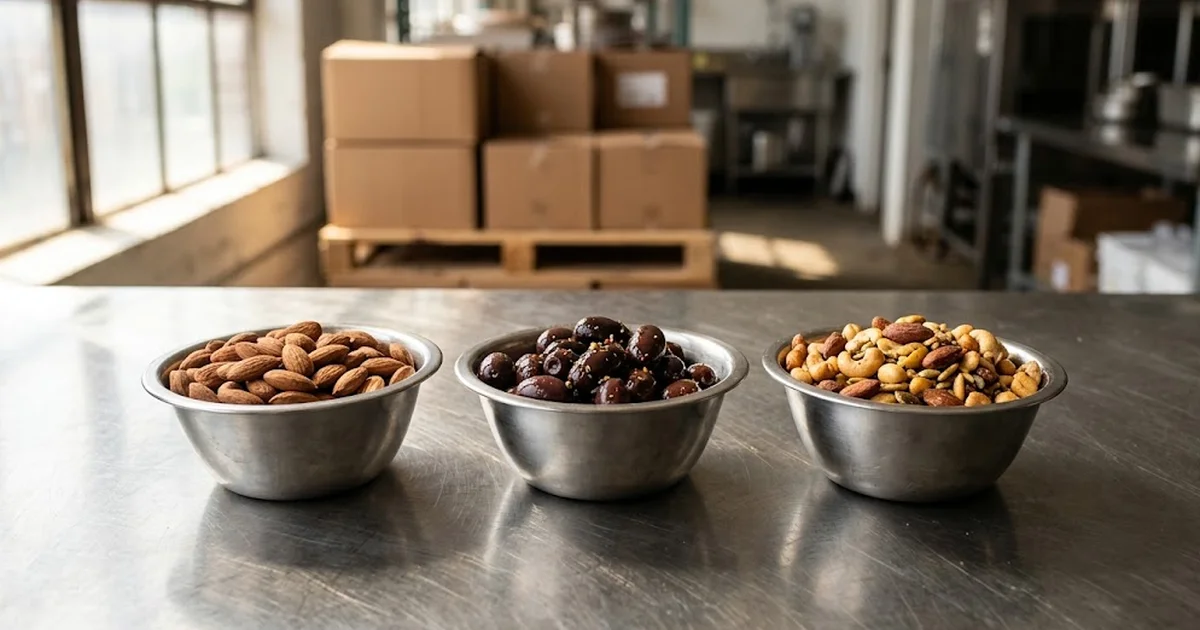
- Plain dried fruits (almonds, nuts, hazelnuts, unprocessed): generally at the reduced rate.
- Roasted and salted dried fruits, elaborate aperitif mixes: may fall under a different rate depending on the level of processing and added ingredients.
- Candied or coated fruits (chocolate, icing sugar): often classified as confectionery, standard rate.
- Non-essential beverages, sodas, certain liquid sweet preparations: standard rate in most cases.
This is why two references that seem similar on the shelf—a plain dried fruit and a coated dried fruit—may display different VAT rates on the same invoice. The professional buyer must integrate this parameter into their margin calculation product by product, rather than applying an average rate to the entire order.
Controlling your supplier invoice: key points for the B2B buyer
Receiving an invoice with multiple VAT rates on different lines is normal in food wholesale. What should raise concern, however, is an inconsistency between the nature of the product delivered and the rate applied. Here are the basic checks to include in your order reception process.
- Ensure each invoice line specifies the VAT rate applied, product by product, rather than a flat overall rate.
- Compare the invoiced rate with the actual nature of the product (raw, processed, as-is, or prepared) based on its product sheet and packaging.
- Cross-check batch numbers and best-before dates with the delivery note to confirm the invoice matches the physically received goods.
- Maintain a record of these checks in your supplier file, useful in case of an audit or commercial dispute.
- If in doubt about an applied rate, consult your accountant rather than deciding alone—and for questions on commercial practices, the DGCCRF remains the institutional reference.
At Palimex, we regularly see professional buyers discovering too late that an invoice line applied an inappropriate VAT rate to the actual product delivered—often on references at the boundary between raw material and processed product, such as aperitif mixes or coated fruits. Our field advice: always request a line-by-line detailed invoice, with the rate displayed next to each reference, and never approve a purchase order based solely on a total inclusive amount. This detail, repeated across hundreds of orders per year, protects your margin and your accounting.
Setting your own resale prices: integrating VAT correctly
Once the goods are received and the invoice validated, the professional buyer must reflect these rates in their own pricing policy. This step is distinct from accessing the professional rate itself, already covered in our article Buying in bulk: VAT number, VAT, and B2B framework: here, the focus is on how the applicable rate influences your final selling price, not how to access wholesale pricing.
- Systematically calculate your actual net cost price, including the purchase VAT rate in your margin reasoning.
- Do not confuse the VAT rate you pay on purchase with the one you must apply on resale: they may differ depending on your activity (catering, grocery, processing).
- Document, product by product, the rate applied upstream to facilitate your own downstream invoicing and avoid discrepancies during an accounting audit.
- Anticipate the impact of a packaging change (bulk to individual portion, for example) on the fiscal classification of the resold product.
Special cases in the dried fruits, olives, spices, and snacking catalogue
In a catalogue as extensive as Palimex’s—dried fruits, dehydrated fruits, candied fruits, spices, olives and spreads, oils, dried vegetables, sweet groceries, snacks and aperitifs, global flavours—the diversity of applicable rates reflects the variety of processing levels offered. A buyer ordering both plain almonds in 5 kg cartons and a roasted-salted aperitif assortment should expect to see two distinct rates on their invoice, without this indicating an error.
- Dried and dehydrated fruits sold plain, in bulk for pastry use or in cartons: generally at the reduced rate.
- Olives in brine or olive-based spreads: to be verified based on the level of preparation and added ingredients (flavoured oils, condiments).
- Bulk or packaged spices: raw products, generally at the reduced rate.
- Snack and aperitif selection, processed ranges: rates to be verified line by line, particularly for coated or heavily seasoned products.
To further explore the practical management of these references, also consult our articles on the difference between best-before and use-by dates for dried fruits, on choosing bulk or carton packaging for professionals, and on stock rotation management for dried fruits, three topics directly linked to structuring your supplier invoicing.
In summary: the VAT reflex to adopt for every order
Remembering three rates—5.5%, 10%, 20%—is not enough: what matters for a professional buyer is understanding the two criteria that shift a product from one rate to another: immediate or deferred consumption, and the degree of processing. Based on this, every supplier invoice line becomes verifiable, every discrepancy becomes detectable, and every resale price can be set with full knowledge. If in doubt about a specific situation, the reflex remains the same: consult your accountant or refer to the official documentation from the tax authorities, rather than generalising a rule observed for another product or supplier. For any questions regarding setting up your professional account and accessing B2B pricing terms, our article Buying in bulk: VAT number, VAT, and B2B framework usefully complements this guide, as does our resource on palette delivery and free delivery for professionals to anticipate all cost items related to a bulk order.
Further reading
Frequently asked questions
Everything you need to know about this topic.
A question?
Get in touch directly.

Marketing & Communications Manager — Palimex / Meyva
As Marketing & Communications Manager at Palimex / Meyva, Aude Moyne leads the company's communications and digital marketing strategy: editorial content, email campaigns and the promotion of its product ranges. Her experience at Palimex, a specialist in dried fruit, nuts, olives and spices for professionals, has given her in-depth knowledge of the products, their origins and uses, and the expectations of food-industry professionals. The blog articles are written or supervised by her, in collaboration with Palimex's sales and product teams whenever a topic calls for specific expertise.
Our advice related to Pro-tips
 pro-tips
Safety Stock and Reorder Point in Foodservice Wholesale
Safety stock and reorder point in foodservice wholesale: the formula, a step-by-step numerical example, and how packaging impacts the calculation.
 pro-tips
Cycle Counting: Counting Without Halting B2B Operations
Cycle counting method for grocery and foodservice: segmentation by product family, frequency based on turnover, acceptable discrepancies, and handling recurring variances.
 pro-tips
Origin and Provenance: Mandatory B2B Disclosures
Origin, provenance, processed products: what a B2B buyer must verify on product datasheets and traceability documents before making any claims.