
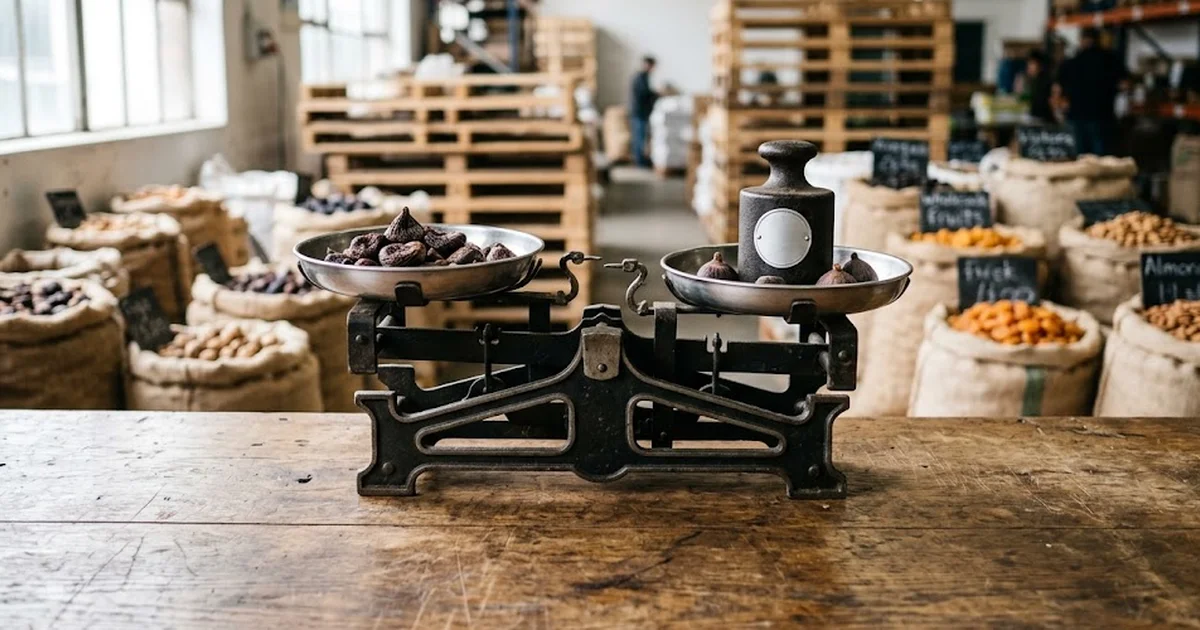
Balances et pesage : le contrôle des instruments en commerce
Verification of sales scales, control marks, frequency, and risks of non-compliance: the practical guide to weighing in the food trade.
In a food business, the scale is not just a simple counter accessory: it is the instrument that sets the price paid by the customer with each weighing. Bulk sections, dried fruit counters, weighing of HoReCa orders by the unit: as soon as a price depends on weight, the instrument used must be compliant and verified. This article reviews the control of weighing instruments used in trade: why it is necessary, how often it is carried out, who performs it, what the marks on the device mean, and what a business risks in case of non-compliance.
Why a sales scale must be a verified instrument
A scale used to determine a selling price builds trust between the trader and their customer. Even a minor weighing discrepancy repeats with every transaction and can distort the commercial relationship over time—whether in favor of the business or the customer. This is why weighing instruments intended for sales fall under legal metrology: they must meet precision requirements and be subject to control before and during their professional use.
- The scale serves as the basis for calculating the final price: any drift directly affects the receipt.
- An unverified instrument exposes the trader to customer disputes that are difficult to resolve without proof of compliance.
- In a busy bulk section, repeated weighings amplify the impact of an undetected calibration defect.
- Instrument compliance is one of the points an official inspection may check during a store or warehouse visit.
For a professional selling dried fruits, olives, or spices by weight, scale reliability is as important as the quality of the product itself: a well-chosen grade is useless if the billed weight is inaccurate.
Control of weighing instruments: who is involved and when
Controlling a commercial scale is not limited to a one-time adjustment at purchase. It involves several stages, from commissioning to ongoing monitoring, and different actors depending on the instrument’s lifecycle phase.
| Control stage | Relevant time | Who is involved |
|---|---|---|
| Initial verification | Before the first use of a new scale | Manufacturer or authorized body, before marketing |
| Periodic verification | Throughout commercial use | Authorized verification body, at regular intervals |
| Verification after repair | Following technical intervention on the instrument | Authorized repairer or control body |
| Market surveillance | At any time, in case of doubt or inspection | Metrological surveillance authority |
In practice, a trader does not need to know the internal procedures of these bodies in detail: they must primarily ensure their scale bears the marks certifying it has been controlled and retain the corresponding documentation. To accurately determine the obligations applicable to their activity, the safest approach is to consult the official resources of the DGCCRF, the authority responsible for legal metrology and fair trading in France.
Understanding the marks and stamps on a professional scale
A compliant scale bears several visible marks, each certifying a different control stage. Recognizing them allows the trader to quickly verify, at a glance, that their instrument is compliant before using it at the counter.
- The CE marking: indicates that the instrument meets the technical requirements applicable to weighing equipment at the time of manufacture.
- The verification mark or sticker: applied after control, it certifies that the scale was inspected and deemed compliant on the indicated date.
- The instrument identification number: links the scale to its control history and any repairs.
- The validity date or indicator: shows until when the current verification remains valid.
A trader purchasing a second-hand scale or taking over an existing business should check for the presence and legibility of these marks before first use, rather than assuming the instrument is in order.
At Palimex, we handle dozens of tons of dried fruits, olives, and spices by weight daily, across our platforms in Rungis and Bordeaux Lac. Our field feedback is clear: a poorly maintained scale is not obvious at first glance—it reveals itself over time through small discrepancies that ultimately cost dearly, both in margins and customer trust. We recommend any business weighing at the counter keep a log of their instrument, including the date of the last known verification, rather than relying on memory.
Bulk sections and customer weighing: best practices for a food business
The bulk section is where scale accuracy is most frequently tested in front of the customer. For a business offering dried fruits, dehydrated fruits, or olives by weight, a few simple practices reduce the risk of discrepancies and facilitate internal control.
- Regularly weigh empty to ensure the scale returns to zero between weighings.
- Avoid placing bags or containers that distort the tare if it is not properly reset.
- Place the scale on a stable, level surface, away from vibrations from an oven or loading dock.
- Train staff to report any unusual behavior, even minor, from the instrument.
- Keep verification documentation readily available in case of inspection or customer queries.
These best practices apply equally to a retail business and a professional preparing bulk orders: when an order of dried fruits or almonds is split for a HoReCa client, the scale used internally must be as reliable as the one at the sales counter. The topic of weight also ties into product grade and size: for further guidance on interpreting technical data sheets and stated weights, our article on how to read a size and grade technical sheet provides useful additional benchmarks when placing an order.
Risks for a business with a non-compliant weighing instrument
A weighing instrument that is unverified or whose control mark has expired exposes the trader to several consequences beyond mere administrative inconvenience.
- A customer dispute over the billed weight, difficult to defend without proof of instrument compliance.
- An official inspection that may identify non-compliance and initiate follow-up actions based on the severity and recurrence of the breach.
- A lasting loss of trust with professional customers, particularly sensitive to commercial rigor in a B2B sector where volumes and amounts are significant.
- An indirect financial risk: a scale consistently drifting in one direction can represent a significant cumulative discrepancy over a large volume of business.
The precise obligations and applicable sanctions fall under the current regulatory framework, the detailed knowledge of which lies with the competent authorities. For any questions regarding thresholds, deadlines, or procedures applicable to a specific instrument, the trader should refer directly to the DGCCRF services, the only body authorized to provide definitive answers.
Choosing and maintaining your professional scale daily
Beyond regulatory compliance, the scale is a working tool that deserves regular maintenance to remain reliable over time, especially in a high-turnover warehouse or retail environment.
| Point of attention | Recommended frequency for professional use |
|---|---|
| Cleaning the tray and product contact areas | Daily, at the end of service |
| Visual zero and stability check | At the start of each shift |
| Verification of control mark legibility | Monthly, or after each instrument relocation |
| In-depth control by an authorized professional | According to the periodicity applicable to the instrument |
A business selling products like dates by the unit or offering a flagship product such as jumbo golden Chilean sultanas in bulk has every interest in integrating this monitoring into their routine, just like stock management and batch rotation. A well-maintained instrument also reduces service interruptions due to unexpected breakdowns or malfunctions during peak hours.
Summary: Making scale compliance a professional reflex
Control of weighing instruments is not an isolated formality: it is an ongoing process that begins when the scale is commissioned and continues throughout its use in trade. Recognizing verification marks, understanding who is involved at each stage, and adopting best practices in the bulk section help mitigate risks—both for customer relations and business compliance. For any specific questions about the regulatory obligations applicable to a given weighing instrument, consulting the DGCCRF services remains the reference source.
Frequently asked questions
Everything you need to know about this topic.
A question?
Get in touch directly.

Marketing & Communications Manager — Palimex / Meyva
As Marketing & Communications Manager at Palimex / Meyva, Aude Moyne leads the company's communications and digital marketing strategy: editorial content, email campaigns and the promotion of its product ranges. Her experience at Palimex, a specialist in dried fruit, nuts, olives and spices for professionals, has given her in-depth knowledge of the products, their origins and uses, and the expectations of food-industry professionals. The blog articles are written or supervised by her, in collaboration with Palimex's sales and product teams whenever a topic calls for specific expertise.
Our advice related to Pro tips
 Pro tips
Paniers garnis de fin d'année pour les entreprises : les composer en épicerie fine
Composez des paniers garnis de fin d'année rentables pour entreprises et CSE : sélection de produits, formats stables, prix de revient et facturation B2B.
 Pro tips
Commandes de fin d'année : le calendrier d'achat d'un pâtissier-chocolatier, d'octobre à décembre
Commandes de fin d'année : calendrier d'achat d'octobre à décembre pour pâtissier-chocolatier. Cadencez fruits secs, confits et marrons sans rupture.
 Pro tips
Triman, REP et éco-contribution : l'emballage d'un préemballé alimentaire
Reconditionnement de denrées et vente au consommateur : obligations REP, identifiant IDU, signalétique Triman et Info-tri. Le guide légal pour les professionnels.