
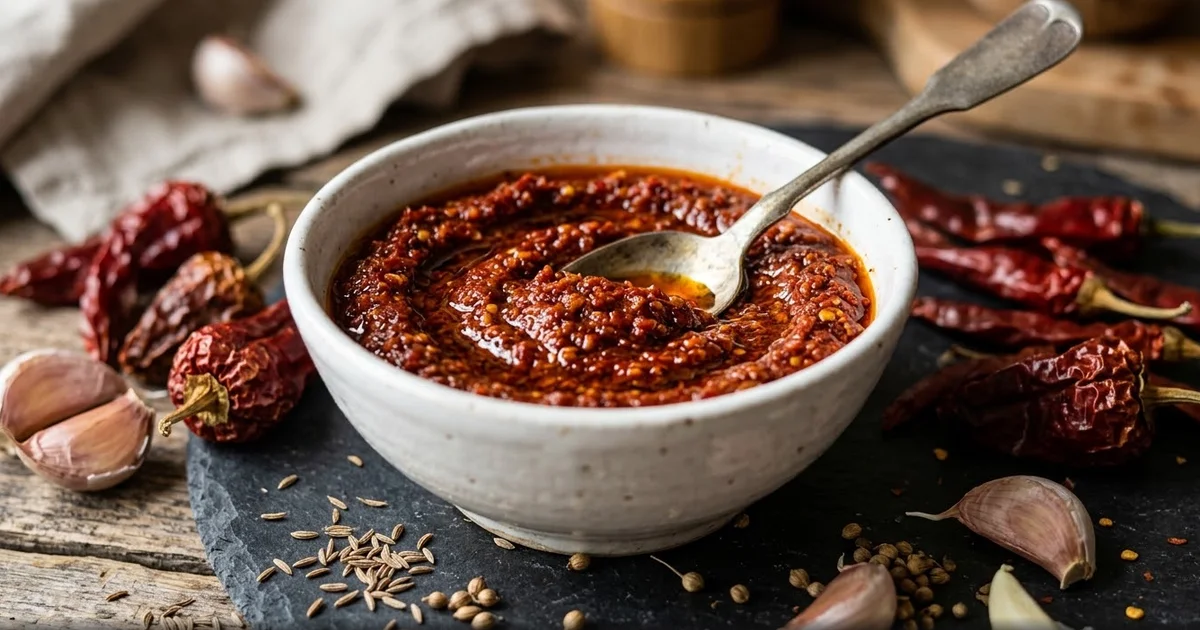
Bulk Cap Bon harissa: spicy and CHR uses
Bulk harissa for foodservice: Cap Bon origin, spicy scale, tube and can formats. Culinary uses and professional storage.
Cap Bon harissa is among the most sought-after references by professionals in the foodservice and fine grocery sectors. Originating from a specific region of Tunisia, this chili paste stands out for its aromatic concentration and spicy intensity, which have nothing to do with generic harissas sold in individual jars. For a wholesaler like Palimex, supplying professional kitchens with Cap Bon harissa requires mastering three key aspects: the origin and what it truly changes on the palate, the spicy scale for correct dosing in collective catering, and finally, the formats and storage suited to intensive CHR use. This article provides an overview.
Cap Bon harissa: an origin that changes everything in professional kitchens
The Cap Bon is a peninsula in northeastern Tunisia, renowned for its fertile agricultural lands and climate particularly favorable to chili cultivation. This is not a commercial name but a genuine geographical indication that directly impacts the finished product delivered to kitchens.
Three factors explain the difference perceived by chefs and professional buyers:
- The chili variety cultivated: Cap Bon chilies have a fleshy pulp and a high dry matter content, resulting in a denser and less watery paste than harissa produced with bulk-imported chilies.
- Sun drying: the chilies are traditionally spread out and air-dried before processing, which concentrates the aromas and develops characteristic smoked notes absent from industrially low-temperature-dried harissas.
- Paste concentration: the chili-to-water ratio is higher in authentic Cap Bon harissa, translating into superior aromatic intensity and spicy strength per equal volume.
For a professional, this origin is therefore not just a marketing argument: it directly conditions the dosage in cooking, the shelf life, and the product's stability over time. To explore the sourcing of oriental products further, your team can consult our category Saveurs du Monde > Oriental.
Spicy scale and dosing in collective catering
The main challenge faced by central kitchens and restaurateurs discovering Cap Bon harissa is adjusting the dosage. A more concentrated paste requires revising usual measurements, or risk serving disproportionately spicy dishes.
Here are the guidelines we regularly provide to our professional clients:
| Culinary use | Indicative dosage for 10 portions | Field note |
|---|---|---|
| Couscous broth | 15 to 25 g | Dilute directly in hot broth to homogenize the spicy diffusion |
| Marinade for grilled meats | 30 to 40 g per 1 kg of meat | Combine with olive oil to smooth the intensity and facilitate coating |
| Sandwich sauce | 10 to 15 g per 500 g of base (mayonnaise, fresh cheese) | Taste in 5 g increments, as the increase in spiciness is not linear |
| Simmered tajine | 20 to 30 g per 1.5 kg of garnish | Incorporate at the start of cooking to round out the spiciness |
In collective catering, the most common mistake is maintaining the dosages used for standard commercial harissa. With Cap Bon harissa, reducing the dosage by 20 to 30% compared to a usual recipe is generally necessary to achieve a balanced result.
At Palimex, we systematically recommend that our CHR clients test a new delivery of Cap Bon harissa on a small volume before incorporating it into a regular service recipe. Batches may vary slightly in intensity depending on the chili harvest, and a chef who adjusts the dosage blindly without tasting risks disappointing their clientele accustomed to a stable level of spiciness.
Traditional harissa vs. rose harissa: differences for your menu
Two references often coexist in professional catalogs: traditional harissa, red and powerful, and rose harissa, milder, obtained by adding ingredients that soften the chili's heat (often tomatoes or a reduced proportion of seeds).
The choice between the two depends directly on the clientele and the type of establishment:
- Traditional Cap Bon harissa: recommended for couscous, tajines, and marinades where spiciness is part of the dish's identity. It suits oriental restaurants, specialized caterers, and fine grocery stores targeting knowledgeable customers.
- Rose harissa: better suited to general sandwich shops, accompanying sauces, and menus that need to appeal to the widest audience without surprising sensitive palates. It also facilitates recipe standardization in collective catering.
Some establishments choose to stock both versions in parallel, the traditional for signature dishes and the rose for everyday preparations. This dual approach ensures customer satisfaction while maintaining a differentiating offer on the menu.
Professional formats: tube, 400 g can, and bucket — which packaging to choose
Packaging is a decisive criterion for any bulk purchase. Palimex offers Cap Bon harissa in several formats suited to different kitchen turnover volumes.
| Format | Recommended use | Logistical advantage |
|---|---|---|
| Individual tube (grouped in a box) | On-the-spot plating, dish service, sandwich shops | Precise dosing, hygiene in the dining area, no cross-contamination between batches |
| 400 g can | Medium-sized kitchens, restaurant brigades | Good compromise between fast turnover and limited storage volume |
| Bucket (2 kg to 5 kg depending on reference) | Central kitchen, collective catering, high consumption | Optimized cost per kilo, reduced restocking handling |
The choice of format should consider the order frequency and storage capacity in cold or dry storage. A high-turnover kitchen will benefit from prioritizing the bucket, while a smaller establishment will limit waste with the 400 g can. For logistics regarding pallet reception and free delivery, consult our page dedicated to professional CHR packaging delivery.
Storage after opening: covering oil and batch management
Storing Cap Bon harissa after opening directly conditions food safety and the gustatory quality served to the end customer. Good professional kitchen practice relies on a few simple but essential rules.
- Maintain a fine layer of covering oil on the paste's surface after each use to limit oxidation and slow microbial growth.
- Seal the container tightly after each use and store it in a cool storage area, away from direct light.
- Use a clean, dedicated spatula for each use, avoiding any contact with utensils used for other preparations.
- Strictly adhere to the best-before date indicated on the label and note the opening date on the container to ensure traceability compliant with HACCP requirements.
- Never pour back any leftover sauce or preparation containing harissa into the original container, as this would accelerate the degradation of the remaining product.
When well managed, an opened can or bucket can retain its organoleptic qualities for several weeks in a professional kitchen. This duration, however, strongly depends on respecting the cold chain and the rigor of daily handling. For a reminder of good practices applicable to all dry products and concentrates, consult our article on storing dry products in professional kitchens.
CHR applications: couscous, tajine, sandwich shops, and marinades
The versatility of Cap Bon harissa makes it a strategic ingredient for many types of establishments. Here are the main applications found among our professional clients:
- Couscous and simmered broths: incorporated directly into the broth or offered separately as an accompaniment, Cap Bon harissa enhances traditional dishes without overpowering other spices.
- Tajines and simmered dishes: added at the start of cooking, it slowly infuses the dish and develops rounder notes than an addition at the end of preparation.
- Sandwich shops and oriental fast food: mixed with a mayonnaise, fresh cheese, or olive oil base, it becomes a signature sauce easily reproducible in volume.
- Marinades for grilled meats: combined with olive oil, garlic, and lemon, it forms an effective marinade base for white meats, lamb, and poultry.
- Vinaigrettes and cold sauces: in small quantities, it adds character to accompanying sauces for raw vegetables or marinated olives.
For caterers and fine grocery stores looking to expand their oriental offerings beyond harissa, our complete range of olives and Mediterranean condiments is presented in our section olives and oil preservation for professionals.
Sourcing, traceability, and bulk purchasing of Cap Bon harissa
Bulk purchasing of Cap Bon harissa requires particular attention to batch traceability, an essential point for establishments subject to HACCP controls. Each delivery must allow precise identification of the chili's origin, the manufacturing date, and the corresponding batch number.
Several criteria help secure this sourcing:
- Request a complete technical sheet mentioning the precise geographical origin of the chili used.
- Verify the consistency between the batch number indicated on the packaging and that on the delivery note.
- Prioritize a wholesaler able to justify the regularity of their supply, a guarantee of aromatic profile stability from one order to another.
To better understand the Cap Bon region geographically and grasp the agricultural specificities of this Tunisian peninsula, the page dedicated to Cap Bon on Wikipedia offers useful insights into the region's geographical and agricultural context.
Summary: key points for purchasing Cap Bon harissa in bulk
Cap Bon harissa stands out for its precise origin, traditional sun-drying method, and superior aromatic concentration compared to generic references. For professionals, this means adjusting usual dosages, choosing the format suited to the establishment's turnover—whether tube, 400 g can, or bucket—and adhering to strict storage rules after opening, particularly through covering oil. Whether for traditional couscous, simmered tajine, sandwich sauce, or grilled meat marinade, this chili paste remains an ingredient with high differentiating potential on a CHR menu, provided its dosage and supply logistics are mastered. To discover our full range of spices and condiments from the Mediterranean basin, visit our category Saveurs du Monde > Oriental.
Further reading
Frequently asked questions
Everything you need to know about this topic.
A question?
Get in touch directly.

Marketing & Communications Manager — Palimex / Meyva
As Marketing & Communications Manager at Palimex / Meyva, Aude Moyne leads the company's communications and digital marketing strategy: editorial content, email campaigns and the promotion of its product ranges. Her experience at Palimex, a specialist in dried fruit, nuts, olives and spices for professionals, has given her in-depth knowledge of the products, their origins and uses, and the expectations of food-industry professionals. The blog articles are written or supervised by her, in collaboration with Palimex's sales and product teams whenever a topic calls for specific expertise.
Our advice related to Grocery & Recipes
 Grocery & Recipes
Épices de l'hiver : pain d'épices, vin chaud et pâtisserie de Noël, dosage et achat
Guide B2B des épices d'hiver pour boulangers, pâtissiers et CHR : dosages au kilo et au litre, mélanges vin chaud et pain d'épices, approvisionnement en gros.
 Grocery & Recipes
Nougat en meule : découpe à la coupe, conservation et vente au poids
Guide B2B pour épiceries et confiseries : réussir la découpe à la coupe du nougat en meule, limiter les pertes, maîtriser le stockage et l'affichage au poids.
 Grocery & Recipes
Seau d'olives entamé : durée de vie, saumure et gestion du reste
Comment conserver un seau d'olives entamé ? Rôle de la saumure, température, règles d'hygiène et gestion des tapenades : le guide professionnel Palimex.