
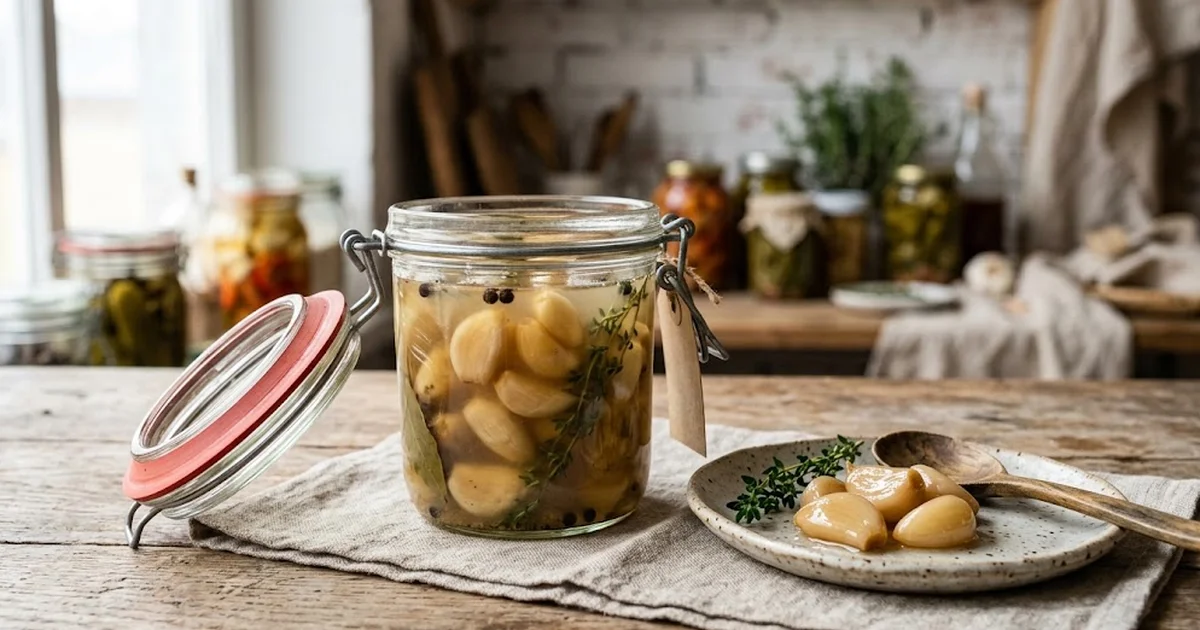
Garlic in brine: CHR uses and storage
Garlic in brine for foodservice: formats, storage after opening, and kitchen uses. Time savings and portion cost in CHR.
Fresh garlic imposes a recurring constraint in professional kitchens: peeling, degerming, chopping, with labor time that is difficult to absorb in CHR volumes. Garlic in brine directly addresses this issue by delivering a ready-to-use product, calibrated, stable, and compliant with the production requirements of commercial and collective catering. This article details the available formats, storage rules after opening, dosage equivalences with fresh garlic, and the most common professional uses.
Garlic in brine: a direct response to labor savings in the kitchen
In a context of recruitment tension in kitchens and pressure on production costs, every minute spent peeling and chopping fresh garlic represents a burden on profitability. Garlic in brine eliminates this upstream step: the cloves are delivered peeled and ready to be incorporated directly into a preparation.
For a caterer or restaurant processing several kilos of garlic per week, this gain translates concretely:
- Elimination of peeling and degerming time, estimated at several minutes per kilo of fresh garlic processed.
- Reduction of waste linked to peeling losses (peels, damaged cloves, bitter green germs to remove).
- Standardization of the finished product: homogeneous taste and texture from one service to the next.
- Reduction in the number of utensils and work surfaces dedicated to peeling, with a positive impact on the HACCP cleaning plan.
This time saving follows the same logic as other upstream processed products offered by Palimex, such as pitted olives ready to use, designed to limit kitchen handling.
Whole cloves or chopped garlic in brine: which format to choose based on your preparations
The choice between whole cloves and chopped garlic depends directly on the final use in the kitchen and the desired level of processing at the production station.
Whole cloves retain a firm texture and a rounder aromatic profile, suitable for preparations where the piece remains visible or needs to be crushed on demand. Chopped garlic, on the other hand, offers an additional time saving for sauces, marinades, and large cooking bases, at the cost of slightly faster oxidation once the jar is opened.
| Criterion | Garlic in brine — whole cloves | Garlic in brine — chopped |
|---|---|---|
| Main use | Marinades, mezze, snacking, on-demand crushing | Sauces, cooking bases, stuffings |
| Preparation time in the kitchen | Low (no cutting required) | None (direct incorporation) |
| Texture | Firm, slight crunch | Melt-in-the-mouth |
| Stability after opening | Good, immersion in preserved brine | More sensitive to oxidation, rapid rotation recommended |
| Professional order format | Jars and 5 kg buckets, palletizable cartons | 5 kg buckets, CHR packaging |
Brine, acidity, and best-before date: what you need to know before receiving in the kitchen
Garlic in brine typically combines water, salt, and an acidifier (vinegar or citric acid), a balance that ensures the microbiological stability of the product before opening and allows for a long best-before date, favorable to stock management in professional kitchens.
The acidity of the medium plays a decisive role in the final texture and taste: the higher the rate, the more the product retains a marked firmness, but with a more pronounced acidic note that can alter the balance of a marinade or sauce recipe. It is therefore useful to check the product sheet of the received batch before adjusting an existing recipe, particularly when changing suppliers or batches.
"For our batches of garlic in brine, we systematically recommend that our CHR customers taste a sample before adjusting their marinade or sauce recipes. Acidity can vary slightly from one batch to another depending on sourcing, and an adjustment of a few grams of salt or vinegar in the kitchen is usually enough to restore the usual balance." — The Palimex team
To delve deeper into label reading and batch traceability, our article on HACCP best practices for batch traceability of dry products details the control points to integrate upon receipt.
Storage after opening: best practices in professional kitchens
Storage after opening is the main point of vigilance in collective catering or commercial restaurants, where opened jars circulate between several workstations.
A few simple rules ensure the shelf life of the product after opening:
- Store the jar or bucket in the refrigerator (between 0 and 4°C) immediately after opening.
- Ensure that the cloves remain always immersed in the brine, avoiding any prolonged contact with air.
- Use a clean and dry utensil for each sampling, to limit the introduction of germs.
- Label the container with the opening date, in line with the establishment's sanitary control plan.
- Respect a rapid rotation of the opened stock, particularly for chopped garlic, which is more sensitive to oxidation than whole cloves.
For establishments managing several opened jars simultaneously, a rotation system by color labeling (first in, first out) remains the simplest method to implement in the kitchen, as mentioned in our guide on stock rotation in professional kitchens. For a general overview of sanitary safety practices applicable to products stored in brine, the recommendations available on the website of the French Agency for Food, Environmental and Occupational Health & Safety provide a useful reference base for kitchen teams.
Dosage and equivalence with fresh garlic: controlling food cost in production
Switching from fresh garlic to garlic in brine requires a dosage adjustment, as the brine slightly modifies the aromatic intensity of the product and its net weight once drained.
In practice, production teams generally adapt their technical sheets as follows:
- A clove of garlic in brine is approximately equivalent to a medium-sized fresh garlic clove, once drained.
- For chopped garlic in brine, the dosage is close to that of chopped fresh garlic, with a slight reduction to compensate for the salt content of the brine.
- It is recommended to adjust the seasoning in the final recipe, as the brine already provides a sodium load to the product.
- The drained weight indicated on the label should serve as the basis for calculating food cost, not the gross weight of the jar.
This precise management of drained weight ensures reliable portion cost calculation, a central issue for purchasing managers and head chefs who must maintain a stable margin despite seasonal variations in fresh garlic prices.
Professional culinary uses: marinades, sauces, snacking, and mezze
Garlic in brine fits into a wide range of professional preparations, with particular interest for high-turnover productions where consistency of the finished product is a quality criterion.
- Marinades for meats, fish, and grilled vegetables, where whole crushed cloves provide a stable aromatic base without the risk of bitterness from an unremoved germ.
- Sauces and cooking bases (tomato sauces, creamy sauces, vinaigrettes), where chopped garlic in brine is incorporated directly without preparation steps.
- Snacking and mezze bars, where whole cloves are presented as-is alongside olives, cheeses, or charcuterie, in a professional appetizer tray logic.
- Mediterranean and Middle Eastern cuisine, where garlic in brine naturally integrates into preparations such as hummus, tapenade, or slow-cooked dishes, complementing the professional mezze ingredients already referenced at Palimex.
This versatility makes it a cross-functional product, usable in both hot and cold preparations, simplifying reference management in stock for establishments with rotating menus.
Packaging formats and bulk order logistics
In line with the exclusively professional orientation of the Palimex catalog, garlic in brine is offered in packaging adapted to CHR production volumes, gourmet grocery stores, and caterers.
The common formats include:
- Jars of several kilograms, suitable for medium-sized kitchens with regular rotation.
- 5 kg buckets, the reference format for high-production kitchens or processing workshops.
- Palletizable cartons for bulk orders intended for gourmet grocery networks or CHR purchasing centers, with free delivery depending on the ordered volume.
This minimum packaging logic is part of Palimex's overall logistics strategy, already applied to the entire range of spices, dried fruits, and olives, as detailed in our article on choosing bulk, carton, or CHR packaging.
Summary: garlic in brine, a relevant choice for streamlining kitchen production
Garlic in brine meets a concrete need in professional kitchens: reducing the labor time spent on peeling while ensuring consistent taste and texture from one service to the next. The choice between whole cloves and chopped garlic depends on the final use, while mastering storage after opening and dosage equivalence with fresh garlic ensures both sanitary quality and food cost control. Available in formats adapted to professional volumes, this product naturally integrates into the ranges already present in Palimex's World Flavors universe, alongside olives, spices, and Mediterranean ingredients intended for CHR kitchens and gourmet grocery stores.
Further reading
Frequently asked questions
Everything you need to know about this topic.
A question?
Get in touch directly.

Marketing & Communications Manager — Palimex / Meyva
As Marketing & Communications Manager at Palimex / Meyva, Aude Moyne leads the company's communications and digital marketing strategy: editorial content, email campaigns and the promotion of its product ranges. Her experience at Palimex, a specialist in dried fruit, nuts, olives and spices for professionals, has given her in-depth knowledge of the products, their origins and uses, and the expectations of food-industry professionals. The blog articles are written or supervised by her, in collaboration with Palimex's sales and product teams whenever a topic calls for specific expertise.
Our advice related to Grocery & Recipes
 Grocery & Recipes
Épices de l'hiver : pain d'épices, vin chaud et pâtisserie de Noël, dosage et achat
Guide B2B des épices d'hiver pour boulangers, pâtissiers et CHR : dosages au kilo et au litre, mélanges vin chaud et pain d'épices, approvisionnement en gros.
 Grocery & Recipes
Nougat en meule : découpe à la coupe, conservation et vente au poids
Guide B2B pour épiceries et confiseries : réussir la découpe à la coupe du nougat en meule, limiter les pertes, maîtriser le stockage et l'affichage au poids.
 Grocery & Recipes
Seau d'olives entamé : durée de vie, saumure et gestion du reste
Comment conserver un seau d'olives entamé ? Rôle de la saumure, température, règles d'hygiène et gestion des tapenades : le guide professionnel Palimex.