
Cashew nuts for professionals: sizing, sourcing and storage
Professional guide to cashew nuts: calibres from W180 to W450, producing countries, HACCP storage, HoReCa uses and bulk packaging for wholesalers at Palimex.
Since 1984, Palimex has been supplying food industry professionals — delicatessens, restaurants, caterers and HoReCa outlets — with dried fruit, dehydrated fruit, spices and olives. Among the tree nuts most in demand from our professional customers, the cashew nut occupies a special place: versatile in the kitchen, popular both as a snack and in pastry-making, yet still poorly understood on issues that are decisive for a B2B buyer — grading, origin, storage and regulatory compliance. This guide sets out what a trade professional (HoReCa, neighbourhood grocer, gourmet artisan) needs to know before placing a bulk order.
The cashew nut, a staple of the B2B dried fruit range
Botanically, the cashew nut is the seed housed beneath the cashew apple, the fruit of the cashew tree (Anacardium occidentale), a tree native to South America now grown throughout tropical regions. Its shell, which contains an irritant resin, is removed before sale: it is this shelling stage that largely explains the price of cashew nuts on the world market, significantly higher than that of almonds or peanuts.
For a professional point of sale, the cashew nut serves several purposes at once: a premium savoury snack, an ingredient in pastry and confectionery, a base for culinary preparations (Asian cuisine, vegetarian dishes), or a component of mixes for snacking and gourmet gift baskets. This versatility makes it a fast-turnover product for delicatessens and a menu classic for HoReCa outlets.
Origins and sourcing: which producing countries to favour
Sourcing is the primary lever for quality and consistency for a professional buyer. Global production of raw cashew nuts is now dominated by a small number of countries, with the economic weight gradually shifting towards West Africa.
| Producing country | Estimated production (2025, in tonnes) | Role in the supply chain |
|---|---|---|
| Côte d'Ivoire | approximately 1,150,000 t | World's leading producer of raw cashew nuts |
| India | approximately 725,000 t | Major production plus major processing capacity |
| Tanzania | approximately 425,000 t | Fast-growing production |
| Vietnam | approximately 320,000 t | World leader in processing and export |
| Benin | approximately 220,000 t | Developing production |
| Indonesia, Mozambique, Burkina Faso | 155,000 to 175,000 t each | Secondary production areas |
Africa now accounts for around 56% of global raw cashew nut production, but a large share of this raw material continues to be exported to Asia (Vietnam, India) for shelling and grading, before re-export to Europe. For a wholesaler like Palimex, this means a single batch may have been grown in Côte d'Ivoire and processed in Vietnam: requesting full batch traceability (country of cultivation, processing site, batch number) is one of the sourcing best practices to demand from any supplier.
Understanding grades: from W180 to W450
On the professional market, whole cashew nuts are classified according to an international grading system, denoted by the letter W (for "whole") followed by a number. This number corresponds to the number of nuts per pound (approximately 454 g): the lower the figure, the larger, rarer and more expensive the nuts.
| Grade | Nuts per pound (454 g) | Size | Typical use |
|---|---|---|---|
| W180 | 140 to 180 | Very large, premium | Gourmet gift boxes, premium per-unit sales |
| W210 | 180 to 210 | Large | Delicatessens, corporate gifts |
| W240 | 220 to 240 | Large-medium | Premium snacking, gift baskets |
| W320 | 300 to 320 | Medium (most widely traded grade) | Snacking, pastry, cooking |
| W450 | 400 to 450 | Standard | Processing, mixes, granola |
For a B2B buyer, knowing these grades makes three things possible: negotiating a price consistent with the size actually delivered, specifying an order precisely with no commercial ambiguity, and weighing up presentation (larger grades for visible bulk display) against material yield (smaller grades for processing, pastry or mixes). W320 remains the most widely traded grade worldwide, as it offers the best price/availability trade-off for everyday professional use.
A Palimex sourcing tip: never buy cashew nuts in bulk on the sole mention of "higher grade" without a numerical reference (W180, W240, W320...). This detail must appear on the technical data sheet and the delivery note for every batch.
Nutritional composition and allergens: what you need to know for labelling
Beyond taste, the nutritional composition of the cashew nut is a commercial argument frequently highlighted by delicatessens and wellness-oriented HoReCa outlets. Below are reference values for 100 g of roasted, unsalted cashew nuts.
| Nutrient (per 100 g) | Value |
|---|---|
| Energy | 588 kcal |
| Protein | 17.4 g |
| Fat | 48.1 g (mostly monounsaturated fatty acids) |
| Carbohydrates | 21.3 g |
| Fibre | 8.4 g |
| Magnesium | 260 mg |
| Iron | 5.4 mg |
| Zinc | 5 mg |
| Phosphorus | 510 mg |
| Potassium | 610 mg |
From a regulatory standpoint, the cashew nut belongs to the tree nut family, a category of major allergens whose declaration is mandatory in consumer information, whether the product is sold loose or pre-packaged. For any professional who repackages, cooks with or incorporates cashew nuts into a preparation, this labelling requirement is in addition to general traceability and best-before date management requirements. The precise rules applicable to wholesale trade and catering fall under the regulations of the DGCCRF, which should be consulted in case of doubt on a specific situation.
Professional culinary uses: HoReCa, pastry, delicatessen
The cashew nut lends itself to very different uses depending on the point of sale or establishment:
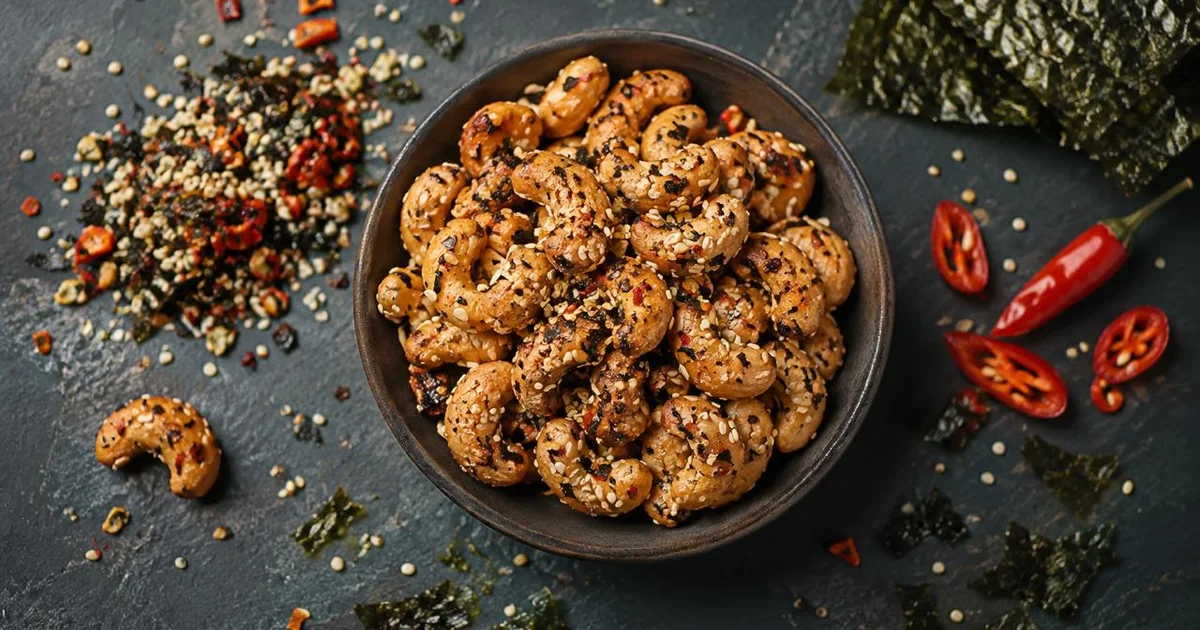
- Snacking and aperitifs: plain roasted, salted, or flavoured (garlic and herbs, garlic-basil-olive, ginger-curry-coconut...) for a differentiating offer in HoReCa or self-service grocery.
- Pastry and confectionery: cashew praline, tuiles, inclusions in chocolates and bars, cake decoration.
- Savoury cooking: cashew chicken, curries, stir-fries and Asian-inspired dishes where the nut adds crunch and roundness.
- Plant-based food: cashew purée, plant-based "cheeses", plant milks — a fast-growing segment in which delicatessens are increasingly positioning themselves.
- Mixes and blends: granola, snack mixes, gourmet gift baskets and corporate gift boxes.
Palimex notably offers a range of snacking cashew nuts roasted in France, with no added oil or colouring, available in several recipes (garlic and herbs, garlic-basil-olive, ginger-curry-coconut), packed in a 2.5 kg tub suited to regular professional use. This local roasting approach helps control the freshness and aromatic consistency of the product delivered, an important point of attention for outlets offering a year-round snacking range.
Storage, stock rotation and bulk packaging
Cashew nuts, rich in unsaturated fats, are prone to rancidity if poorly stored. A few simple rules help preserve the quality of a professional stock:
- Store in a dry, cool place away from direct light (ideally between 10 and 18°C).
- Use airtight packaging once a carton or tub has been opened, to limit oxidation.
- Avoid prolonged contact with strong-smelling products (spices, cleaning products), as cashew nuts readily absorb surrounding aromas.
- Apply strict FIFO stock rotation (first in, first out) and track best-before dates batch by batch.
- Anticipate consumption peaks (end-of-year holidays, summer season for snacking) to avoid stockouts while keeping tied-up stock capital under control.
On the packaging side, Palimex applies a strictly B2B approach: a minimum order of 5 kg, formats suited to professional needs (loose, carton, HoReCa-size tub), and delivery by pallet or free of carriage charges above certain volumes. These formats avoid unnecessary overstocking for smaller operations while offering tiered pricing for high-volume buyers. To learn more about best practices for storing dried fruit in a professional environment, our Storage & preservation section details the recommended protocols, alongside the HACCP requirements applicable in professional kitchens.
Market trends and prices: anticipating seasonal variations
The price of raw cashew nuts varies each year depending on harvest seasons, climatic conditions in the main production areas and decisions by regulatory bodies in producing countries, notably in Côte d'Ivoire where a minimum farm-gate price is set each season. For a professional buyer, this translates into supplier price adjustments that need to be anticipated, particularly for businesses building a menu or a year-round snacking offer.
A few levers can help secure supplies despite this volatility:
- Diversify supply sources rather than depending on a single producing country.
- Place grouped or advance orders ahead of seasonal peaks.
- Work with a wholesaler able to smooth price variations over the year through consolidated purchasing volumes.
Our Market trends section regularly tracks price and available volume trends for the main raw materials distributed by Palimex, of which the cashew nut is one.
Choosing the right wholesale cashew nut supplier
For a professional, choosing a cashew nut supplier is not just about the price per kilo. Several criteria are worth checking before signing a listing agreement:
- The ability to provide a complete technical data sheet (origin, grade, nutritional values, allergens, best-before date).
- Batch traceability back to the country of production and, ideally, the processing site.
- Supply reliability, to avoid stockouts on a fast-turnover line.
- Consistency between the packaging offered (loose, carton, tub) and the establishment's rate of consumption.
- The availability of a full range around the product (plain, flavoured, other dried fruit) to simplify ordering.
At Palimex, this approach fits within a wider range of dried fruit and ranges and packaging designed for professionals, with support on volumes, pallet logistics and product advice. Our B2B Guides section brings together other useful resources for structuring dried fruit purchasing, while our Recipes section offers ideas for showcasing cashew nuts on a menu or shelf.
A question?
Get in touch directly.
Our advice related to Dried-fruits
 dried-fruits
Seau, carton, sac de 25 kg : le conditionnement décide de la rotation
Bucket, carton, or 25 kg bag: which packaging to choose based on your actual turnover in professional kitchens. Palimex advice for foodservice, grocers, and pastry chefs.
 dried-fruits
Abricot sec : lire un calibre n°1 à n°4, soufré ou non
How to read size grades No.1 to No.4 for dehydrated apricots, and choose between sulphured and unsulphured based on professional kitchen use. Buyer’s guide for foodservice, pastry chefs, and specialty grocery stores.
 dried-fruits
Amande émondée, effilée, bâtonnet, poudre : quel format pour quel usage
Professional guide: uses, cooking performance, and storage of blanched almonds, flaked, slivered, and powdered. Procurement and B2B logistics tips from Palimex.