
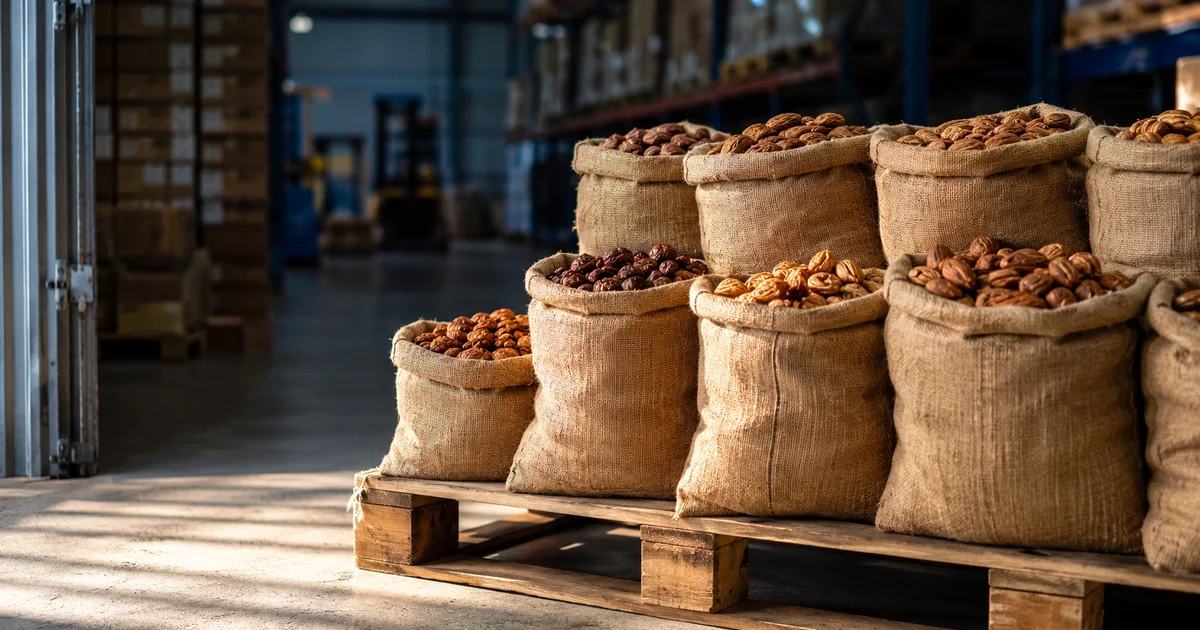
Tarif dégressif et paliers : comment se construit un prix en gros
How wholesale pricing is structured and how to read a volume discount pricing grid: raw materials, transport, packaging, and order size. A guide for B2B buyers.
In the food wholesale trade, the price displayed on a pricing grid is never an isolated figure. It results from a stack of factors—raw material, transport, packaging, order volume, and purchase frequency—that every professional buyer benefits from understanding to negotiate orders and anticipate margins. This article explains how wholesale pricing is structured by a specialist wholesaler in dried fruits, dehydrated fruits, spices, and olives, and how to read a volume discount grid without misinterpreting the tiers.
How wholesale pricing is formed by a food wholesaler
A wholesale price is not a retail price divided by volume. It incorporates costs specific to the B2B supply chain, which are either absent or averaged differently in retail sales. Understanding this structure enables professional buyers—such as restaurateurs, fine grocers, pastry chefs, and caterers—to better interpret price differences between suppliers and between tiers.
- Raw material cost: market price of the raw material (dried fruit, spice, olive), quality grade, batch origin, and seasonal availability.
- Logistics cost: warehouse storage, order preparation, pallet transport, and delivery terms by zone.
- Packaging cost: bulk in bags, cartons, foodservice formats, or potential repackaging based on professional needs.
- Order volume: the higher the quantity per order line, the lower the unit processing cost.
- Purchase frequency: a recurring commitment allows for better supply planning and stock rotation optimisation.
These elements do not substitute for one another: they add up. A premium-quality batch, packaged in small formats and delivered in small quantities, will always cost more per kilogram than the same product purchased in bulk packaging and full-pallet volumes.
Quantity tiers: understanding the logic behind volume discounts
Volume-based pricing follows a simple principle: beyond a certain quantity threshold, the per-unit processing cost decreases, and part of this saving is passed on to the price. However, this logic must be read carefully, as tiers are not always linear or identical across product ranges.
For a food wholesaler, tiers typically apply per product line, not per total order. In other words, mixing multiple SKUs in a single order does not necessarily allow reaching the next tier for each—unless specified otherwise in the commercial terms.
| Factor observed | Typical impact on price | Key consideration for the buyer |
|---|---|---|
| Quantity per SKU | Reduction in unit cost beyond a threshold | Check whether the tier applies per product or per order |
| Packaging format | Bulk is generally more cost-effective than small cartons | Compare price per kilogram, not the unit price displayed |
| Order frequency | May unlock negotiated terms over time | Distinguish a contractual commitment from a regular purchasing habit |
| Delivery zone | Affects the free delivery threshold | Verify the minimum weight required for free delivery |
| Product seasonality | May impact the availability of certain tiers | Plan orders for products with high price volatility |
This table is not a fixed pricing grid: it illustrates the mechanisms to monitor when reviewing commercial terms, regardless of the supplier.
Reading a volume discount grid without misinterpreting the tiers
The most common challenge for professional buyers is not understanding that tiers exist, but knowing exactly where their order fits within the grid. A misreading—often due to confusion between net weight, gross weight, or packaging units—can distort the total cost estimate.
- Identify the reference unit used in the grid: kilogram, carton, or pallet.
- Verify whether the threshold is calculated per product SKU or by combining multiple SKUs.
- Distinguish between a price tier and a free delivery threshold, as they follow different logics.
- Account for packaging rounding: in food wholesale, you order whole units, from the case of retail bags to the bulk sack.
- Compare the total delivered cost (product + transport) rather than the price per kilogram alone.
One often overlooked point concerns the cross-reading of multiple product ranges. A professional ordering both dried fruits and spices for their kitchen must check whether tiers are calculated separately per range or globally. This distinction significantly impacts the final cost, particularly for mixed orders intended for bulk use by pastry chefs and artisans.
At Palimex, we regularly observe that buyers who optimise their orders most effectively are not those who systematically aim for the highest tier, but those who adjust their volume to their actual stock turnover. A tier reached on paper is meaningless if the product sits in storage beyond its useful shelf life. — The Palimex team
Raw materials, transport, packaging: breaking down wholesale pricing
For professionals accustomed to retail pricing, it can be helpful to break down what goes into wholesale pricing, product by product. Each category in the catalogue—dried fruits, dehydrated fruits, spices, olives and spreads, oils, pulses—follows distinct cost logics.
- Dried and dehydrated fruits: grade, residual moisture content, and batch origin directly influence the raw material cost.
- Spices: price volatility, batch traceability, and quality controls impact the final price.
- Olives and spreads: packaging method (brine, bulk, bucket) significantly affects transport and storage costs.
- Oils: weight and liquid volume strongly influence logistics costs per pallet.
- Pulses: high-density products often benefit from more pronounced volume discounts on large quantities.
Transport, meanwhile, depends on total weight, number of pallets, and delivery zone. This is why a professional located near a logistics hub may sometimes benefit from different terms than one served in a more remote area. For further details on delivery logistics, refer to our article on pallet delivery and free delivery logistics.
Volume commitment and order frequency: real impact on pricing
A volume or frequency commitment may allow a wholesaler to better plan raw material purchases and batch management, which can sometimes result in more favourable terms for the professional buyer. However, this is never an automatic price reduction guarantee: raw material prices fluctuate, and a contractual commitment does not systematically protect against these variations.
It is important to distinguish between different types of commitment:
- One-off bulk order: grants access to a price tier, with no time-bound commitment.
- Recurring orders over a defined period: may enable better logistics planning, without a price freeze guarantee.
- Multi-range sourcing: a professional who regularly purchases several product families (dried fruits, spices, global flavours) can structure a more stable supply plan, useful for stock rotation in foodservice businesses.
Transparency on this point is essential: no serious wholesaler can guarantee a fixed price over an extended period when raw materials are subject to fluctuating market prices, as is the case for many imported dried fruits and spices.
Common mistakes when reading B2B pricing grids
Certain mistakes recur among professional buyers new to volume discount grids, particularly when transitioning from retail purchasing to wholesale structured around bulk lots and minimum packaging.
- Comparing price per kilogram without considering the actual packaging format.
- Confusing the free delivery threshold with the price tier threshold.
- Failing to account for the product’s shelf life relative to the order volume, risking exceeding the best-before date before full stock depletion.
- Adding multiple different SKUs assuming a single tier applies, when each product line is calculated separately.
- Overlooking repackaging costs when the standard format does not match kitchen or point-of-sale use.
These mistakes directly impact the buyer’s actual margin, far beyond the price displayed on the grid. A rigorous reading, combined with a clear understanding of stock turnover needs, remains the best negotiation tool. For buyers seeking to explore storage challenges related to order volumes, our article on storage and best-before dates for dried fruits provides practical guidance.
For general regulatory aspects of wholesale trade, definitions and obligations applicable to professionals are available on the reference website economie.gouv.fr, useful for understanding the broader framework of B2B supplier-buyer relationships.
Structuring professional orders for controlled bulk purchasing
Beyond the technical reading of a pricing grid, wholesale pricing must align with a broader assessment of the buyer’s actual needs. A caterer, pastry chef, or fine grocer does not face the same volume, frequency, or grade constraints depending on their activity.
- Assess actual monthly consumption before targeting a higher tier.
- Verify compatibility of the chosen packaging format with kitchen usage rates.
- Consider available storage: an advantageous tier is meaningless if space or storage conditions are inadequate.
- Inquire about sourcing and batch traceability, particularly important for products subject to HACCP controls in professional kitchens.
For professionals structuring their supply around multiple ranges—dried fruits, spices, global flavours, foodservice selection—advance planning of orders minimises surprises and streamlines the administrative management of bulk orders for foodservice professionals.
Summary: building an informed bulk order rather than chasing the highest tier
Wholesale pricing is built from a combination of factors—raw materials, transport, packaging, volume, commitment—that no pricing grid can summarise in a single figure. Understanding this structure enables professional buyers to read volume discount grids with discernment, avoid common tier misinterpretations, and tailor orders to their actual stock turnover rather than a theoretical volume target. The best bulk purchasing strategy is not to systematically aim for the highest tier, but to find the balance between unit cost, storage capacity, turnover frequency, and shelf-life requirements specific to each product range.
Further reading
Frequently asked questions
Everything you need to know about this topic.
A question?
Get in touch directly.

Marketing & Communications Manager — Palimex / Meyva
As Marketing & Communications Manager at Palimex / Meyva, Aude Moyne leads the company's communications and digital marketing strategy: editorial content, email campaigns and the promotion of its product ranges. Her experience at Palimex, a specialist in dried fruit, nuts, olives and spices for professionals, has given her in-depth knowledge of the products, their origins and uses, and the expectations of food-industry professionals. The blog articles are written or supervised by her, in collaboration with Palimex's sales and product teams whenever a topic calls for specific expertise.
Our advice related to Pro tips
 Pro tips
Paniers garnis de fin d'année pour les entreprises : les composer en épicerie fine
Composez des paniers garnis de fin d'année rentables pour entreprises et CSE : sélection de produits, formats stables, prix de revient et facturation B2B.
 Pro tips
Commandes de fin d'année : le calendrier d'achat d'un pâtissier-chocolatier, d'octobre à décembre
Commandes de fin d'année : calendrier d'achat d'octobre à décembre pour pâtissier-chocolatier. Cadencez fruits secs, confits et marrons sans rupture.
 Pro tips
Triman, REP et éco-contribution : l'emballage d'un préemballé alimentaire
Reconditionnement de denrées et vente au consommateur : obligations REP, identifiant IDU, signalétique Triman et Info-tri. Le guide légal pour les professionnels.