
Food cost d'une carte de desserts aux fruits secs
Master the food cost of a dried fruit dessert menu: balancing premium and margin-driving products, seasonality, and substitutions. A B2B guide for pastry chefs and foodservice professionals.
Building a profitable dessert menu when it relies on nuts, dried fruits, and candied fruits requires a constant balancing act between crowd-pleasing gourmet products and margin-driving items. For a pastry chef, a foodservice operator, or a procurement manager in a gourmet grocery store, food cost is not an abstract accounting constraint: it is the tool that allows you to sell a fig and walnut tart without compromising the establishment’s profitability. This article details the balancing method, the effects of seasonality, and the substitution levers that help maintain a controlled ingredient ratio without degrading the taste promise served in the dining room.
Understanding the food cost of a dessert menu featuring nuts: the fundamentals
The food cost of a dessert is calculated simply: cost of raw materials divided by the pre-tax selling price, expressed as a percentage. On a dessert menu incorporating nuts and dried fruits, this ratio is more volatile than on a savoury dish menu, as certain ingredients (pistachios, macadamia nuts, high-end candied fruits) show a significant price gap per kilogram compared to staple nuts like raisins or prunes.
In a professional dessert menu, a target food cost typically ranges between 20% and 35%, depending on the establishment’s positioning (bistronomy, fine dining, cash-and-carry pastry). However, this figure must be adjusted recipe by recipe: a signature dessert based on whole pistachios may legitimately exceed this threshold if it is offset by margin-driving desserts elsewhere on the menu.
- Cost of raw materials (nuts, dried fruits, pastry base, spices)
- Waste due to sizing, sorting, and potential peeling
- Packaging and container costs for takeaway sales in foodservice
- Amortisation of preparation labour, to be isolated from the pure ingredient ratio
To refine these calculations for professional volumes, it is useful to rely on updated market data, such as the sector publications from FranceAgriMer on the nuts and processed fruits sectors, which provide insights into upstream price trends.
Nuts and dried fruits: which products impact the ingredient ratio
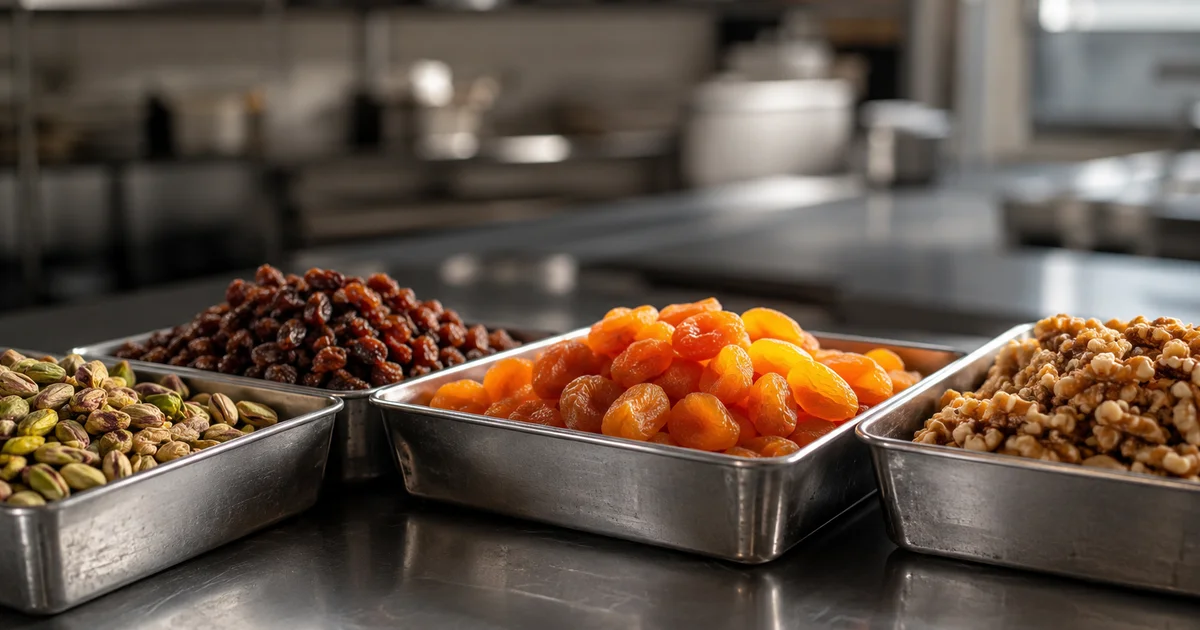
Not all nuts are equal on a dessert menu. Some are structurally expensive (shelled pistachios, macadamia nuts, pecans), while others offer a highly favourable price-to-visual-impact ratio and help maintain the menu’s overall ingredient ratio. The procurement manager’s role is to map this positioning precisely before designing recipes.
| Category of nut or dried fruit | Indicative price positioning | Typical dessert use | Impact on ingredient ratio |
|---|---|---|---|
| Shelled whole pistachios | High | Garnish, tartlet centre, praline | Crowd-pleaser, to be used in small quantities |
| Macadamia nuts and pecans | High | Cookies, crumbles, signature tarts | Premium product, reserved for flagship desserts |
| Calibrated almonds (whole, flaked, powdered) | Mid-range | Frangipane, financiers, filling | Staple product, base for many recipes |
| Raisins and sultanas | Margin driver | Cakes, puddings, compotes | Margin-driving product, high volume |
| Soft apricots and pitted prunes | Margin driver | Compotes, rustic tarts, cooked fillings | Margin driver, excellent visual yield per kilogram |
| Dried figs | Mid-range | Tarts, verrines, accompaniment for sweet cheeses | Balanced product between cost and taste impact |
| Candied fruits (orange, cherry, angelica) | Mid-range to high | Holiday cakes, entremets, garnish | Reserved for seasonal menus |
This hierarchy allows you to build a menu where expensive products never account for more than 15% to 20% of the total volume purchased, while remaining visible on signature desserts that define the establishment’s reputation. To explore sizing criteria in more detail, read our article on selecting almond sizes for professional pastry.
Balancing premium products and margin-driving items
The balance between expensive products and margin drivers is not decided at the level of each individual recipe but at the level of the entire menu. A dessert with a high pistachio or macadamia nut content may push the food cost up, provided that two or three other desserts on the menu compensate with a more favourable ingredient ratio.
- Limit premium products to a garnish or finishing touch rather than a recipe base
- Design at least two margin-driving desserts per menu, based on raisins, prunes, or soft apricots
- Use bulk packaging (buckets or bulk sacks, pallet format) to smooth the unit cost for high-turnover products
- Reserve high-end candied fruits for seasonal or event menus rather than the permanent menu
This balancing logic directly aligns with wholesale logistics: ordering in homogeneous batches, in professional packaging, ensures a stable purchase price over several months and avoids food cost fluctuations linked to fragmented supplies. Our article on nuts inventory management for foodservice details this group purchasing mechanism.
At Palimex, we regularly observe that the establishments that best control their food cost are those that structure their menu around two or three margin-driving desserts based on stable nuts (raisins, prunes, apricots) and reserve premium products like pistachios or macadamia nuts for a signature role, dosed to the gram. It is this disciplined balancing act, more than the purchase price itself, that keeps the ingredient ratio in check over time.
Seasonality, shelf life, and stock rotation: the hidden levers of food cost
Nuts and dried fruits are stable products with long shelf lives, which sets them apart from fresh products in terms of inventory management. However, this stability does not eliminate the need for vigilance regarding stock rotation: poorly managed stock, with old batches losing texture or colour, degrades the taste promise without the purchase cost having changed.
Seasonality primarily affects upstream purchase prices: pistachio, almond, and nut harvests experience price variations linked to production campaigns, which can cause ingredient costs to fluctuate from one season to the next, even for identical recipes. Anticipating these variations by placing group orders during favourable price periods is a direct lever for annual food cost control.
- Apply strict FIFO (first in, first out) management for batches of nuts and dried fruits
- Track batch numbers in line with the establishment’s HACCP requirements
- Adjust orders based on the production calendar rather than just-in-time purchasing
- Maintain a buffer stock for high-turnover margin-driving products (raisins, almonds)
For practical storage guidelines in a professional setting, our dedicated article on storing nuts in professional kitchens details the temperature, humidity, and storage duration conditions suited to the volumes of a foodservice establishment or an artisanal pastry shop.
Technical substitutions: preserving the taste promise without compromising margins
When a dessert’s food cost exceeds the establishment’s set threshold, ingredient substitution is often more effective than simply reducing quantities, which risks degrading the customer experience. The challenge is to substitute without the customer perceiving a drop in quality.
- Replace whole pistachios with pistachio pieces for garnishes, maintaining visual impact and flavour at a significantly lower cost
- Substitute some pecans with standard walnuts in cooked recipes, where texture takes precedence over visual appeal
- Use diced candied fruits instead of whole pieces for mixed preparations (cakes, puddings)
- Switch from a high-end dried fruit to a more common variety in cooked preparations where cooking evens out the texture
Any substitution must be tested in the kitchen before being rolled out across the menu to ensure it does not alter the final texture, cooking time, or dessert stability. Here is the method we recommend for validating an ingredient change:
- Identify the exact function of the ingredient in the recipe (texture, flavour, garnish, stability)
- Select a substitute that fulfils the same function
- Conduct a small-scale test and compare the result with the front-of-house team
- Recalculate the full food cost of the recipe with the new ingredient
- Validate or adjust before final integration into the menu
To compare the respective uses of candied fruits and dried fruits in pastry, our article candied fruits vs. dried fruits in pastry offers a decision grid based on preparation type.
Building your menu: a step-by-step method for controlled food cost
Beyond product-by-product analysis, building a profitable dessert menu follows a structured method applicable to each season or menu refresh. This method is based on the balancing, seasonality, and substitution principles outlined above.
- List all existing recipes and calculate the unit ingredient cost for each
- Categorise desserts into three groups: premium crowd-pleasers, margin drivers, and low-turnover items
- Ensure premium crowd-pleasers do not account for more than 20% of the total volume of nuts purchased
- Adjust the quantities of expensive ingredients without altering the recipe structure
- Test targeted substitutions for recipes exceeding the set food cost threshold
- Review the selling price of signature desserts based on the establishment’s positioning
- Implement monthly monitoring of stock rotation and food cost variances
This method requires reliable sourcing in professional packaging tailored to the actual volumes of a foodservice establishment or an artisanal pastry shop, with traced batches and delivery organised by pallet or free delivery to smooth out logistics costs across the entire order.
Summary: maintaining food cost control on a nut-based dessert menu
Maintaining the ingredient ratio of a nut-based dessert menu relies on three combined levers: a clear hierarchy between premium products and margin drivers, rigorous management of seasonality and stock rotation, and a substitution policy tested before rollout. None of these levers works in isolation: it is their alignment, recipe by recipe and season by season, that allows you to offer a gourmet and cohesive menu without compromising the establishment’s profitability. For professionals structuring their bulk purchases, stable supplies and batch traceability remain the foundation for turning this method into measurable results on the profit and loss statement.
Further reading
Frequently asked questions
Everything you need to know about this topic.
A question?
Get in touch directly.

Marketing & Communications Manager — Palimex / Meyva
As Marketing & Communications Manager at Palimex / Meyva, Aude Moyne leads the company's communications and digital marketing strategy: editorial content, email campaigns and the promotion of its product ranges. Her experience at Palimex, a specialist in dried fruit, nuts, olives and spices for professionals, has given her in-depth knowledge of the products, their origins and uses, and the expectations of food-industry professionals. The blog articles are written or supervised by her, in collaboration with Palimex's sales and product teams whenever a topic calls for specific expertise.
Our advice related to Pro tips
 Pro tips
Paniers garnis de fin d'année pour les entreprises : les composer en épicerie fine
Composez des paniers garnis de fin d'année rentables pour entreprises et CSE : sélection de produits, formats stables, prix de revient et facturation B2B.
 Pro tips
Commandes de fin d'année : le calendrier d'achat d'un pâtissier-chocolatier, d'octobre à décembre
Commandes de fin d'année : calendrier d'achat d'octobre à décembre pour pâtissier-chocolatier. Cadencez fruits secs, confits et marrons sans rupture.
 Pro tips
Triman, REP et éco-contribution : l'emballage d'un préemballé alimentaire
Reconditionnement de denrées et vente au consommateur : obligations REP, identifiant IDU, signalétique Triman et Info-tri. Le guide légal pour les professionnels.