
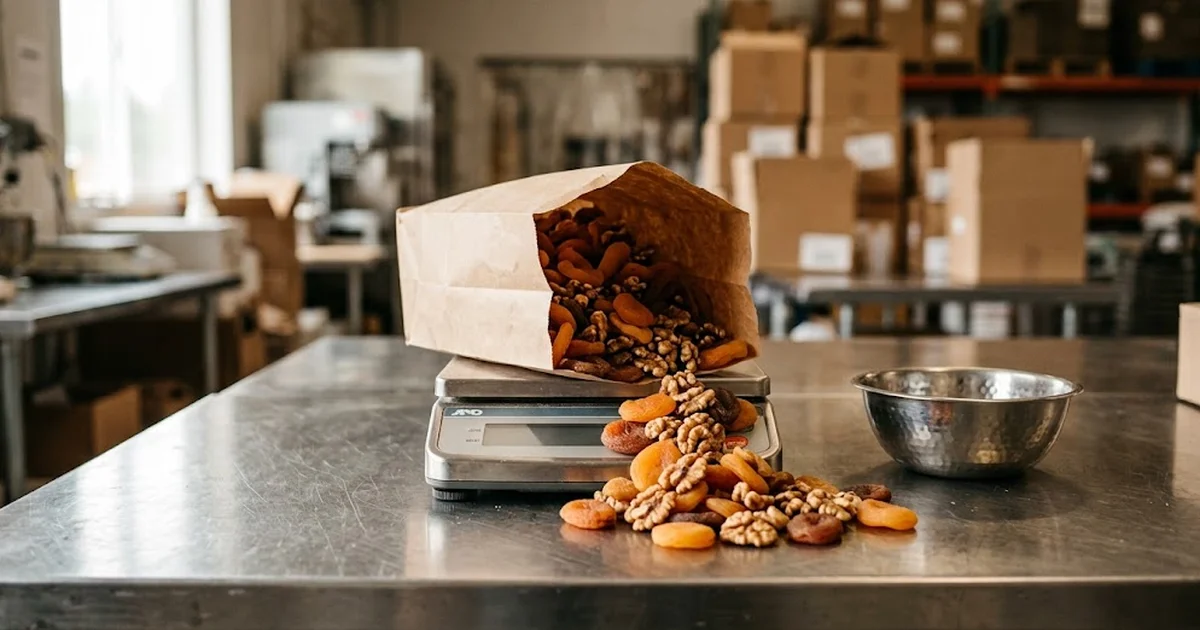
Calculer un coût portion : du sac de 5 kg au dessert servi
Step-by-step method to calculate a reliable portion cost: price per kilo, waste, and portion weight. Complete worked example and reusable template for professionals.
Mastering your portion cost is one of the most direct levers for protecting your margin in foodservice, pastry, and gourmet grocery. Yet many professionals still think only in terms of price per kilo, without factoring in preparation waste, actual weight per item, or the multiplier applied to the selling price. This article details, step by step, the method for moving from a 5 kg bag of dried fruits, dehydrated fruits, or spices to a reliable ingredient cost, all the way to the dessert or preparation served to the end customer.
Why portion cost is the key to profitability in professional kitchens
Portion cost represents the share of raw material consumed to produce one item, one dessert portion, or one garnish. In B2B, where purchases are made in bulk packaging (5 kg bags, cartons, pallets), the common mistake is to compare only the price per kilo between suppliers without accounting for actual kitchen waste.
A bag of dried fruits that is more expensive per kilo but with a uniform size and low waste rate can prove more cost-effective than an entry-level product requiring significant sorting. This is particularly true for almonds, nuts, soft apricots, or candied fruits used in pastry, where size directly determines usable yield.
- A poorly calculated portion cost distorts the profitability of your entire menu.
- Preparation waste (sorting, residual pitting, peeling, rehydration) can account for 2% to 10% of gross weight, depending on the product.
- The actual weight per item must be checked regularly, as it varies with recipes and teams.
Starting data: price per kilo, packaging, and supplier batches
Before any calculation, you need to gather reliable data from your purchase orders and product sheets. In wholesale procurement, this data is typically available per batch, with an associated best-before date and sometimes a batch number for traceability under your HACCP plan.
The essential information to collect for each SKU:
- Purchase price per kilo excluding tax, as invoiced on the packaging unit (bag, carton or bulk sack).
- Stated size (large, medium, pieces) which directly affects the waste rate.
- Waste rate observed in the kitchen across multiple preparations, not just one test.
- Weight used per portion or per item, measured on a scale and not estimated visually.
- Best-before date and storage conditions, which influence stock rotation and thus indirect storage costs.
To explore size selection based on your needs, you can consult our dedicated article on selecting the size of dried fruits for your preparations, as well as our guide on storage and best-before date management in professional stock.
Step-by-step calculation method: from the 5 kg bag to the dessert’s ingredient cost
Here is the method we recommend to transform a bulk purchase price into a usable ingredient cost for your technical sheets.
Step 1: Calculate the real cost per kilo after waste
The real cost per kilo factors in the preparation waste rate. The formula is as follows:
Real cost per kg = Purchase price per kg × (1 + waste rate)
Example: a 5 kg bag of pitted soft apricots purchased at £8.90/kg, with a 5% waste rate due to sorting residual pits and damaged pieces, results in a real cost of £8.90 × 1.05 = £9.35/kg.
Step 2: Determine the cost per ingredient and per recipe
Once the real cost per kilo is known, simply multiply it by the weight used, converted to kilograms:
Ingredient cost = Real cost per kg × weight used (kg)
Step 3: Add up all ingredients to obtain the total ingredient cost
The total ingredient cost of a dessert or preparation is the sum of the costs of each ingredient in the recipe, including ancillary items (pastry, butter, individual packaging if applicable).
Step 4: Divide by the number of portions
Portion cost = Total ingredient cost ÷ number of portions produced
Step 5: Apply a multiplier to set an indicative selling price
The multiplier depends on your pricing policy and overheads. Many establishments aim for an ingredient cost representing about a quarter to a third of the selling price excluding tax, which corresponds to a multiplier of 3 to 4.
"In our discussions with pastry chefs and foodservice professionals who source from us, the same observation comes up: the price per kilo is only part of the equation. We always advise recalculating the real cost after waste on at least three different batches before finalising a technical sheet, as the waste rate can vary depending on the size received and the product’s seasonality. This verification work protects your margin in the long run." — The Palimex team, dried fruits and spices wholesaler at Rungis MIN
Complete worked example: portion cost of a dried fruit tart for 20 servings
Let’s take a concrete example based on common products in professional pastry: a tart topped with soft apricots, nuts, and candied fruits, cut into 20 servings.
Starting data:
- Pitted soft apricots: £8.90/kg, 5% waste rate, 300 g used
- Whole walnut kernels: £12.50/kg, 3% waste rate (sorting broken kernels), 150 g used
- Mixed candied fruits: £9.80/kg, 2% waste rate, 100 g used
- Estimated cost of shortcrust pastry, butter, and ancillary items: £3.50
Detailed calculation:
- Real cost of apricots: £8.90 × 1.05 = £9.345/kg → 0.300 kg × £9.345 = £2.80
- Real cost of nuts: £12.50 × 1.03 = £12.875/kg → 0.150 kg × £12.875 = £1.93
- Real cost of candied fruits: £9.80 × 1.02 = £9.996/kg → 0.100 kg × £9.996 = £1.00
- Topping ingredient cost: £2.80 + £1.93 + £1.00 = £5.73
- Total dessert ingredient cost: £5.73 + £3.50 (pastry and ancillary items) = £9.23
- Portion cost: £9.23 ÷ 20 = £0.46 per serving
- Indicative selling price with a multiplier of 3.5: £0.46 × 3.5 = £1.62 ex VAT per serving (ingredient cost only, excluding labour and fixed costs)
This calculation is a baseline: it must be supplemented by labour costs, energy, and packaging if the serving is sold individually in a display case.
Summary table: portion cost by size and waste rate
The following table illustrates how the waste rate and chosen size affect the real cost per kilo, and thus the final portion cost, for the same 20-serving tart recipe.
| Ingredient | Purchase price per kg | Estimated waste rate | Real cost per kg | Weight used | Cost per portion (÷20) |
|---|---|---|---|---|---|
| Soft apricots, large size | £8.90 | 5% | £9.35 | 300 g | £0.14 |
| Soft apricots, standard size | £7.60 | 9% | £8.28 | 300 g | £0.12 |
| Whole walnut kernels | £12.50 | 3% | £12.88 | 150 g | £0.10 |
| Walnut kernel pieces | £9.20 | 1% | £9.29 | 150 g | £0.07 |
| Mixed candied fruits | £9.80 | 2% | £9.996 | 100 g | £0.05 |
This type of comparison is particularly useful when deciding between two sizes for the same SKU, or when evaluating the switch from a whole product to a broken version, often more economical for blended preparations, mousses, or tart bases.
Reusable template for your technical sheets and stock management
To streamline this calculation across your entire menu, we recommend building a simple, repeatable template for each recipe, updatable with each new order.
6-column calculation template to include in your technical sheet or management spreadsheet:
- Column 1 — Ingredient name and supplier reference (useful for HACCP traceability)
- Column 2 — Purchase price per kg ex VAT, taken from the latest delivery note
- Column 3 — Average observed waste rate (to be updated after each production)
- Column 4 — Real cost per kg = purchase price × (1 + waste rate)
- Column 5 — Weight used per portion, in kilograms
- Column 6 — Portion cost = real cost per kg × weight used
Then add up the portion costs of all ingredients in the same recipe to obtain the total ingredient cost per portion, and apply your multiplier. This template allows you to quickly recalculate the impact of a supplier price change or a size switch, without redoing the entire calculation each time. It also facilitates stock rotation and batch management when multiple deliveries follow one another for the same SKU.
Common mistakes and best practices to ensure accurate portion cost calculation
Certain mistakes recur in professional kitchens and can distort margins if not corrected.
- Confusing gross weight and net weight: the price per kilo shown always corresponds to the gross weight of the delivered bag or carton, never the net weight after sorting.
- Estimating the waste rate instead of measuring it: weighing before and after preparation across several batches provides a much more reliable value than a rough estimate.
- Not updating technical sheets: a change in size, supplier, or season can significantly alter the waste rate, especially for dehydrated fruits and candied fruits.
- Overlooking ancillary costs: individual packaging, best-before date labelling, and preparation labour must be included separately if the ingredient cost alone is not sufficient for pricing decisions.
- Ignoring the impact of packaging: bulk packaging in 5 kg bags does not have the same handling and storage costs as a pre-portioned carton format, which affects the overall cost beyond just the price per kilo.
For further insights on organising your procurement logistics, our article on choosing between bulk and carton packaging for foodservice details the criteria to consider based on your production volume. You can also consult general resources on ingredient cost calculation in foodservice, such as this methodological summary available on Wikipedia’s food cost page, as an educational supplement.
Summary: from bulk purchasing to a controlled portion cost
Calculating a reliable portion cost, from the 5 kg bag to the served dessert, relies on a simple but rigorous method: factor in the actual waste rate in the cost per kilo, measure the weight used precisely, add up all the recipe’s ingredients, then divide by the number of portions. This disciplined approach, applied systematically and updated with each new batch, allows you to objectively decide between sizes, suppliers, and packaging, while securing your margin across your entire menu. By structuring your technical sheets around this template, you turn each bulk order of dried fruits, dehydrated fruits, or spices into actionable data for your daily management, rather than just another line on an invoice.
Further reading
Frequently asked questions
Everything you need to know about this topic.
A question?
Get in touch directly.

Marketing & Communications Manager — Palimex / Meyva
As Marketing & Communications Manager at Palimex / Meyva, Aude Moyne leads the company's communications and digital marketing strategy: editorial content, email campaigns and the promotion of its product ranges. Her experience at Palimex, a specialist in dried fruit, nuts, olives and spices for professionals, has given her in-depth knowledge of the products, their origins and uses, and the expectations of food-industry professionals. The blog articles are written or supervised by her, in collaboration with Palimex's sales and product teams whenever a topic calls for specific expertise.
Our advice related to Pro tips
 Pro tips
Paniers garnis de fin d'année pour les entreprises : les composer en épicerie fine
Composez des paniers garnis de fin d'année rentables pour entreprises et CSE : sélection de produits, formats stables, prix de revient et facturation B2B.
 Pro tips
Commandes de fin d'année : le calendrier d'achat d'un pâtissier-chocolatier, d'octobre à décembre
Commandes de fin d'année : calendrier d'achat d'octobre à décembre pour pâtissier-chocolatier. Cadencez fruits secs, confits et marrons sans rupture.
 Pro tips
Triman, REP et éco-contribution : l'emballage d'un préemballé alimentaire
Reconditionnement de denrées et vente au consommateur : obligations REP, identifiant IDU, signalétique Triman et Info-tri. Le guide légal pour les professionnels.