
Dried Fruit Sizes and Grades: How to Read a Technical Data Sheet
Understanding dried fruit sizes and grades: W320, No. 1, count, moisture content. Decoding a technical data sheet before bulk procurement.
A size indicated on a technical data sheet is never a cosmetic detail: it determines kitchen yield, purchase price per kilogram, the final presentation of a dish, and ultimately a professional’s margin. For a B2B buyer—whether in gourmet retail, restaurants, pastry, or catering—knowing how to read a sizing system avoids unpleasant surprises upon pallet delivery and allows for an objective comparison between two suppliers. This article serves as a reference guide: it explains the common logic behind all dried fruit sizing systems, details product grades item by item, and directs you to the specialised data sheets in our catalogue for further information on each SKU.
The count per unit of weight: the common logic behind all sizing systems
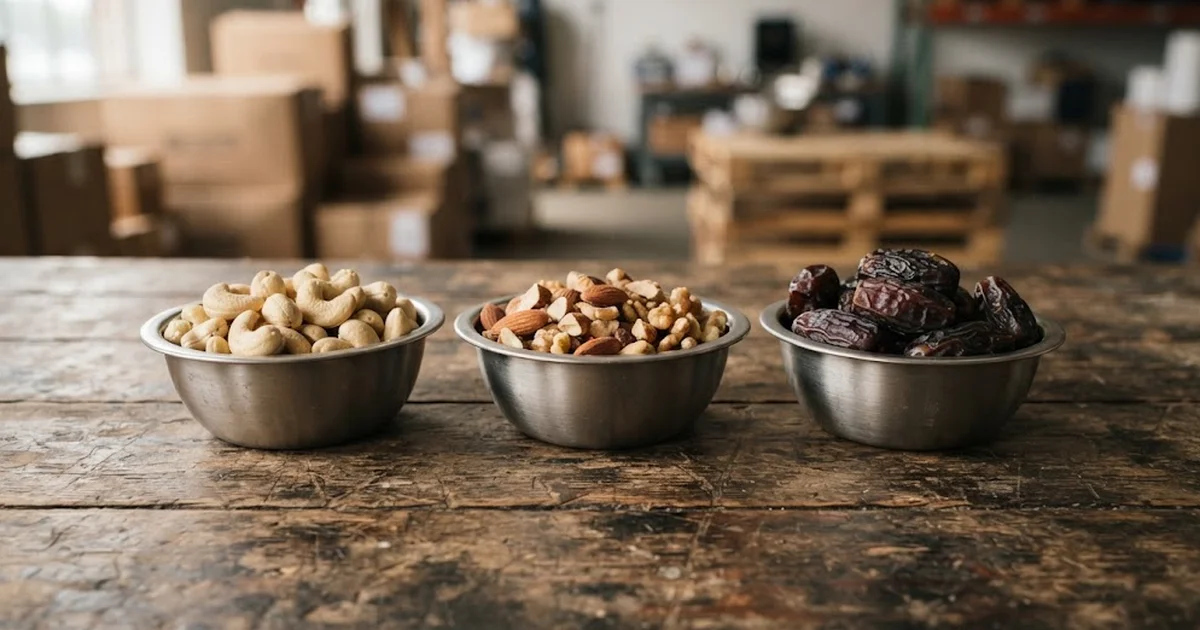
Whether referring to cashews, almonds, or dates, most sizing systems are based on a single principle: the count, i.e., the number of units contained in a reference weight, most often the English pound (454 g) for nuts, or the kilogram for Mediterranean dried fruits.
The lower the count, the larger the fruits—since fewer are needed to reach the same weight. Conversely, a high count indicates smaller sizes, often intended for processing (industrial pastry, snack mixes) rather than direct consumption.
- Low count = large fruits, higher price per kilogram, used for display or tasting.
- High count = smaller fruits, more affordable price per kilogram, used for processing (paste, powder, mix).
- Count range = tolerance accepted by the supplier, always to be checked on the technical data sheet before bulk ordering.
This count logic underpins all the grades detailed below, even when the nomenclature changes from one product to another (W for cashews, numbering for apricots and figs, commercial categories for dates).
Cashew grades: W180, W240, W320, SW, and pieces
White whole cashews use the most standardised international nomenclature in the nut sector. The letter W stands for “whole,” and the following number indicates the count per pound.
| Grade | Count per pound (approx.) | Typical professional use |
|---|---|---|
| W180 | 150 to 180 | Premium gift boxes, bulk retail, display presentation |
| W210 | 180 to 210 | High-end aperitif mixes |
| W240 | 220 to 240 | Standard foodservice, snacking, Asian cuisine |
| W320 | 300 to 320 | Pastry, institutional catering, best price-to-use ratio |
| SW (Scorched Wholes) | Variable | Slightly roasted appearance, not a defect, used for processing |
| Pieces (Splits, Butts, LWP) | Not applicable (broken) | Cashew paste, powder, incorporation in pastry |
For a detailed comparison between the two most ordered grades by professionals, refer to our dedicated article: Cashew W320 vs W240: Which size to choose based on your use. The choice between these two grades directly impacts the cost price of a mix or garnish.
Numbering of dried apricots and figs
Unlike cashews, dried apricots and figs use an ascending numbering system that may initially seem counterintuitive to an uninitiated buyer.
- Dried apricots: the number corresponds to a decreasing fruit size— the lower the number, the larger and plumper the fruit, reserved for tasting or visible pastry garnishes.
- Dried figs: the numbering works by counting range (number of figs per kilogram), with a low number indicating large, whole figs, and a high number indicating smaller sizes suitable for cutting or confectionery.
The colour of the apricot (deep orange to natural brown) and the residual sugar content of the fig are two criteria complementary to pure size, always to be cross-referenced on the technical data sheet. For further details on dried figs and their original numbering system, see our article: Dried fig sizes: Understanding Turkish numbering.
Date sizes: Medjool, Deglet Nour, and commercial classes
Date sizes are read differently depending on the variety. For Medjool, size is generally expressed as the number of units per kilogram, with classes ranging from Jumbo to Large. For Deglet Nour, more commonly used in professional cooking and pastry, classification combines size and texture (firm flesh, semi-soft).
| Class | Typical variety | Size indication |
|---|---|---|
| Jumbo | Medjool | Fewer than 20 units/kg |
| Large | Medjool | 20 to 26 units/kg |
| Extra | Deglet Nour | Firm flesh, uniform size |
| Standard | Deglet Nour | Variable size, used in cooking and processing |
These classes directly determine the use: a Jumbo Medjool is intended for per-unit sales or visible stuffing, while a Standard Deglet Nour is better suited for pastry, compotes, or incorporation in hot dishes. Our dedicated data sheet details each class and its uses: Date sizes: Understanding Medjool and Deglet Nour.
Walnut kernel classes: whole, halves, quarters, and pieces
For walnuts, sizing does not refer to a count per weight but to the integrity of the kernel after cracking. This classification directly impacts price and final use.
- Whole kernels (Halves Light/Extra Light): Direct consumption, gift boxes, premium mixes.
- Halves: Versatile, good price/presentation balance for foodservice.
- Quarters: Cooking, pastry, incorporation in dough or garnish.
- Pieces: Industrial use, powder, oil, lowest cost per kilogram.
The kernel colour (extra light, light, light amber, amber) complements this classification and also influences pricing: a lighter kernel is generally more expensive than an amber one, all other quality factors being equal.
Moisture content: the indicator that changes the actual weight paid
Moisture content is arguably the most underestimated parameter by professional buyers, yet it directly affects the price paid per net kilogram and stock preservation.
At Palimex, we regularly see orders disputed upon delivery simply because the buyer had not compared the moisture content stated on the technical data sheet with that of the delivered batch. A difference of a few percentage points in moisture content changes the actual dry weight, thus the cost per usable kilogram—this is the first figure to check before signing a purchase order, even before the size.
- A higher moisture content means a greater gross weight for the same amount of usable dry matter—thus a relative overpayment if the price is set per gross kilogram.
- Too low a moisture content may indicate an over-dried fruit, impacting mouthfeel and pastry yield.
- Moisture content also determines shelf life: the higher it is, the greater the risk of mould development during warehouse storage.
Any serious technical data sheet must indicate this content with a referenced measurement method, to be compared from one batch to another rather than considered as an absolute and fixed value.
Origin, harvest campaign, and batch traceability
Size is never read in isolation: geographical origin and harvest campaign explain much of the size variation from one year to the next, for the same ordered grade.
A drought in a production area, a harvest delay, or a supplier change from one country to another can alter the average size delivered, even with the same grade number. This is why a complete technical data sheet must always specify:
- The country of origin and, if possible, the production region.
- The harvest campaign (year and sometimes semester for products with two harvests).
- The batch number, essential for any HACCP traceability in case of recall or inspection.
For almonds in particular, origin (California, Spain, Mediterranean) strongly influences available size and supply consistency from one campaign to the next—a point detailed in our dedicated guide: Almond sizes: Understanding origin and commercial classes.
Reading a Certificate of Analysis before confirming an order
The Certificate of Analysis, or CoA, accompanies a professional batch and compiles all measurable data to verify compliance between what is ordered and what is delivered.
| CoA section | What it indicates | Why to verify it |
|---|---|---|
| Batch number | Unique traceability identifier | Essential in case of complaint or HACCP audit |
| Size / count | Actual grade measured on sample | Confirms correspondence with ordered grade |
| Moisture content | Measured residual water percentage | Affects dry weight and preservation |
| Best-before date | Optimal use-by date | Determines stock rotation planning |
| Origin and campaign | Country and harvest year | Explains size or colour discrepancies |
| Microbiological analyses | Sanitary test results for the batch | Documentary support for your HACCP file |
For further information on international classification standards for nuts and dried fruits, the Codex Alimentarius documentation remains a key reference available online: Codex Alimentarius (FAO/WHO).
Pistachio grades and sizes: a special case to know
Pistachios deserve special mention as their sizing combines several criteria: the count per ounce (number of pistachios per 28 g), the natural shell opening rate, and the presence or absence of shelled kernels. A low count (e.g., 18/20) indicates large pistachios valued for in-shell sales, while a shelled kernel is sized according to a logic similar to that of cashews.
This dual reading—size in-shell and size of shelled kernel—is a frequent source of confusion for buyers new to the product. Our specialised article details this complete nomenclature: Pistachio sizes and grades: in-shell and kernel.
Summary: The method for comparing two technical data sheets
When faced with two commercial proposals for the same product, comparison cannot be limited to the displayed price per kilogram. A rigorous reading must systematically cross-reference: the announced grade or count, the measured moisture content, origin and harvest campaign, as well as the presence of a complete and legible Certificate of Analysis.
This reading grid applies to the entire catalogue of dried fruits, dehydrated fruits, and oilseeds sold in professional packaging. To refine your product decision item by item, refer to our specialised data sheets on cashews, almonds, dates, figs, and pistachios mentioned throughout this article: they detail grades, culinary uses, and storage recommendations specific to each SKU, in line with stock rotation and logistics requirements for bulk procurement.
Further reading
Frequently asked questions
Everything you need to know about this topic.
A question?
Get in touch directly.

Marketing & Communications Manager — Palimex / Meyva
As Marketing & Communications Manager at Palimex / Meyva, Aude Moyne leads the company's communications and digital marketing strategy: editorial content, email campaigns and the promotion of its product ranges. Her experience at Palimex, a specialist in dried fruit, nuts, olives and spices for professionals, has given her in-depth knowledge of the products, their origins and uses, and the expectations of food-industry professionals. The blog articles are written or supervised by her, in collaboration with Palimex's sales and product teams whenever a topic calls for specific expertise.
Our advice related to Pro tips
 Pro tips
Paniers garnis de fin d'année pour les entreprises : les composer en épicerie fine
Composez des paniers garnis de fin d'année rentables pour entreprises et CSE : sélection de produits, formats stables, prix de revient et facturation B2B.
 Pro tips
Commandes de fin d'année : le calendrier d'achat d'un pâtissier-chocolatier, d'octobre à décembre
Commandes de fin d'année : calendrier d'achat d'octobre à décembre pour pâtissier-chocolatier. Cadencez fruits secs, confits et marrons sans rupture.
 Pro tips
Triman, REP et éco-contribution : l'emballage d'un préemballé alimentaire
Reconditionnement de denrées et vente au consommateur : obligations REP, identifiant IDU, signalétique Triman et Info-tri. Le guide légal pour les professionnels.