
Allergènes fruits à coque : ce que l'achat en vrac oblige à afficher
Bulk purchase of nuts: what the wholesaler must provide, what you must display. Product sheet, batch, best-before date, DGCCRF — the complete guide for professionals.
Purchasing nuts in bulk — almonds, walnuts, hazelnuts, pistachios, cashews — is a common practice among wholesalers and their professional clients: gourmet grocery stores, pastry chefs, artisans, and caterers. However, as soon as this bulk product is repackaged, resold at retail, or incorporated into a preparation, the allergen information obligation does not disappear — it shifts. Understanding who must display what, in what form, and what the supplier must provide upstream is a matter of compliance as much as it is of safety for your end customers.
Why bulk nut purchases change the game on allergens
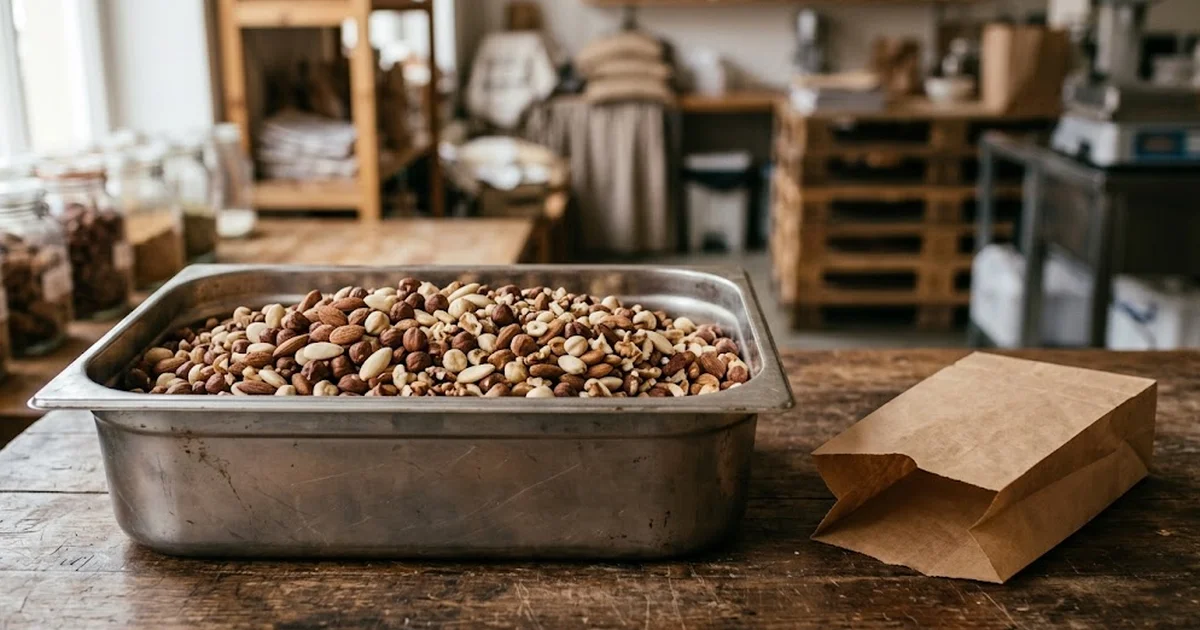
A pre-packaged product carries a label with the list of ingredients and the highlighting of allergens. A 5, 10, or 25 kg bulk bag purchased from a food wholesaler is not intended to be sold as-is to the end consumer: it is meant to be repackaged, weighed, processed, or incorporated into a recipe. This repackaging step is precisely when the responsibility for allergen information shifts to the professional handling the product.
Nuts are among the allergen families most frequently involved in severe reactions. An almond, a hazelnut, or a cashew stored in bulk in the same space as other food items can also generate cross-contamination if physical separation is not ensured. This is why bulk purchasing does not exempt anyone from vigilance: it shifts the traceability burden downstream in the supply chain.
- Bulk does not mean exemption from allergen information.
- The professional who repackages becomes responsible for displaying information to their own customer.
- The supplier remains responsible for the compliance of the information provided upstream, batch by batch.
Allergens to declare and the specific role of nuts
European regulations require the declaration of a list of substances recognised as major allergens, whenever they are present in a food product, regardless of quantity. Nuts constitute one of these categories, with a breakdown by species (almond, hazelnut, walnut, cashew, pecan, brazil nut, pistachio, macadamia nut).
| Allergen category | Common examples in the catalogue | Key point for bulk storage |
|---|---|---|
| Nuts | Almonds, hazelnuts, walnuts, cashews, pistachios | Cross-contamination between storage bins |
| Peanuts | Plain or roasted peanuts | Often stored near nuts |
| Sesame | Seeds, tahini, aperitif mixes | Fine dust that can contaminate an entire section |
| Coated stone fruits | Candied fruits, snack mixes | Possible traces of nuts in packaging lines |
| Sulphites | Dehydrated fruits (apricots, raisins) | Variable concentration by batch, to be checked in the product sheet |
For professionals working with our ranges of dried fruits and dehydrated fruits, vigilance applies as much to the product itself as to its storage and handling environment.
What the supplier must provide with each bulk delivery
The information obligation does not rest solely on the professional who resells or processes the product: it begins with the wholesaler. A reliable supplier must provide, for each batch delivered, the elements enabling the buyer to correctly relay the information at their own level.
- A product technical sheet mentioning the composition and allergens present or likely to be present.
- The batch number, essential for traceability in case of recall or complaint.
- The minimum durability date (best-before date) associated with the delivered batch.
- Information on the risk of cross-contamination linked to the supplier’s packaging site.
- A delivery note clearly stating the product designation and its declared origin.
These documents must be retained by the purchasing professional, as they form the basis of their own display obligation. Without this upstream transmission, it is impossible for a grocer, pastry chef, or caterer to correctly inform their own display or menu.
In-store display: formats, placement, and required information
Once the bulk product is received, processed, or simply repackaged for retail sale, the professional must make the allergen information accessible to their customer, without the latter having to request it actively. In practice, several formats coexist depending on the sales context.
| Sales context | Recommended display format | What it must contain |
|---|---|---|
| Gourmet grocery store, bulk bin retail sale | Label or sheet placed directly on or near the bin | Product name, mention of relevant allergens |
| Commercial catering, menu | Paper format, chalkboard, or document available on request | Identification of dishes containing allergens, reference to a detailed document |
| Caterer, takeaway preparations | Label on the final container | List of ingredients and highlighted allergens |
| Pastry shop, display of finished products | Sheet per SKU or binder available at the counter | Allergen details per recipe |
In all cases, the information must be easily accessible before purchase, legible, and consistent with the actual composition of the delivered product. A display failure, even in the absence of an incident, constitutes a breach identifiable during an inspection.
At Palimex, we regularly see professionals repackaging our bags of nuts without retaining the product sheet associated with the batch. This is the most common mistake we observe in the field: the document exists, it was provided at delivery, but it gets lost between the receiving dock and the point of sale. Our advice is simple: systematically file the product sheet and batch number before even opening the bag, as this information will enable you to respond to a customer or inspection without delay.
Traceability, cross-contamination, and stock rotation in an HACCP environment
Allergen display only makes sense if it is based on reliable upstream traceability. A well-maintained HACCP environment limits declaration errors and cross-contamination, particularly sensitive with nuts, whose fragments and dust easily move from one container to another.
- Physically separate bins of nuts from other product families, especially dehydrated fruits without shells.
- Clean handling tools (scoops, funnels, scales) between each different SKU.
- Apply strict FIFO stock rotation to avoid mixing batches with different best-before dates.
- Train sales staff to recognise the allergens present in each bulk SKU offered.
- Retain a control sample per batch when the sold volume justifies it.
These practices align with the principles outlined in our article on HACCP traceability applied to dried fruits, where we detail the specific control points for this type of product.
Inspections, responsibilities, and what puts your establishment at risk
Compliance with allergen information is part of a general obligation of safety and fairness towards the consumer, monitored in particular by the DGCCRF during its inspections of points of sale and catering establishments. A breach identified can lead to a compliance notice, or even more serious consequences in case of repeat offences or proven harm to an allergic consumer.
For professionals purchasing in bulk, the best protection remains documentary rigour: retaining product sheets, delivery notes, batch numbers, and ensuring that the final display accurately reflects this information. You can consult the official resources of the DGCCRF to further explore the general framework applicable to consumer information on allergens.
| Supply chain actor | Main responsibility |
|---|---|
| Wholesaler (Palimex) | Provide product sheet, batch number, and best-before date with each delivery |
| Purchasing professional (grocery, foodservice, pastry chef) | Retain these documents and display the information to the end consumer |
| Sales staff | Be able to answer any questions about present allergens |
To organise your orders in line with these obligations, our page on bulk packaging for professionals details the available formats and the documents associated with each pallet delivery.
Best practices to secure your bulk nut orders
Beyond regulatory compliance, a rigorous organisation of the reception and storage of bulk nuts limits the risk of errors at the time of resale or processing. Here are the points we recommend checking systematically with each order.
- Check for the presence of the product sheet and batch number upon pallet receipt.
- Archive these documents by SKU and delivery date for quick retrieval.
- Clearly identify each repackaging bin or container with the product name and associated allergens.
- Plan your order volumes to avoid stockouts that lead to mixing batches from different origins.
- Train your teams regularly, especially in case of sales staff turnover.
These practices apply equally to almonds and hazelnuts as to snack mixes or pastry preparations, available in our selection dedicated to foodservice professionals.
Summary: key takeaways before your next bulk order
Purchasing nuts in bulk does not exempt any professional from their allergen information obligation: it transfers it to the one who repackages, processes, or resells the product. The supplier must provide a product sheet, batch number, and best-before date with each delivery; the purchasing professional must retain these documents and make the information accessible to their customer, in a format adapted to their point of sale. Documentary rigour and a well-organised HACCP system remain the best guarantees of lasting compliance and a trusting relationship with your own customers.
Further reading
Frequently asked questions
Everything you need to know about this topic.
A question?
Get in touch directly.

Marketing & Communications Manager — Palimex / Meyva
As Marketing & Communications Manager at Palimex / Meyva, Aude Moyne leads the company's communications and digital marketing strategy: editorial content, email campaigns and the promotion of its product ranges. Her experience at Palimex, a specialist in dried fruit, nuts, olives and spices for professionals, has given her in-depth knowledge of the products, their origins and uses, and the expectations of food-industry professionals. The blog articles are written or supervised by her, in collaboration with Palimex's sales and product teams whenever a topic calls for specific expertise.
Our advice related to Pro tips
 Pro tips
Paniers garnis de fin d'année pour les entreprises : les composer en épicerie fine
Composez des paniers garnis de fin d'année rentables pour entreprises et CSE : sélection de produits, formats stables, prix de revient et facturation B2B.
 Pro tips
Commandes de fin d'année : le calendrier d'achat d'un pâtissier-chocolatier, d'octobre à décembre
Commandes de fin d'année : calendrier d'achat d'octobre à décembre pour pâtissier-chocolatier. Cadencez fruits secs, confits et marrons sans rupture.
 Pro tips
Triman, REP et éco-contribution : l'emballage d'un préemballé alimentaire
Reconditionnement de denrées et vente au consommateur : obligations REP, identifiant IDU, signalétique Triman et Info-tri. Le guide légal pour les professionnels.