
Bulk Turkish Sucuk: Destan, Parmak, Cold Chain
Bulk Turkish sucuk for grocers and restaurants: parmak sucuk, Destan, 9x1 kg packaging. Cooking, cold chain, and halal certification.
Turkish sucuk has established itself for several years on the menus of oriental restaurants, in the delicatessen sections of fine grocers, and on the worktops of foodservice establishments offering an authentic kahvaltı (Turkish breakfast). A fermented product made from beef, spiced and dry, sucuk requires rigorous professional handling: respect of the cold chain, knowledge of packaging formats, mastery of cooking, and verification of halal certification. This article deals exclusively with Turkish sucuk — for a broader overview including cecina, refer to our article Halal dried meat in bulk: cecina and sucuk.
What is sucuk? Definition and production of a Turkish fermented sausage
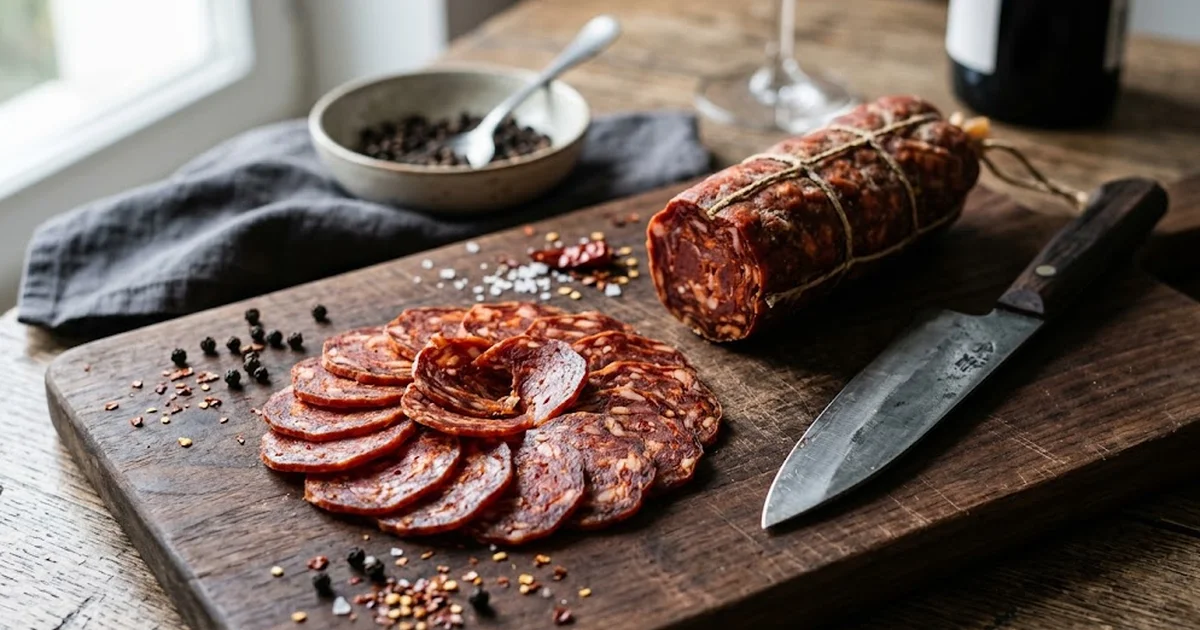
Sucuk is a spiced and fermented beef sausage, originating from Turkish culinary tradition and more broadly from the Balkans and the Caucasus. Unlike a classic dry sausage, sucuk relies on short fermentation followed by controlled drying, which gives it its firm texture, dark red color, and characteristic taste enhanced with cumin, garlic, paprika, and sometimes sumac.
For professional use in restaurants or fine grocers, several production points should be known before any bulk purchase:
- Meat used: exclusively beef to comply with halal requirements, with no addition of pork.
- Dominant spices: cumin, garlic, pepper, sweet or hot paprika, and sometimes sumac depending on regional recipes.
- Process: grinding, stuffing into natural or artificial casing, fermentation, partial or total drying depending on the size.
- Final texture: semi-dry to dry, more tender than a traditional French sausage, which facilitates pan-frying.
Sucuk is thus clearly distinct from pastırma (whole spiced dried meat with fenugreek) and cecina, with which it is sometimes confused in generic catalogs. Our dedicated article on halal dried meats in bulk details these differences for professionals sourcing several families of dry meat products.
The parmak sucuk format: size, uses, and benefits for foodservice
The term parmak means "finger" in Turkish and refers to a thin and elongated sucuk format, calibrated for quick cooking and individual presentation. Parmak sucuk is particularly sought after by professionals for three reasons: its even cooking, controlled portioning, and versatility on various menus.
In professional kitchens, the parmak format is used in numerous preparations:
- Kahvaltı (Turkish breakfast): grilled slices or whole pieces, served with eggs, white cheese, and flatbread.
- Sandwiches and wraps: cut into sections for quick fillings in oriental fast food.
- Pizza and pide: thin rounds arranged before oven baking, appreciated for their controlled fat rendering.
- Grilled dishes (izgara): direct grilling, plated as an accompaniment to meats.
- Mezze and catering trays: thin slicing for buffets and oriental appetizer trays.
Parmak sucuk thus allows for finer portion management than sucuk in the traditional horseshoe shape, reducing kitchen waste and facilitating cost calculation for high-turnover foodservice establishments.
Destan sucuk and 9x1 kg packaging: understanding the professional offering
Among the references available for bulk purchase, Destan sucuk is a benchmark for professionals seeking a calibrated, consistent product from one batch to another, suitable for demanding B2B logistics. The 9x1 kg cardboard packaging is designed to balance order volume, stock management, and cold chain compliance throughout transport.
This format offers several concrete advantages for fine grocers or foodservice establishments:
- 1 kg units: facilitated kitchen rotation, gradual opening without overexposing the rest of the box to ambient air.
- 9 kg box: format compatible with pallet management and free delivery, reducing logistics cost per kilo.
- Batch traceability: each box is identified, simplifying HACCP tracking and best-before date management in case of internal inspection.
- Size consistency: the Destan parmak sucuk format maintains diameter regularity useful for uniform plating or buffet presentation.
Comparative table of bulk sucuk formats available
| Format | Approximate size | Typical packaging | Preferred professional use |
|---|---|---|---|
| Parmak sucuk | Fine, elongated ("finger") | 9x1 kg box | Kahvaltı, grill, individual portions |
| Classic sucuk (horseshoe) | Medium to large | Bulk box or pieces | Slicing, slow-cooked dishes, deli counter |
| Destan sucuk | Consistent size, parmak format | 9x1 kg box under cold chain | Fast food, fine grocers, fresh resale |
Cold chain and logistics: ensuring sucuk quality until the kitchen
Sucuk is a fresh fermented product, which requires constant vigilance over the cold chain from the warehouse to receipt in the kitchen or shop. Even a brief temperature break can affect texture, accelerate fat oxidation, and shorten the product's commercial shelf life.
For professionals ordering in bulk, several logistical points of vigilance should be integrated:
- Refrigerated truck delivery: systematic temperature check upon receipt, before unloading.
- Receipt in refrigerated buffer zone: avoid any temporary storage at ambient temperature, even for a few minutes.
- Visual box inspection: packaging integrity, absence of excessive condensation indicating a cold chain break.
- Batch and best-before date recording: essential for HACCP traceability and FIFO (first in, first out) rotation organization.
At Palimex, we find that most sucuk complaints do not come from the product itself but from poorly managed cold chain breaks upon receipt, particularly during summer deliveries. Our field advice: train your receiving team to systematically check the box temperature as soon as the truck arrives, even before signing the delivery note. A 9x1 kg box that has experienced a temperature deviation should be isolated and reported immediately, never mixed with compliant stock.
To learn more about cold chain best practices in a B2B environment, our article cold chain for fresh products in B2B details the protocols to implement at each reception stage.
Cooking sucuk: pan, grill, and preparation for kahvaltı
Cooking sucuk is simple but requires some technical adjustments depending on the format and final use in professional kitchens. The thinner parmak sucuk cooks quickly and requires close monitoring to prevent drying out.
Here are the most commonly used cooking methods in foodservice:
- Pan without added fat: sucuk naturally releases its fat; medium heat cooking for a few minutes on each side is sufficient for parmak sucuk.
- Grill or plancha: ideal for quick service in dining rooms or food trucks, marking the product without drying it out if temperature is controlled.
- Cooking for kahvaltı: thin pan-fried slices, often accompanied by scrambled eggs (menemen) or fried eggs, served hot on a Turkish breakfast tray.
- Integration in long cooking: rounds added to slow-cooked dishes or spiced tomato sauces to flavor without overpowering.
A technical point to remember: since sucuk is already fermented and partially dried, it does not require prolonged cooking to be safely consumed, but short cooking significantly improves texture and aromatic expression of spices in hot dishes.
Halal certification and batch traceability for sucuk
For professionals purchasing Turkish sucuk in bulk, halal certification is a central selection criterion, both for religious compliance and customer trust in foodservice or community grocers.
Elements to systematically verify during sourcing include:
- Halal certificate for the batch: document associated with each reference, to be kept in the supplier file for any internal or external inspection.
- Meat origin: exclusively beef, with no mixing of other non-compliant meats.
- Legible batch number: essential for ensuring complete traceability, from slaughter to delivery in 9x1 kg boxes.
- Documentary consistency: the certificate must exactly match the delivered batch, not a generic supplier reference.
This documentary rigor is part of a global HACCP approach that all food professionals must maintain. For general hygiene and food safety best practices, the official health recommendations published by the Anses provide a useful reference framework for structuring your internal procedures.
Storage and stock rotation for sucuk in grocers and foodservice
Once received, sucuk must be stored and handled according to precise rules to preserve its quality until sale or use in the kitchen. Stock rotation plays a decisive role in best-before date management, especially for establishments with large order volumes.
Some practical recommendations for professional storage:
- Constant refrigerated storage: sucuk must remain in cold storage from receipt, with no cold chain interruption.
- Strict FIFO management: older boxes should be used first, particularly for opened 9x1 kg formats.
- Resealed packaging after opening: limit air exposure to prevent excessive drying or surface fat oxidation.
- Regular visual monitoring: check appearance, smell, and texture before each use, especially for units opened for several days.
- Kitchen staff training: raise team awareness about best-before date reading and proper handling of fresh fermented products.
To discover our entire range of oriental fresh products, including various sucuk references and halal charcuterie, consult the World Flavors > Oriental > Fresh category in our professional catalog. You will also find useful complements on warehouse storage in our article HACCP and food warehouse storage.
Summary: choosing and handling bulk Turkish sucuk
Turkish sucuk, particularly the parmak sucuk format, stands out as a reliable and versatile product for professionals in oriental foodservice, kahvaltı, and fine grocers. Its success in the kitchen relies on three inseparable pillars: a rigorous cold chain from receipt of the 9x1 kg packaging, short and controlled cooking that preserves texture and aromas, and documented and traceable halal certification for each batch. Destan sucuk exemplifies this consistency sought by professional buyers. By structuring your reception, storage, and stock rotation around these principles, you ensure your customers a compliant, flavorful, and safe product from box to plate.
Further reading
Frequently asked questions
Everything you need to know about this topic.
A question?
Get in touch directly.

Marketing & Communications Manager — Palimex / Meyva
As Marketing & Communications Manager at Palimex / Meyva, Aude Moyne leads the company's communications and digital marketing strategy: editorial content, email campaigns and the promotion of its product ranges. Her experience at Palimex, a specialist in dried fruit, nuts, olives and spices for professionals, has given her in-depth knowledge of the products, their origins and uses, and the expectations of food-industry professionals. The blog articles are written or supervised by her, in collaboration with Palimex's sales and product teams whenever a topic calls for specific expertise.
Our advice related to Grocery & Recipes
 Grocery & Recipes
Épices de l'hiver : pain d'épices, vin chaud et pâtisserie de Noël, dosage et achat
Guide B2B des épices d'hiver pour boulangers, pâtissiers et CHR : dosages au kilo et au litre, mélanges vin chaud et pain d'épices, approvisionnement en gros.
 Grocery & Recipes
Nougat en meule : découpe à la coupe, conservation et vente au poids
Guide B2B pour épiceries et confiseries : réussir la découpe à la coupe du nougat en meule, limiter les pertes, maîtriser le stockage et l'affichage au poids.
 Grocery & Recipes
Seau d'olives entamé : durée de vie, saumure et gestion du reste
Comment conserver un seau d'olives entamé ? Rôle de la saumure, température, règles d'hygiène et gestion des tapenades : le guide professionnel Palimex.