
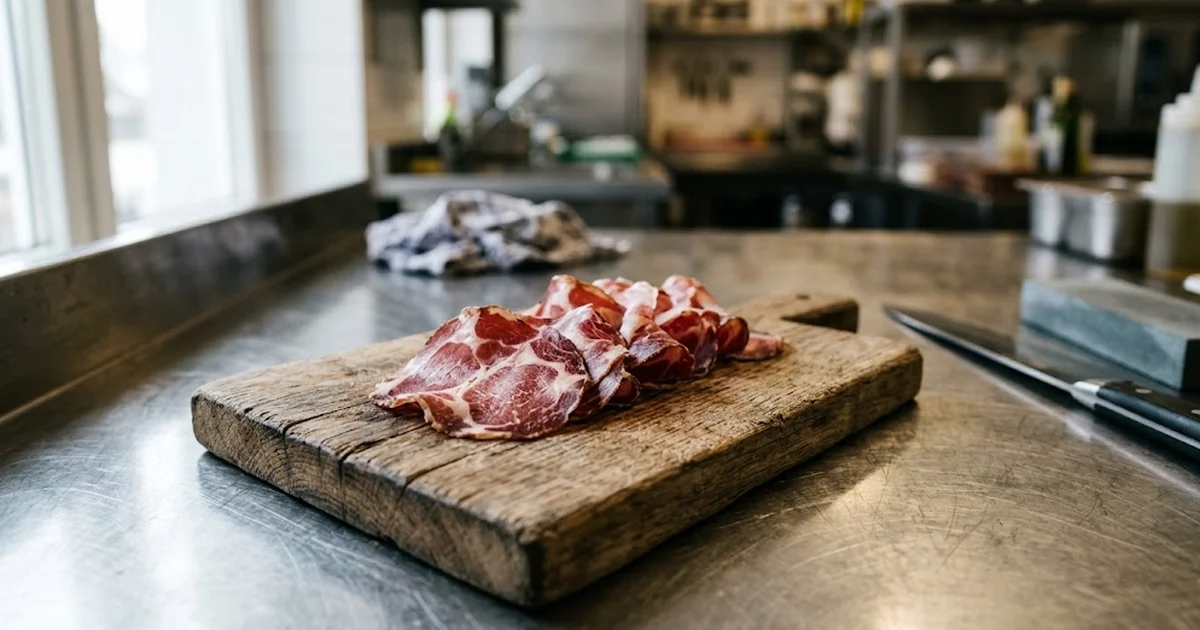
Cecina : découpe, épaisseur et dressage en salle
Pro guide: slice thickness, cold chain, plating techniques, and pairings for serving cecina in foodservice. B2B tips from Palimex for restaurateurs and caterers.
Cutting cecina: thickness, angle, and suitable equipment for professional kitchens
Cecina is a dried and aged beef product that requires precise cutting to highlight its texture and flavour. In professional kitchens, mastering slice thickness directly influences mouthfeel: too thick, the slice becomes fibrous and difficult to chew; too thin, it loses its character and dries out on contact with air. For foodservice use—aperitif boards, tapas, starters, or premium sandwich fillings—thickness must be tailored to each service configuration.
Cutting is ideally performed using an electric slicer set to a fine blade, or by hand with a long, flexible ham knife, regularly sharpened to avoid crushing the meat fibres. Here are the key points to ensure consistent professional cutting:
- Gradually bring the piece to positive cold temperature; never cut cecina that is still too cold, as it may break the blade or fragment.
- Slice perpendicular to the grain to minimise resistance in the mouth.
- Adjust thickness between 1 and 2 mm for tasting on boards or tapas, up to 3 mm for use in filled sandwiches.
- Cut as needed during service rather than in large quantities in advance, to limit oxidation of the sliced surface.
- Clean and disinfect the blade between each cutting session, in line with good hygiene practices in catering.
For establishments handling large volumes during peak services, using a professional electric slicer is recommended to ensure consistent slices from one service to the next—a factor that directly impacts presentation in the dining room and customer satisfaction.
Serving temperature and cold chain: key guidelines for kitchens
Like all dried cured meats, cecina remains sensitive to temperature during cutting and display. Maintaining the cold chain ensures both food safety and the product’s gustatory quality. A product that is too cold masks aromas; one left exposed to room temperature for too long accelerates drying and compromises batch traceability.
| Step | Recommended temperature | Key consideration |
|---|---|---|
| Storage in reserve | Positive cold, dedicated refrigerated unit | Follow first expired, first out (FEFO) based on the batch’s best-before date |
| Removal before cutting | Gradual removal, a few minutes out of cold storage | Avoid thermal shock, which weakens texture |
| Cutting | Refrigerated or air-conditioned workstation | Minimise handling time exposed to air |
| Service in dining room | Cool room temperature, quick service | Avoid prolonged exposure on uncovered boards |
| Return to reserve | Immediate return to cold storage | Wrap and label the opened batch with the opening date |
This temperature framework aligns with a comprehensive HACCP approach, where every step in handling dried cured meats must be traceable. Establishments looking to deepen their understanding of food safety in catering can refer to public resources, such as those published by the French Directorate-General for Competition, Consumer Affairs and Fraud Control, which sets out hygiene obligations for food professionals.
Plating in the dining room: showcasing cecina on boards and plates
Plating is where cutting takes on its full visual and commercial impact. Well-sliced cecina, arranged with care, enhances the menu and justifies the dish’s pricing. In the dining room, presentation should prioritise product visibility while avoiding prolonged exposure to air.
Several plating techniques work well for cecina in foodservice settings:
- Arrangement in a rosette on wooden or slate boards, with slightly overlapping slices for a dense visual effect.
- Individual rolls for tapas or aperitif formats, easy to pick up without distorting the slice.
- Pairing with dry ingredients on the menu (dried fruits, olives) to create a mixed board consistent with the rest of the offering.
- Using a warm or tempered support—never hot—to avoid altering the texture of the dried meat.
Plating should be quick between cutting and serving: the longer the delay, the more the slice loses suppleness and colour. A well-organised service plans cutting as close to dispatch as possible, particularly during peak times.
At Palimex, we consistently advise our foodservice clients not to plate cecina more than 15 to 20 minutes before service during busy periods. This is the timeframe we consider reasonable to preserve slice integrity without disrupting kitchen workflow. A board prepared too far in advance, even if wrapped, loses visual freshness and structure—a point our restaurant clients regularly highlight in their dining room feedback.
Culinary pairings and flavour combinations for a cohesive foodservice menu
Cecina lends itself to many combinations in professional kitchens, provided complementary products respect its dry, aged aromatic profile. For delicatessens and caterers creating assortments, the pairing should balance the saltiness of the cured meat with sweet, tangy, or crunchy notes.
Some successful pairing ideas for menus:
- Dried fruits (almonds, hazelnuts, walnuts) for a crunchy contrast and a complete aperitif board.
- Dehydrated fruits (apricots, figs) to add a sweet note that softens the salty profile of the meat.
- Olives and spreads to create a balanced Mediterranean board in the dining room.
- Toasted or lightly grilled bread, a neutral base that lets the cecina shine.
For professionals looking to build a cohesive menu around these pairings, it is useful to refer to complementary B2B product ranges, particularly to adjust order volumes based on dining room turnover. You can consult our guide to composing aperitif boards for foodservice to refine your product combinations.
Exposure time, storage, and management of opened batches during service
Once a piece of cecina is opened, its management in the kitchen becomes a matter of traceability and consistent quality. Exposure time in the dining room or display case should be limited, and any return to storage must be accompanied by rigorous labelling indicating the opening date, separate from the batch’s original best-before date.
Best practices to integrate into kitchen protocols for managing an opened piece:
- Carefully wrap the sliced surface after each service to limit air contact and oxidation.
- Label the batch with the first cutting date, in addition to the supplier’s best-before date.
- Prioritise rotation of opened pieces before starting a new batch, following FEFO logic.
- Visually inspect the surface before each new cut to detect any signs of excessive drying.
- Document the batch’s traceability in the establishment’s HACCP log, as with all dried cured meats.
This rigour in managing opened batches optimises yield while ensuring consistent quality from one service to the next—a key consideration for establishments operating with tight workflows and short menus. To explore stock management practices tailored to dried meats and fruits in professional kitchens, our article on stock rotation for dried products in foodservice details the applicable principles.
Packaging, purchase formats, and logistics for regular foodservice use
The purchase format of cecina directly impacts cutting frequency and batch management in the kitchen. In a B2B context, packaging in whole pieces suited to service volumes allows orders to be adjusted to the establishment’s actual turnover, without multiplying batch openings or generating waste.
| Type of establishment | Recommended cutting frequency | Main use |
|---|---|---|
| Tapas bar / aperitif | Cut during service, in small quantities | Boards and thin rolls |
| Fixed-menu restaurant | Short advance cutting, just before dispatch | Starters plated on dishes |
| Event caterer | Pre-cut, with wrapping management | Trays and buffets |
| Delicatessen | Cut to order | Sale by the slice |
For professionals organising procurement at a warehouse or multi-site level, logistical planning remains crucial: pallet delivery, free delivery based on volumes, and management of reception deadlines according to opening days. Our team supports bulk orders for foodservice and delicatessens looking to secure their supply of cecina and associated products, in line with our professional cecina purchasing guide, dedicated to sourcing and batch selection.
Summary: best practices for serving cecina in the dining room
Successfully serving cecina in professional catering relies on three complementary pillars: controlled cutting at a thickness suited to each use, rigorous cold chain management from storage to the dining room, and quick plating that preserves the product’s visual and gustatory integrity. Once integrated into kitchen protocols, these practices allow cecina to be showcased across all menu configurations—aperitif boards, plated starters, or catering trays—while meeting the traceability requirements of professional catering. Service organisation planned in advance, with properly labelled batches and cutting scheduled as close to need as possible, remains the best guarantee of consistent product quality from one service to the next.
Further reading
Frequently asked questions
Everything you need to know about this topic.
A question?
Get in touch directly.

Marketing & Communications Manager — Palimex / Meyva
As Marketing & Communications Manager at Palimex / Meyva, Aude Moyne leads the company's communications and digital marketing strategy: editorial content, email campaigns and the promotion of its product ranges. Her experience at Palimex, a specialist in dried fruit, nuts, olives and spices for professionals, has given her in-depth knowledge of the products, their origins and uses, and the expectations of food-industry professionals. The blog articles are written or supervised by her, in collaboration with Palimex's sales and product teams whenever a topic calls for specific expertise.
Our advice related to Grocery & Recipes
 Grocery & Recipes
Épices de l'hiver : pain d'épices, vin chaud et pâtisserie de Noël, dosage et achat
Guide B2B des épices d'hiver pour boulangers, pâtissiers et CHR : dosages au kilo et au litre, mélanges vin chaud et pain d'épices, approvisionnement en gros.
 Grocery & Recipes
Nougat en meule : découpe à la coupe, conservation et vente au poids
Guide B2B pour épiceries et confiseries : réussir la découpe à la coupe du nougat en meule, limiter les pertes, maîtriser le stockage et l'affichage au poids.
 Grocery & Recipes
Seau d'olives entamé : durée de vie, saumure et gestion du reste
Comment conserver un seau d'olives entamé ? Rôle de la saumure, température, règles d'hygiène et gestion des tapenades : le guide professionnel Palimex.