
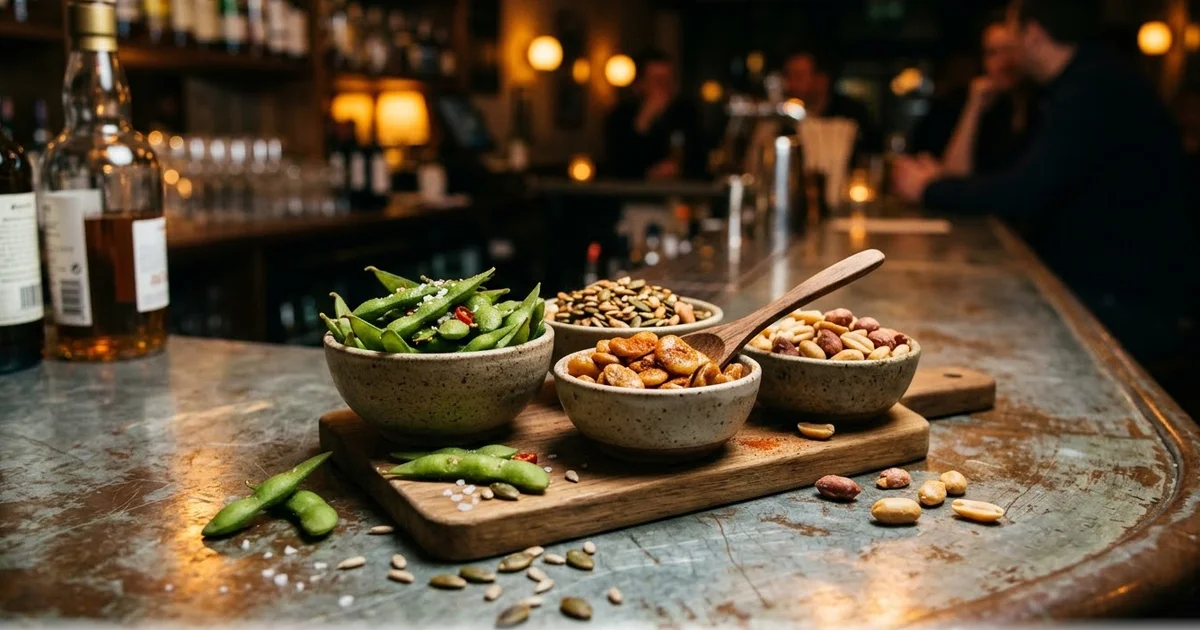
Bulk CHR aperitif snacking: edamame, broad beans, seeds
Bulk aperitif snacking for bars and restaurants: grilled edamame, roasted broad beans, seeds and mixes. Formats, portion cost and storage.
Aperitif snacking has now established itself as a distinct segment in the offerings of bars, brasseries and restaurants. Yet, at Palimex, this category started from a nearly blank page: no dedicated product was listed under the Snack & aperitif heading, even though the search for "grilled edamame" spontaneously ranked 13th in queries from our professional clients. This seemingly minor signal reflected a real and unmet demand among CHR businesses: to accompany bar service with dry, crunchy products that are easy to portion and profitable per ramekin.
This article outlines Palimex’s new aperitif snacking range, exclusively for professionals with a SIRET number: range composition, portion cost calculation, packaging formats suited to bar service, salt and seasoning management, crunch preservation and control of the tree nut allergen.
Why aperitif snacking is becoming essential for CHR businesses
Salted snacking served with drinks meets a specific operational need: to offer a standardised accompaniment at a low cost price, which enhances the average spend without complicating preparation. Unlike tapenade or a platter prepared in the kitchen, an aperitif mix or salted grilled edamame is served directly from the container to the ramekin, with no additional handling.
- Fast turnover: immediate consumption at the counter, no preparation or cooking required.
- Additional margin: a product with a low material cost that enhances the bar or brasserie bill.
- Service standardisation: each ramekin serves the same quantity, making margin calculation easier.
- Complementarity with the drinks menu: beer, wine, cocktails and aniseed aperitifs naturally pair with salty, crunchy products.
This historical lack of dedicated listings led us to consolidate a complete range, visible and coherent on the Snack & aperitif page, so that CHR establishments have a single entry point for their bulk snacking orders.
The Palimex aperitif snacking range: edamame, broad beans, wasabi peas, seeds and mixes
The range developed for this launch covers the most common uses observed among our CHR clients: bar accompaniment, counter display and aperitif baskets in the dining room. Each product was selected for its consistent size, crunch retention and compatibility with ramekin service.
| Product | Flavour profile | Recommended use in the dining room | Point of attention |
|---|---|---|---|
| Salted grilled edamame | Salty, roasted, crunchy texture | Beer and cocktail accompaniment | Soy allergen to be mentioned |
| Roasted broad beans | Salty, toasted notes | Aperitif basket, mixed platter | Sensitivity to ambient humidity |
| Wasabi peas | Spicy, strong | Cocktail bar, spirits pairing | Seasoning dosage varies by batch |
| Pumpkin and sunflower seeds | Neutral, slightly roasted | Base mix, vegetable basket | Optimal storage for 6 months after opening |
| Aperitif mixes | Composed, varies by recipe | Versatile service for all occasions | Check composition for tree nut allergens |
These five product families complement the other dehydrated lines available in the MEYVA range, whose sourcing follows the same size grading and batch traceability requirements as the entire Palimex catalogue.
Portion cost and ramekin economics: calculating profitability per bar service
The profitability of aperitif snacking is not measured per kilo, but per ramekin served. This is what we call "ramekin economics": relating the purchase price to the actual grams served per customer, to quantify the margin generated on this often underestimated item in bar cost accounting.
- Determine the average weight served per ramekin (generally between 25 and 40 g depending on the product and container used).
- Divide the purchase price per kilo by 1000 to obtain the cost per gram.
- Multiply this cost per gram by the average weight of the ramekin.
- Compare this portion cost to the number of services generated by the sale of associated drinks, to quantify the impact on the overall bar cover margin.
A 5 kg carton of salted grilled edamame, divided into 30 g ramekins, thus allows for precise calculation of the number of portions generated and the corresponding unit cost, without relying on an approximate estimate at the end of service.
At Palimex, we observe that bars which track their ramekin economics down to the gram significantly reduce snacking waste, simply because they adjust the ramekin size to the product served rather than using a single container for the entire range. A very spicy wasabi pea is served in smaller quantities than a neutral seed mix: the container must follow the flavour profile, not the other way around.
2 kg bucket formats and packaging suited to CHR bar service
The 2 kg bucket format was specifically chosen for the aperitif snacking range, in addition to standard cartons. It meets a need identified in the dining room: a resealable container that is easy to store behind the counter, which limits moisture absorption between services without requiring manual repackaging.
- Resealable 2 kg bucket: ideal for counter storage with quick access for service.
- Multi-bucket carton: grouping of several 2 kg units to reach the professional order threshold and optimise pallet/free delivery.
- Rotation per establishment: one bucket opened per week limits prolonged exposure to ambient air and preserves crunch.
In line with the entire Palimex B2B catalogue, the order can combine several 2 kg buckets within the same logistics carton. Preparation and delivery details are available on our dedicated page about bulk and carton packaging for CHR professionals.
Salt, seasoning and crunch control: choosing your aperitif range wisely
The salt level and type of seasoning largely determine the perceived quality of an aperitif snack. Edamame that is too salty masks the grilled flavour, while poorly dosed wasabi peas lose their taste appeal from the first bite. Crunch, meanwhile, depends directly on storage conditions between receipt and service.
- Prioritise seasoning that is homogeneous per batch, verifiable upon receipt with a quick visual and taste check.
- Avoid repackaging salted products in non-airtight containers: ambient humidity softens the crunch within hours.
- Store opened buckets away from direct light and bar heat, particularly near coffee machines or dishwashing areas.
- Always reseal the container after each service to limit seed and bean oxidation.
These simple steps, integrated into the service routine, significantly extend the commercial shelf life of an opened bucket and prevent product loss due to premature softening.
Shelf life, best-before date and tree nut allergen management in kitchens and bars
Shelf life management and traceability are part of HACCP obligations applicable to all establishments open to the public. Each product in the aperitif snacking range is delivered with a clearly indicated best-before date and a batch number for traceability in case of recall or customer complaint.
A particular point of attention concerns the tree nut allergen: some aperitif mixes and production lines share facilities with products containing almonds, hazelnuts or cashew nuts. This information must be communicated to customers in accordance with allergen labelling requirements in catering, a topic explored in depth on our page about allergen management in professional kitchens.
| Best practice | Operational objective |
|---|---|
| Keep the batch label until the container is empty | Traceability in case of inspection or complaint |
| Store at a stable temperature, protected from humidity | Maintain crunch and comply with the best-before date |
| Display the tree nut allergen notice in the dining room | Clear information for sensitive customers |
| Do not mix two different batches in the same service container | Maintain individual batch traceability |
For establishments wishing to explore regulatory references on allergen information, the ANSES provides useful general resources to complement the establishment’s internal procedures.
Optimising stock rotation for the aperitif snacking range in CHR businesses
Introducing an aperitif snacking range also requires integrating this new product line into the establishment’s overall stock management logic. A product that remains in storage too long loses its crunch, even when stored correctly, which justifies rigorous monitoring of ordered quantities relative to actual consumption observed during service.
- Order quantities consistent with the bar’s service rhythm, rather than stocking several months in advance.
- Adjust order frequency to the chosen format: a 2 kg bucket is consumed faster than a full carton.
- Cross-reference ramekin sales data with supplier orders to adjust the replenishment rhythm.
This monitoring work aligns with the principles detailed in our article on stock rotation for dried fruits and snacking in CHR businesses, applicable to all dry and dehydrated products in the catalogue.
Summary: sustainably structuring the aperitif snacking range in CHR businesses
The launch of this range meets a demand already present among professionals, revealed by the spontaneous ranking of grilled edamame in searches even before a dedicated category existed. The range built around salted grilled edamame, roasted broad beans, wasabi peas, pumpkin and sunflower seeds and aperitif mixes covers the main uses observed in bars and restaurants.
The profitability of this type of product is determined per ramekin, which requires precise calculation of the portion cost rather than a simple per-kilo price assessment. The 2 kg bucket format provides a logistical solution suited to daily service, while respecting storage rules, batch traceability and tree nut allergen labelling remains essential to ensure the establishment’s sanitary and regulatory compliance.
Further reading
Frequently asked questions
Everything you need to know about this topic.
A question?
Get in touch directly.

Marketing & Communications Manager — Palimex / Meyva
As Marketing & Communications Manager at Palimex / Meyva, Aude Moyne leads the company's communications and digital marketing strategy: editorial content, email campaigns and the promotion of its product ranges. Her experience at Palimex, a specialist in dried fruit, nuts, olives and spices for professionals, has given her in-depth knowledge of the products, their origins and uses, and the expectations of food-industry professionals. The blog articles are written or supervised by her, in collaboration with Palimex's sales and product teams whenever a topic calls for specific expertise.
Our advice related to Grocery & Recipes
 Grocery & Recipes
Épices de l'hiver : pain d'épices, vin chaud et pâtisserie de Noël, dosage et achat
Guide B2B des épices d'hiver pour boulangers, pâtissiers et CHR : dosages au kilo et au litre, mélanges vin chaud et pain d'épices, approvisionnement en gros.
 Grocery & Recipes
Nougat en meule : découpe à la coupe, conservation et vente au poids
Guide B2B pour épiceries et confiseries : réussir la découpe à la coupe du nougat en meule, limiter les pertes, maîtriser le stockage et l'affichage au poids.
 Grocery & Recipes
Seau d'olives entamé : durée de vie, saumure et gestion du reste
Comment conserver un seau d'olives entamé ? Rôle de la saumure, température, règles d'hygiène et gestion des tapenades : le guide professionnel Palimex.