
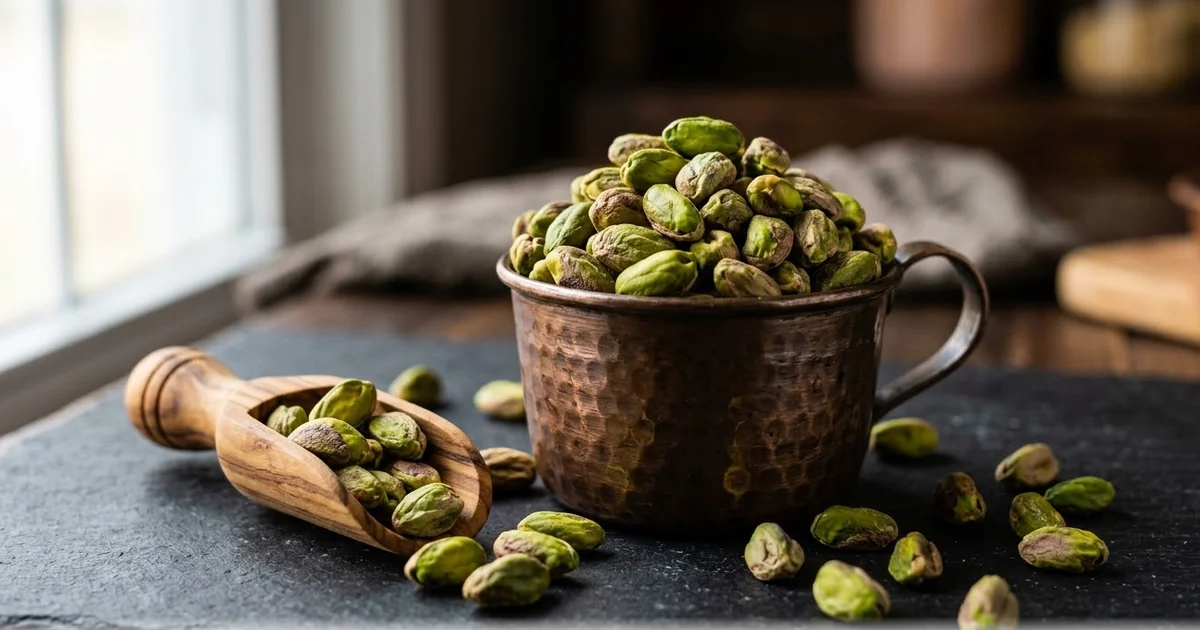
Raw Shelled Pistachio: Sizes and Professional Sourcing
Raw shelled pistachio: sizes, origins, raw/blanched difference and storage. Bulk purchase in 5 kg and wholesale for professional pastry chefs and ice cream makers.
Raw shelled pistachio is the most strategic raw material in any laboratory working with green color, crunch, or homemade pistachio paste. However, behind the same commercial name lie radically different realities in terms of size, origin, and processing, which directly affect the final result in pastry, chocolate-making, or ice cream production. This article details the raw product itself: sizes, origins, differences between raw, blanched, and roasted, paste yield, and storage rules in a professional environment.
Raw shelled pistachio: what exactly are we talking about in professional sourcing
In B2B sourcing, the term « shelled pistachio » refers to a nut whose shell has been mechanically removed, leaving the whole or semi-whole kernel still covered with its fine brownish-purple skin (the tegument). It is this raw kernel, not thermally treated, that constitutes the raw shelled pistachio.
This product differs from two other forms commonly offered to professionals:
- Blanched pistachio: the tegument has been removed, generally by scalding followed by drying, revealing the pure green flesh.
- Roasted pistachio: the raw or blanched pistachio has undergone dry cooking, which develops roasted aromas and a more crumbly texture.
The choice between these three states is never trivial in a laboratory: it determines preparation time, the color obtained in paste, and the stability of the finished product. This is why Palimex systematically documents the processing state on each product sheet and each delivery note.
Sizes of raw shelled pistachio: reading a supplier technical sheet
The size indicates the number of kernels per ounce (28.35 g) or per kilogram, depending on supplier practices. The lower the number, the larger the kernel. This data is crucial for a pastry chef or ice cream maker who must ensure consistent texture from one order to the next.
| Indicative size | Kernel size | Preferred professional use |
|---|---|---|
| 21/25 | Very large size | Whole decoration, visible plating, high-end mendiants |
| 25/29 | Large size | Nougatine, visible insertion in fine pastry |
| 28/32 | Standard size | Crushing, garnish, inclusion in biscuit-making |
| 32/36 and below | Fine size to pieces | Pistachio paste, dusting, coating, praline |
For use in paste (praline-style, ganache, ice cream), size is less important than freshness and fat content, since the kernel will be ground. However, for any visible decoration or inclusion, a homogeneous and documented size per batch is essential to ensure visual consistency across a production run.
Origins and sourcing: Iran, Turkey, USA — what differences in the laboratory
The global pistachio market relies on three main production basins, each with distinct characteristics that directly influence the product's behavior in the workshop.
- Iran: renowned for its long kernels and naturally vibrant green color, particularly sought after for pistachio paste and preparations where the final shade is as important as the taste.
- Turkey: often rounder pistachios, with a slightly milder aromatic profile, frequently offered in medium to fine sizes, well-suited for crushing.
- USA (California): large-scale standardized production, regular sizing, stable availability year-round, appreciated for batch consistency on large volumes.
The choice of origin therefore depends less on an absolute quality hierarchy than on the desired final use: color intensity for homemade paste, size consistency for decoration, or constant availability for series production. To explore concrete uses by profession, the pistachio for pastry chefs, bakers, and ice cream makers details applications recipe by recipe.
At Palimex, we observe the same pitfall every season in laboratories that change suppliers without checking the batch origin: a pistachio paste made with a fine size from a different origin than the previous order may turn duller, forcing the pastry chef to adjust the dosage of natural coloring. Our advice: set a reference origin for your signature recipes and only change it after testing in small quantities.
Raw or blanched pistachio: which choice based on laboratory use
The difference between raw and blanched pistachio is not just aesthetic. It involves a trade-off between preparation time, material cost, and final organoleptic result.
| Criterion | Raw pistachio | Blanched pistachio |
|---|---|---|
| Color | Duller green, brown tegument visible | Bright green, bare flesh |
| Necessary preparation | Blanching to be done in the lab if needed | Ready to use for decoration or grinding |
| Purchase cost | Generally lower | Generally higher (labor included) |
| Storage before processing | Better resistance to oxidation (protective tegument) | More sensitive to oxidation once bare |
| Typical use | Homemade pistachio paste, in-house roasting | Visible decoration, fine powder, visible inclusion |
Many laboratories choose to buy raw pistachio in bulk and perform blanching in-house just before use, which limits oxidation of the bare kernel and allows full control over the freshness of the finished product, particularly for pastes intended for ice cream.
Paste yield: calculating material cost with precision
Converting the raw kernel into pistachio paste involves material loss that must be factored into the cost calculation. This yield varies depending on the batch's moisture content, size, and grinding method.
- Weigh the raw batch upon receipt and check the moisture content declared on the technical sheet.
- Optional light roasting (additional water loss, generally a few percent).
- Progressive grinding until a smooth paste is obtained, with possible addition of neutral oil or sugar depending on the recipe.
- Weigh the obtained paste and calculate the raw material/final paste ratio to adjust the cost of future productions.
A batch of good-quality raw pistachios, properly roasted then ground, generally produces paste with a yield within a range known to industry professionals, but which must be verified internally with each batch or origin change, as differences can be significant.
Storage, oxidation, and best-before date: best practices in the laboratory
Shelled pistachio, due to its high content of unsaturated fat, is particularly prone to oxidation, which results in progressive rancidity that alters the taste even before the best-before date indicated on the packaging.
- Cool storage: prefer a temperate area, away from direct light, ideally under controlled temperature to slow oxidation.
- Airtight containers: repackage after opening the carton in sealed containers to limit contact with air and ambient humidity.
- Batch rotation (FIFO): organize storage on a first-in, first-out basis, using batch numbers and best-before dates indicated on each package.
- Freezing for buffer stock: for large volumes not quickly consumed, freezing the raw kernel preserves freshness beyond the standard ambient storage period.
- Regular visual and olfactory checks: a rancid smell or a color turning yellowish are the first signs of early oxidation, to be immediately discarded from production.
Batch traceability remains a cornerstone of the HACCP approach in the laboratory: each shelled pistachio delivery must be associated with its batch number, best-before date, and origin, documents that Palimex systematically provides for each professional delivery.
5 kg and bulk packaging: which format for which structure
The purchase format directly affects storage logistics and replenishment frequency. For professionals, two approaches coexist depending on the size of the structure and consumption rate.
| Format | Suitable structure | Main advantage |
|---|---|---|
| 5 kg carton | Artisan pastry, gourmet grocery, small caterer | Easy handling, gradual opening, less exposure to air |
| Bulk / 10-25 kg bag | High-volume laboratory, foodservice industry | Optimized unit cost, pallet/free delivery logistics |
For structures starting a pistachio-based range or testing a new origin, the 5 kg format allows securing product freshness without immobilizing too much stock. Workshops with high turnover will prefer bulk packaging, with pallet/free delivery, to optimize material cost on recurring orders. You will find all these formats in the Pastry Chefs & Artisans category of the site, dedicated to the specific needs of professional laboratories.
Responsible sourcing and traceability: key points to check when purchasing
Beyond size and origin, a professional purchase of raw shelled pistachio requires checking certain points before validating a bulk order.
- Availability of a technical sheet specifying size, origin, moisture content, and best-before date.
- Consistency between the announced size and intended use (decoration, paste, dusting).
- Supplier consistency over several seasons, to limit taste and yield variations from one batch to another.
- Delivery capacity in pallet/free format adapted to the laboratory's volume.
To place pistachio within the range of nuts and dried fruits available in professional sourcing, it may be useful to consult general resources on botanical classification and production areas, such as the Wikipedia page on pistachio trees.
Summary: how to choose your raw shelled pistachio in professional sourcing
Choosing a raw shelled pistachio is never just a simple order line. Size, origin, processing state (raw, blanched, roasted), and packaging form a coherent set that must align with the final use in the laboratory: visible decoration, homemade paste, inclusion in biscuit-making, or ice cream base. Good storage management, based on batch rotation and best-before date compliance, completes this approach and ensures the consistency of the finished product over time. For more on concrete uses by profession, see our dedicated article on pistachio for pastry chefs, bakers, and ice cream makers, as well as our full range in the Pastry Chefs & Artisans category.
Further reading
Frequently asked questions
Everything you need to know about this topic.
A question?
Get in touch directly.

Marketing & Communications Manager — Palimex / Meyva
As Marketing & Communications Manager at Palimex / Meyva, Aude Moyne leads the company's communications and digital marketing strategy: editorial content, email campaigns and the promotion of its product ranges. Her experience at Palimex, a specialist in dried fruit, nuts, olives and spices for professionals, has given her in-depth knowledge of the products, their origins and uses, and the expectations of food-industry professionals. The blog articles are written or supervised by her, in collaboration with Palimex's sales and product teams whenever a topic calls for specific expertise.
Our advice related to Grocery & Recipes
 Grocery & Recipes
Épices de l'hiver : pain d'épices, vin chaud et pâtisserie de Noël, dosage et achat
Guide B2B des épices d'hiver pour boulangers, pâtissiers et CHR : dosages au kilo et au litre, mélanges vin chaud et pain d'épices, approvisionnement en gros.
 Grocery & Recipes
Nougat en meule : découpe à la coupe, conservation et vente au poids
Guide B2B pour épiceries et confiseries : réussir la découpe à la coupe du nougat en meule, limiter les pertes, maîtriser le stockage et l'affichage au poids.
 Grocery & Recipes
Seau d'olives entamé : durée de vie, saumure et gestion du reste
Comment conserver un seau d'olives entamé ? Rôle de la saumure, température, règles d'hygiène et gestion des tapenades : le guide professionnel Palimex.