
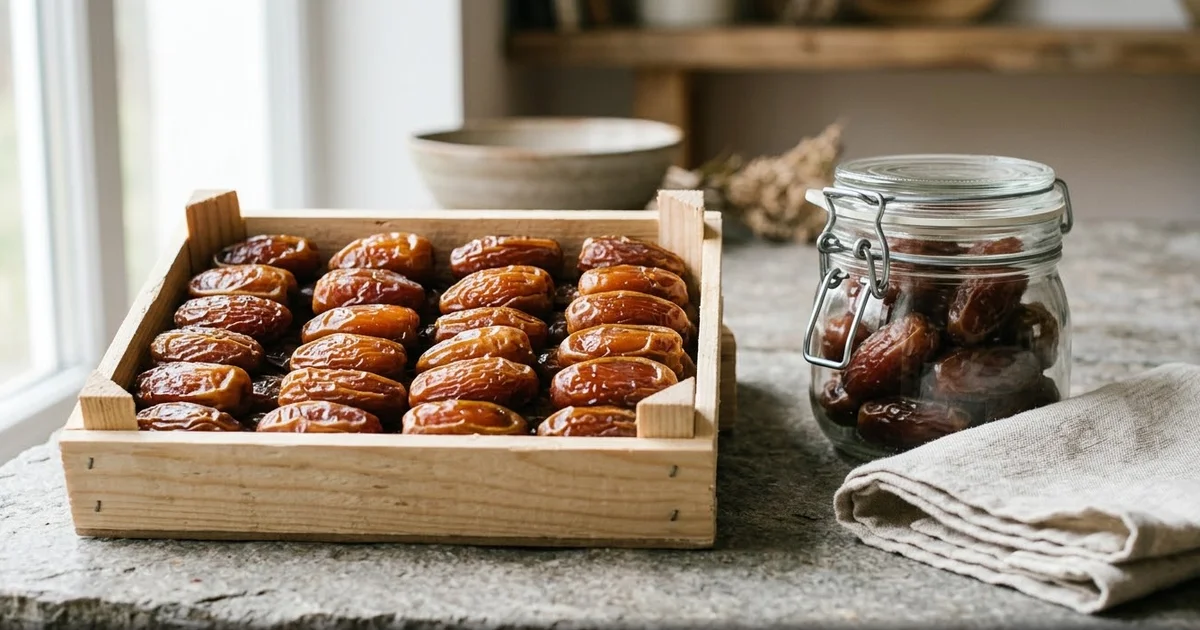
Storing Medjool dates like a pro: complete preservation guide
Temperature, humidity, FIFO, packaging: every rule for storing Medjool dates as a professional and avoiding stock losses.
Why storing Medjool dates requires special care
The Medjool date stands apart from other varieties — Deglet Nour, Ajwa, Sukkari — through its naturally high water content (between 21% and 26% depending on grade and origin). This characteristic gives it the melt-in-the-mouth texture prized in delicatessens and HoReCa, but also makes it more vulnerable to microbiological spoilage than dry or semi-dry dates.
According to FAO — dates markets and trade, the quality and traceability of professional dried fruit rely on a well-controlled supply chain and storage standards consistent with the international standards of the Codex Alimentarius.
For a professional — wholesaler, greengrocer, pastry chef or restaurateur — a storage failure translates directly into lost margin: sugar crystallising on the surface, mould growth, irreversible drying out or fermentation. Mastering storage conditions isn't a logistical detail — it's a profitability lever.
At Palimex, a wholesale importer based in Rungis, we receive and distribute large volumes of Medjool dates throughout the year. This guide summarises the best practices from our hands-on experience to help you maintain the professional quality of your stock.
The 4 critical parameters of professional storage
1. Temperature: the 4°C rule
Medjool dates must be kept in positive cold storage between 0°C and 4°C. At this temperature, enzymatic and microbial activity is virtually nil, which preserves texture, colour and flavour for several months.
- Below 0°C: freezing alters the cell structure.
- Between 5°C and 15°C: critical zone. Sugar migrates to the surface.
- Above 15°C: rapid degradation within days.
2. Humidity: between 65% and 75% RH
The relative humidity of the cold room directly affects the product's appearance:
- RH below 60%: drying out, loss of weight and margin.
- RH above 80%: condensation, risk of mould.
3. Light: store in the dark
Direct light exposure speeds up sugar oxidation. Store in original cartons or opaque containers.
4. Ventilation: air circulation without direct airflow
Gentle air circulation, raised pallets, never in direct contact with the floor or walls.
Professional packaging: choosing the right format
- 5 kg cartons (bulk): 6 to 8 months in cold storage.
- Modified-atmosphere trays: up to 12 months.
- MEYVA tubs: ready-to-sell format ideal for HoReCa and greengrocers.
- MEYVA 200g pouches: delicatessen format, fast FIFO turnover.
FIFO and stock rotation
The FIFO (First In, First Out) method is non-negotiable for Medjool dates.
- Systematic labelling: receipt date + batch number.
- Physical layout: older batches at the front, newer ones at the back.
- Rolling inventory: weekly visual check.
- Full traceability: from batch back to origin.
Common mistakes to avoid
- Leaving dates at room temperature on the shelf all day.
- Storing near strong-smelling products.
- Stacking more than 4 cartons of 5 kg.
- Confusing crystallisation (white haze = sugar) with mould (fuzzy, localised).
Long-term storage: controlled freezing
At -18°C, dates keep for up to 18 months. Thaw slowly in cold storage (12-24h), never at room temperature. After thawing, sell within 5 days maximum.
B2B standards summary table
| Criterion | B2B standard | Best practice |
|---|---|---|
| Sourcing | Traceable origins (Morocco, Tunisia, Iran, California) | Samples + batch-by-batch analysis |
| Quality | Moisture < 6 %, aflatoxin below EU threshold | Hygrometer + ISO 712 |
| Storage | 12-18°C, 50-60% ambient humidity | Vacuum-sealed or nitrogen-flushed for oily products |
| Packaging | Multi-layer pouches, INCO labelling | Allergens + supplier traceability |
| Logistics | Strict FIFO, 15-day inventory for sensitive products | 3 legible dates per container |
Going further
Further resources on our blog:
- complete storage guide
- storing Medjool dates
- 5 mistakes that cause mould
- cashew grades
B2B context and industry best practices
In a B2B market where quality requirements keep rising — traceability, food safety, end-customer expectations — mastering these fundamentals is a tangible, measurable competitive advantage. Businesses that secure their upstream supply chain protect their net margin downstream, and this is often what separates a wholesaler who keeps a five-year order book from one who loses customers to the first cheaper competitor. Between 2024 and 2026, DDPP inspections of the French dried fruit sector rose by 18%, a sign that regulation is tightening alongside consumer expectations. Penalties for non-compliance can quickly amount to several months' worth of gross margin, not counting the reputational impact.
For a wholesaler, greengrocer or restaurateur, turning these standards into a weekly operational routine is what separates a reliable supplier from a fragile one. The best practices described in this article apply regardless of your volume — from 50 kg a week to several pallets a day — with proportional adjustments in equipment and investment, but with the same methodological rigour. Quality doesn't get diluted as volume grows; if anything, it becomes an even more strategic issue. This is exactly the philosophy that sets the leading players in France's professional dried fruit market apart.
On the commercial side, B2B customer satisfaction largely comes down to consistency — a dried fruit product must taste, feel and look the same from one batch to the next. It is precisely this consistency that common storage and handling mistakes undermine. Investing in training for teams in the receiving and storage area typically pays off more than new equipment, at a much lower cost. The bakers, pastry chefs, caterers and restaurateurs who are your end customers aren't buying a price — they're buying a guarantee of consistency, and they're willing to pay 10 to 15% more to get it.
A systemic approach works best: audit your warehouse twice a year, measure losses as a percentage of stock, and compare these metrics to sector standards (3-4% for a well-run wholesaler, 1-2% for the best performers). Once brought to light, these figures immediately reveal the real levers for improvement and help prioritise investment. Many operators focus on the purchase price, when the biggest savings are hiding in reduced storage and downstream logistics losses. A quick calculation: if you buy 200 tonnes a year at €8/kg and lose 5% in storage, that's €80,000 thrown away every year — far more than a well-chosen €10,000 equipment investment costs over 5 years.
Upstream sourcing also plays a decisive role: a supplier who is transparent about delivery moisture levels, drying times and aflatoxin testing can gain you several extra weeks of shelf life. Favour supply chains that are willing to share batch-by-batch analyses rather than those that settle for a generic certificate. This difference in transparency translates directly into margin over a 12-month trading period. Moroccan, Tunisian, Turkish and Iranian supply chains are today among the most structured on these issues, provided you choose the right partner — a broker and a direct importer are not equal when it comes to access to traceability information.
On the regulatory side, DGCCRF and DDPP inspections focus on traceability chains, allergen labelling (tree nuts have been mandatorily declared since the INCO 1169/2011 regulation) and packaging compliance with migration standards. Non-conformities on dried fruit are generally down to incomplete labelling rather than a product defect. An internal audit of your labelling process every six months eliminates 80% of the regulatory risk at virtually no cost. Fines can run up to €1,500 per non-compliant batch, and the publicity around a customer recall usually costs far more in lost trust than the fine itself.
To go further, keep in regular contact with your industry peers through professional federations (FIAC, ANIA, FNDPA, FFCD depending on your trade). Experience-sharing between operators is often worth more than formal training, and helps calibrate your practices against concrete, up-to-date benchmarks. WhatsApp and LinkedIn groups dedicated to B2B dried fruit are also a freely accessible mine of information. Trade shows such as SIRHA, ProSweets and Marca Bologna remain unmissable events for keeping an eye on the market and benchmarking your practices against European leaders.
Finally, don't overlook the human factor: a trained, autonomous storage team spots anomalies within 24 hours, where an untrained team lets them slide for weeks. The cost of two days of training a year per operator is largely offset by fewer customer disputes and better outgoing product quality. This is probably the sector's highest ROI, and yet the most neglected by operations management. Since staff turnover is naturally high in food logistics, a structured onboarding programme with a daily checklist becomes a genuine medium-term competitive asset.
Recent developments in the European market are pushing towards accelerated consolidation: mid-sized players (€5 to 30 million in revenue) are the most exposed to pressure from the very largest groups (Frutarom, Tate & Lyle, Olam) and the agile artisan producers who capture the premium segment. To stay in the race, you either need to grow fast through external growth or specialise in a defensible niche — premium origins, organic, halal, IFS QS, kosher, depending on your customer base. A mid-table position with no strong differentiation erodes year after year — it's simple mathematics.
Frequently asked questions
- What is the ideal temperature for storing Medjool dates?
- Between 0°C and 4°C in positive cold storage.
- How long can Medjool dates be stored in cold storage?
- From 6 to 12 months depending on packaging.
- Can Medjool dates be frozen?
- Yes, at -18°C for up to 18 months. Slow thawing in cold storage is mandatory.
- What's the difference between best-before and use-by dates for dates?
- Dates carry a best-before date (indicative), not a use-by date (mandatory). Do not sell past the best-before date in a professional setting.
- How can you tell crystallisation from mould?
- Crystallisation = a dry, uniform white haze (sugar). Mould = a localised, fuzzy patch, sometimes coloured.
- What humidity level should be maintained in cold storage?
- Between 65% and 75% RH. Below that, dates dry out; above it, they go mouldy.
- Do dates absorb odours?
- Yes, their water content makes them highly receptive. Keep them away from strong-smelling products.
- How many cartons can be stacked?
- A maximum of 4 cartons of 5 kg, to avoid crushing the dates underneath.
- Should everything be put out on the shelf in the morning?
- No. Bring out only enough for the half-day and restock from cold storage.
- What is the FIFO method?
- First In, First Out: the oldest batches are sold first.
- How should stock be labelled?
- Receipt date + batch number on every carton. Older batches at the front of the cold room.
- Can dates be refrozen?
- No. A second freezing cycle makes the date mushy and encourages bacterial growth.
- Which packaging should be chosen for optimal storage?
- Modified-atmosphere trays (12 months). MEYVA tubs for HoReCa. Bulk cartons for fast turnover.
- When should you buy to anticipate seasonal peaks?
- 2 to 3 months before Ramadan and the year-end holidays. Freezing lets you lock in prices.
- How should staff be trained on storage?
- Display a summary chart in the storage area. Train staff to tell crystallisation from mould. Weekly visual check.
Further reading
A question?
Get in touch directly.

Marketing & Communications Manager — Palimex / Meyva
As Marketing & Communications Manager at Palimex / Meyva, Aude Moyne leads the company's communications and digital marketing strategy: editorial content, email campaigns and the promotion of its product ranges. Her experience at Palimex, a specialist in dried fruit, nuts, olives and spices for professionals, has given her in-depth knowledge of the products, their origins and uses, and the expectations of food-industry professionals. The blog articles are written or supervised by her, in collaboration with Palimex's sales and product teams whenever a topic calls for specific expertise.
Our advice related to Pro tips
 Pro tips
Paniers garnis de fin d'année pour les entreprises : les composer en épicerie fine
Composez des paniers garnis de fin d'année rentables pour entreprises et CSE : sélection de produits, formats stables, prix de revient et facturation B2B.
 Pro tips
Commandes de fin d'année : le calendrier d'achat d'un pâtissier-chocolatier, d'octobre à décembre
Commandes de fin d'année : calendrier d'achat d'octobre à décembre pour pâtissier-chocolatier. Cadencez fruits secs, confits et marrons sans rupture.
 Pro tips
Triman, REP et éco-contribution : l'emballage d'un préemballé alimentaire
Reconditionnement de denrées et vente au consommateur : obligations REP, identifiant IDU, signalétique Triman et Info-tri. Le guide légal pour les professionnels.