
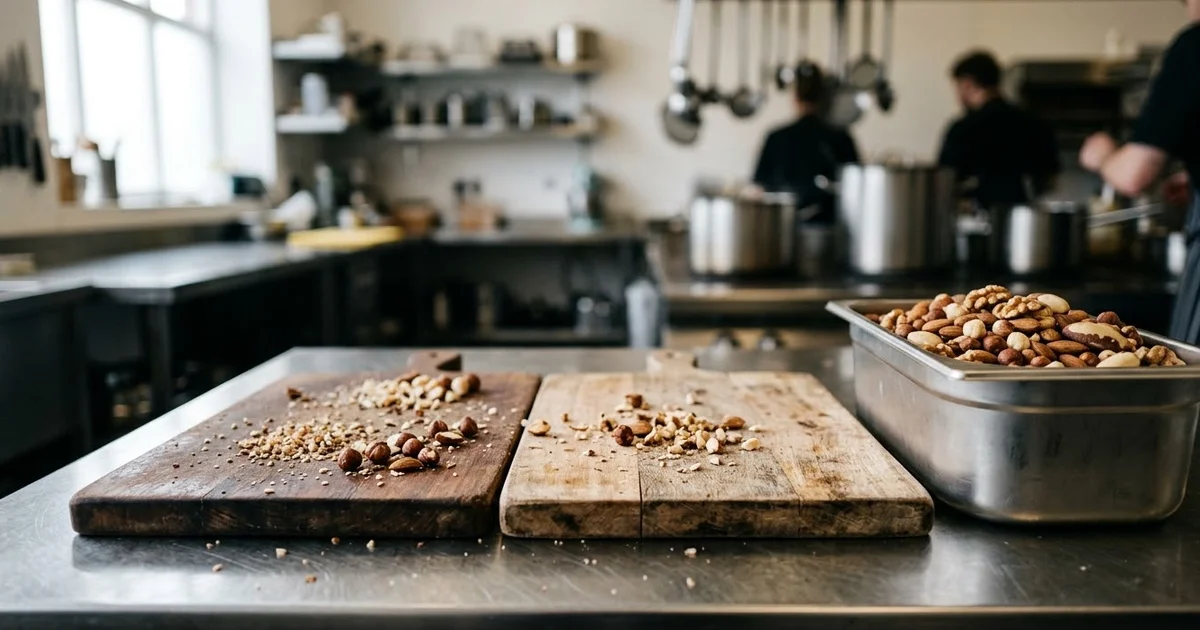
Contamination croisée fruits à coque : le plan de maîtrise en cuisine
Streamlined workflows, dedicated utensils, cleaning protocols, staff training, and traceability: a concrete cross-contamination control plan for nuts in professional kitchens.
The presence of nuts in a professional kitchen—almonds, hazelnuts, walnuts, pistachios, cashews—requires constant vigilance. These products are among the major allergens subject to mandatory declaration, and an uncontrolled trace can be enough to trigger a reaction in a sensitive customer. For restaurateurs, caterers, pastry chefs, and fine food retailers who process these raw materials in large volumes, the question is not whether a control plan is needed, but how to make it truly operational on a daily basis, workstation by workstation, without slowing down production.
Why nuts require a dedicated control plan in professional kitchens
The risk of cross-contamination with nuts is unique: it is not a microorganism that cooking destroys, but an allergenic protein that resists heat and is transmitted through contact—shell dust, grinding residue, airborne particles during crushing. A single poorly rinsed utensil or a shared work surface between a hazelnut preparation and a nut-free dough can be enough to transfer the allergen.
The most frequently identified points of vigilance in professional kitchens are as follows:
- Bulk storage of multiple nuts near other sensitive ingredients (flours, chocolates, shell-free dried fruits).
- Crushing and blending, which generate fine dust that settles on surrounding surfaces.
- Reusing the same utensil (whisk, spatula, sieve) between two preparations without intermediate cleaning.
- Transporting finished preparations on work surfaces not cleaned between services.
- Staff rotation between workstations without clear instructions on changing gloves or aprons.
An effective control plan relies on four complementary pillars: workflow separation, dedicated utensils, a validated cleaning protocol, and ongoing staff training. We detail each of these pillars below, with measures directly applicable in the field.
Workflow separation: organising space to isolate nuts
Physical workflow separation is the most structuring measure of a control plan. It involves defining zones and circuits that prevent any crossover between nuts and the rest of production, from receipt to plating.
In practice, this translates to:
- A dedicated storage area for nuts, if possible in a closed and labelled container, physically separated from other dried fruits and sweet groceries.
- A reserved preparation station when production volume allows, with a circulation flow that avoids re-entering "nut-free" zones without changing attire.
- Staggered production schedules: processing nut-based preparations at the end of service or in an isolated time slot, to limit the number of crossovers in a single day.
- Clear visual labelling of bins, shelves, and storage areas, so any new team member can immediately identify sensitive zones without asking.
- A check upon delivery receipt: verifying that the packaging of nuts has not been damaged during transport, a potential source of dust dispersion in the truck or warehouse.
For establishments lacking space for a fully dedicated zone, the intermediate solution is to process nuts at the very start or end of the production day, immediately followed by the full cleaning protocol described below. This temporal organisation can partially compensate for space constraints, provided it is applied without exception.
Dedicated utensils: what to duplicate and how to identify them
Dedicating utensils is often the weak link in the control plan: due to lack of equipment or habit, the same whisk or cutting board is used for multiple preparations. The table below summarises the equipment to prioritise for systematic duplication, and those that can remain shared subject to enhanced cleaning.
| Equipment | Recommended status | Justification |
|---|---|---|
| Blender / crusher | Dedicated if possible | Generates fine dust that is difficult to eliminate completely, even after cleaning |
| Cutting boards | Dedicated and colour-coded | Porous surface retaining micro-residues |
| Fine sieves and strainers | Dedicated | Mesh difficult to clean thoroughly between uses |
| Smooth metal spatulas and whisks | Shareable with reinforced cleaning | Smooth surface, effective cleaning if protocol followed |
| Intermediate storage bins | Dedicated and labelled | Prolonged contact with product, risk of delayed contamination |
| Scales and weighing surfaces | Dedicated zone or systematic cleaning after use | Direct handling station, high traffic frequency |
Colour coding remains the simplest tool to implement: assigning a unique colour (e.g., a set of cutting boards and bins in a reserved shade) to everything that touches nuts allows every team member, even on rotation or temporary support, to immediately identify authorised equipment without consulting a written procedure for every action.
Cleaning and disinfection protocol between productions
Cleaning is the most frequently underestimated critical point: visual cleaning does not eliminate the protein residues responsible for cross-contamination. The protocol must follow a precise and validated sequence, reproducible by any team member.
- Dry removal of all visible residues (dust, fragments, pieces) before any water contact, to avoid dispersing them in solution on other surfaces.
- Hot water wash with a degreasing detergent, focusing on corners, joints, and crevices of work surfaces and utensils.
- Thorough rinse with clear water to eliminate any detergent residue that could mask residual contamination.
- Disinfection with a product suitable for food contact, respecting the contact time indicated by the product manufacturer.
- Air drying or using single-use wipes, never with a cloth shared across multiple stations.
- Final visual check and, for high-traffic crossover stations, recording the operation on the station’s tracking sheet.
This protocol must be displayed visibly at each relevant station, in a concise format understandable in seconds, and not merely filed in a hygiene control plan binder consulted once a year during an inspection.
Staff training and allergen awareness culture
A control plan, no matter how perfectly written, remains ineffective if the team does not understand why every action matters. Training should not be limited to an onboarding session: it must be reactivated regularly, particularly with each change in production season or new staff arrival.
At Palimex, we deliver daily to professional kitchens that process nuts, dried fruits, and spices side by side on the same production lines. Our field feedback is consistent: cross-contamination incidents almost never stem from a lack of written procedure, but from a lapse during peak service, when a utensil "just this once" serves two different preparations. The most robust control plan is the one that remains applicable even on a Friday evening during service.
Key points to include in an ongoing training programme:
- Recap of major allergens present in the product ranges worked, with visual identification of relevant products in storage and production.
- Practical training on the cleaning protocol, rather than just reading the procedure.
- Clear instructions on changing aprons and gloves between a "nuts" station and an allergen-free station.
- Procedure to follow in case of doubt: whom to alert, how to isolate a suspect batch, how to document the incident.
- Awareness of reading product sheets and delivery notes, to immediately spot any allergen mention on new arrivals.
Training is more effective when it relies on concrete examples from the kitchen’s daily operations, rather than general principles that are difficult to apply. A concise display near each sensitive station, combined with an oral reminder in the service briefing, remains one of the most effective measures observed in the field.
Traceability, batch management, and labelling: the documentary link in the control plan
Beyond physical organisation, documentary traceability completes the system. Each batch of nuts received must be trackable from receipt to incorporation into a final preparation, to enable targeted withdrawal in case of a supplier alert or observed non-compliance.
- Retain delivery notes and associated batch numbers for each container, for the entire duration of product use and beyond, according to the applicable shelf life.
- Transfer the batch number to internal production sheets when the product is repackaged or processed, to maintain the link between raw material and final preparation.
- Check the best-before date upon each receipt and organise stock rotation on a first-in, first-out basis, to avoid any product nearing its date at the back of the shelf.
- Document every suspected contamination incident, even minor, to identify recurring trends at a specific station or time slot.
This documentary rigour naturally aligns with good practices for dried fruit stock rotation and best-before date management, as well as the general principles detailed in our article on HACCP best practices for food wholesalers. For further details on regulatory labelling, our guide on labelling the fourteen major allergens for professionals provides a useful complement to this control plan.
Control plan summary by workstation
To facilitate implementation, here is a summary of measures to apply according to the key workstations in a professional kitchen handling nuts.
| Workstation | Priority measure | Control frequency |
|---|---|---|
| Receiving / storage | Dedicated zone, visual packaging check, batch verification | With each delivery |
| Preparation / crushing | Dedicated utensils, isolated time slot if possible | With each production session |
| Cleaning between productions | Six-step protocol, recorded on tracking sheet | After each preparation change |
| Plating / final packaging | Dedicated or cleaned work surface, allergen labelling check | Before each service |
| Team training | Oral reminder in briefing, update with each new arrival | Ongoing, reactivated by season |
This table provides a starting framework, to be adapted according to the kitchen’s actual configuration, production volume, and product ranges. It is beneficial to complement it with a layout plan specific to each establishment, created with the team that uses the relevant stations daily. For teams also working with olives, spreads, or spices alongside nuts, it is useful to cross-reference this plan with our article on choosing bulk, cardboard, or foodservice packaging, to secure all kitchen workflows, not just the nut station.
For general regulatory guidance, professionals may find it useful to consult the public resources dedicated to allergen management in catering, available on the official DGCCRF portal, to situate this control plan within the general framework applicable to collective and commercial catering establishments.
Summary: a control plan that is actionable, not just written
Cross-contamination from nuts cannot be resolved by a single document consulted once a year. It is managed through daily organisation: separated workflows, clearly identified utensils, a cleaning protocol followed to the letter even during peak activity, continuously trained staff, and rigorous batch traceability. Professional kitchens that achieve the best results on this issue are those that translate these principles into simple actions, displayed in the right place, and that agree to regularly review their organisation as volumes or product ranges evolve. It is this practical, workstation-by-workstation approach that turns a theoretical control plan into real protection for your customers and your establishment.
Further reading
Frequently asked questions
Everything you need to know about this topic.
A question?
Get in touch directly.

Marketing & Communications Manager — Palimex / Meyva
As Marketing & Communications Manager at Palimex / Meyva, Aude Moyne leads the company's communications and digital marketing strategy: editorial content, email campaigns and the promotion of its product ranges. Her experience at Palimex, a specialist in dried fruit, nuts, olives and spices for professionals, has given her in-depth knowledge of the products, their origins and uses, and the expectations of food-industry professionals. The blog articles are written or supervised by her, in collaboration with Palimex's sales and product teams whenever a topic calls for specific expertise.
Our advice related to Pro tips
 Pro tips
Paniers garnis de fin d'année pour les entreprises : les composer en épicerie fine
Composez des paniers garnis de fin d'année rentables pour entreprises et CSE : sélection de produits, formats stables, prix de revient et facturation B2B.
 Pro tips
Commandes de fin d'année : le calendrier d'achat d'un pâtissier-chocolatier, d'octobre à décembre
Commandes de fin d'année : calendrier d'achat d'octobre à décembre pour pâtissier-chocolatier. Cadencez fruits secs, confits et marrons sans rupture.
 Pro tips
Triman, REP et éco-contribution : l'emballage d'un préemballé alimentaire
Reconditionnement de denrées et vente au consommateur : obligations REP, identifiant IDU, signalétique Triman et Info-tri. Le guide légal pour les professionnels.