
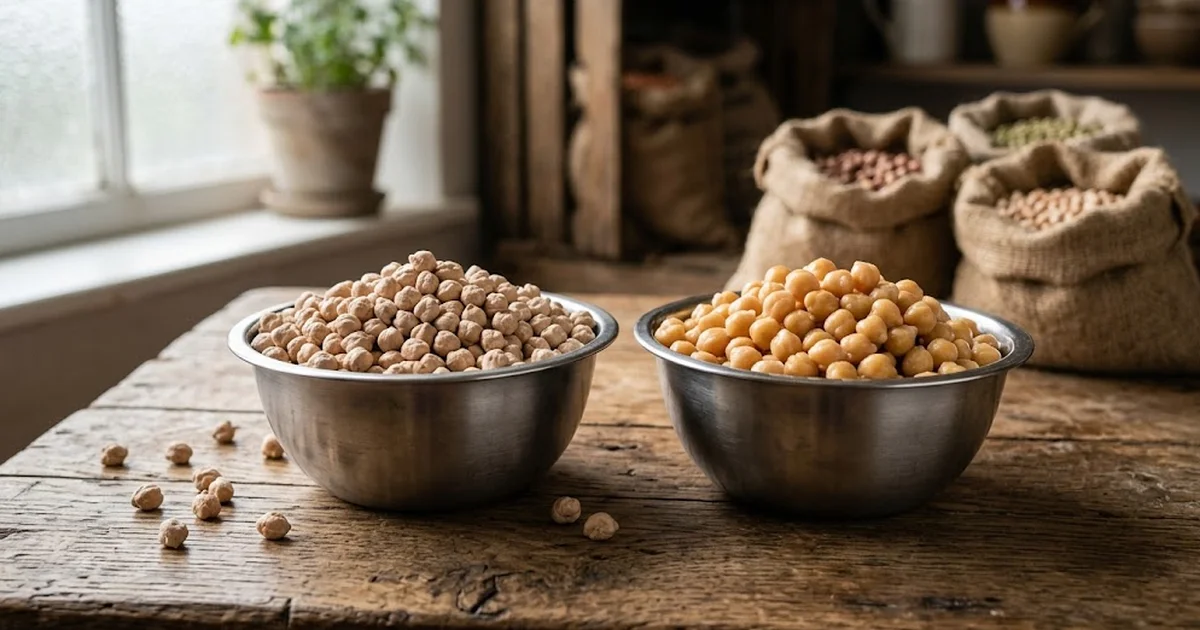
Légumes secs : du poids sec au poids cuit, rendements et coût portion
Rehydration coefficients, soaking, and cooking: the method for calculating the true per-portion cost of bulk-purchased dried vegetables, beyond the price per dry kilogram.
The price per dry kilogram is a pitfall for the professional buyer
Comparing two quotes for dried vegetables based solely on the price per dry kilogram is the most common mistake in B2B procurement. A chickpea, a lentil, and a white bean do not absorb the same amount of water, do not cook in the same time, and do not transform in the same proportions once cooked. The price displayed on a purchase order represents only half of the economic equation: the other half is the yield, meaning what that dry kilogram actually becomes once soaked and cooked.
For a restaurateur, a caterer, or a fine grocer building their technical sheet, ignoring this coefficient amounts to underestimating or overestimating the ingredient cost of a dish. On a pallet-ordered volume, the difference can represent several hundred euros per month.
- The dry weight is never the served weight: you must always reason in cooked weight to establish a reliable per-portion cost.
- Yield varies significantly depending on the type of dried vegetable (chickpea, lentil, bean) and the batch size.
- A higher price per dry kilogram can result in a lower final per-portion cost if the yield is better.
- Comparing suppliers only makes sense when based on the cost of the portion actually served on the plate.
Rehydration coefficients by type: chickpea, lentil, bean
Each type of dried vegetable has its own rehydration coefficient, i.e., the ratio between the cooked weight and the initial dry weight. This figure depends on the structure of the skin, the size of the grain, and the soaking time applied beforehand. Here are the key figures to remember when building your technical sheets.
| Type | Cooked weight / dry weight coefficient | Recommended soaking | Indicative cooking time |
|---|---|---|---|
| Chickpea | 2.2 to 2.5 | 10 to 12 hours at room temperature | 60 to 90 minutes in simmering water, 20 to 25 minutes in a pressure cooker |
| Green / brown lentil | 2 to 2.2 | No mandatory soaking, rinsing is sufficient | 20 to 25 minutes in simmering water |
| Red lentil | 2.3 to 2.5 | No soaking required | 8 to 12 minutes, mushy texture at the end of cooking |
| White / red bean | 2.5 to 3 | 8 to 12 hours at room temperature | 60 to 90 minutes in simmering water, 25 to 30 minutes in a pressure cooker |
These coefficients are average field values observed on standard batches; they vary slightly depending on the age of the harvest, the size, and the hardness of the cooking water used in the kitchen. For a larger-sized chickpea, the coefficient tends toward the upper end of the range; for a finer batch, toward the lower end.
Soaking and cooking time: the variables that drive yield
Soaking is not an optional step for chickpeas and beans: it directly determines the cooking time and, consequently, the texture obtained and the loss of material during cooking. A professional kitchen working with large volumes has an interest in standardizing this parameter to achieve consistent yield from one batch to another.
- Chickpea: insufficient soaking (less than 8 hours) extends cooking time by 20 to 30 minutes and results in uneven texture, with some grains remaining firm at the core.
- White and red bean: soaking reduces cooking time by about one-third and limits skin bursting, a sensitive point for preparations in salad or as a visible garnish.
- Green, brown, or red lentil: no soaking is necessary; prolonged soaking can, on the contrary, cause the grain to burst before cooking.
- Cooking water: hard water significantly extends the cooking time of chickpeas and beans; adding a small amount of bicarbonate during soaking can offset this effect.
- Salt: salting the cooking water from the start hardens the skin of thick-skinned legumes; it is preferable to add salt at the end of cooking to preserve yield and grain integrity.
For volumes in institutional or foodservice kitchens, it is recommended to track these parameters (soaking duration, water type, cooking method) in the dish’s technical sheet to secure ingredient costs from one week to the next, regardless of the chef on duty.
Calculating the real cost of a served portion: method and worked example
The per-portion cost calculation relies on a simple formula, provided you know the yield coefficient of the type in question. The method involves determining the dry weight needed to obtain the served cooked weight, then applying the price per dry kilogram to this dry weight.
Formula: dry weight needed = served cooked weight ÷ yield coefficient.
Per-portion cost = dry weight needed × price per dry kilogram.
Let’s take an illustrative example with a chickpea with a yield coefficient of 2.3 and a fictitious price per dry kilogram of €3.20 for demonstration purposes:
| Data | Value |
|---|---|
| Target served cooked portion | 200 g |
| Chickpea yield coefficient | 2.3 |
| Dry weight needed (200 ÷ 2.3) | ≈ 87 g |
| Price per dry kilogram (example) | €3.20 |
| Ingredient cost of the portion | ≈ €0.28 |
This same method applies to any type: simply replace the coefficient with that of the lentil or bean to obtain a comparable per-portion cost between suppliers, regardless of their pricing presentation. It is this figure, not the price per kilogram displayed on the purchase order, that should appear in your technical sheet and serve as the basis for margin calculation.
At Palimex, we regularly see buyers comparing two quotes based solely on the price per dry kilogram, without factoring in the actual yield of the batch. A chickpea with a homogeneous size, properly soaked, often results in a more advantageous per-portion cost than a cheaper batch that is more heterogeneous when cooked. Our advice: always ask for the size and origin of the batch before comparing prices, and test the cooking on a small volume before committing to a pallet order.
Stock rotation, bulk packaging, and best-before date: optimising professional procurement
Beyond yield, the real cost of a portion also depends on upstream stock management. A poorly stored dried vegetable loses rehydration quality even before being cooked, which extends cooking times and reduces the yield observed in the kitchen.
- Store dried vegetables in a dry location, protected from humidity and temperature fluctuations, to preserve the grain’s water absorption capacity.
- Respect the best-before date indicated on each batch and apply the FIFO (first in, first out) principle to avoid stock ageing in storage.
- Adapt packaging to the establishment’s actual turnover: cases of bags or a bucket suit a kitchen with regular turnover, while a pallet order is justified for higher-volume operations or to consolidate a delivery with free shipping.
- Document the batch number upon receipt to ensure HACCP traceability and quickly identify a batch in case of yield discrepancies observed in the kitchen.
An older dried vegetable requires longer soaking and increased cooking time, which can lower the yield coefficient. This is a point of vigilance to consider when choosing a supplier, particularly for kitchens operating on tight margins with low-margin recipes.
Practical applications in foodservice, pastry, and fine grocery
Knowing the yield coefficient is not only useful for calculating a per-portion cost: it also allows you to size orders based on the establishment’s actual culinary uses.
- Institutional catering and foodservice: for hummus or chickpea salad, calculating the dry weight allows you to precisely anticipate weekly needs and avoid stockouts or overstocking.
- Event catering: the yield coefficient of white beans is critical for sizing a cassoulet or garnish served in large quantities.
- Fine grocers: knowing the cooking yield helps advise professional customers on the appropriate packaging to order based on the intended use.
- Pastry and snacking: red lentils, with their quick cooking time and high yield, are suited to just-in-time preparations like composed bowls or hot garnishes.
To further explore the management of legume and dry grocery families in professional procurement, also check out our resources on the storage and best-before date of dried vegetables, on bulk ordering for foodservice and restaurateurs, on bulk spices for professionals, and on pallet delivery and free shipping logistics.
Summary: yield, the key figure in any bulk purchase of dried vegetables
The price per dry kilogram is only part of the information needed for a well-informed professional purchase. The yield coefficient, specific to each type of dried vegetable, is the figure that transforms a purchase price into a real per-portion cost, comparable between suppliers and usable in a technical sheet. Soaking, cooking time, water quality, and batch age influence this coefficient and should be monitored with the same rigour as the price displayed on the purchase order. By incorporating this parameter into your margin calculations, you secure your bulk purchases and have an objective argument for choosing between multiple supplier offers. For any questions about size, packaging, or the availability of our dried vegetable batches, the Palimex team is available during the opening hours of the Rungis warehouse.
To supplement this approach with reference nutritional data, the public database Ciqual by Anses allows you to consult the composition of cooked and raw dried vegetables.
Further reading
Frequently asked questions
Everything you need to know about this topic.
A question?
Get in touch directly.

Marketing & Communications Manager — Palimex / Meyva
As Marketing & Communications Manager at Palimex / Meyva, Aude Moyne leads the company's communications and digital marketing strategy: editorial content, email campaigns and the promotion of its product ranges. Her experience at Palimex, a specialist in dried fruit, nuts, olives and spices for professionals, has given her in-depth knowledge of the products, their origins and uses, and the expectations of food-industry professionals. The blog articles are written or supervised by her, in collaboration with Palimex's sales and product teams whenever a topic calls for specific expertise.
Our advice related to Pro tips
 Pro tips
Paniers garnis de fin d'année pour les entreprises : les composer en épicerie fine
Composez des paniers garnis de fin d'année rentables pour entreprises et CSE : sélection de produits, formats stables, prix de revient et facturation B2B.
 Pro tips
Commandes de fin d'année : le calendrier d'achat d'un pâtissier-chocolatier, d'octobre à décembre
Commandes de fin d'année : calendrier d'achat d'octobre à décembre pour pâtissier-chocolatier. Cadencez fruits secs, confits et marrons sans rupture.
 Pro tips
Triman, REP et éco-contribution : l'emballage d'un préemballé alimentaire
Reconditionnement de denrées et vente au consommateur : obligations REP, identifiant IDU, signalétique Triman et Info-tri. Le guide légal pour les professionnels.