
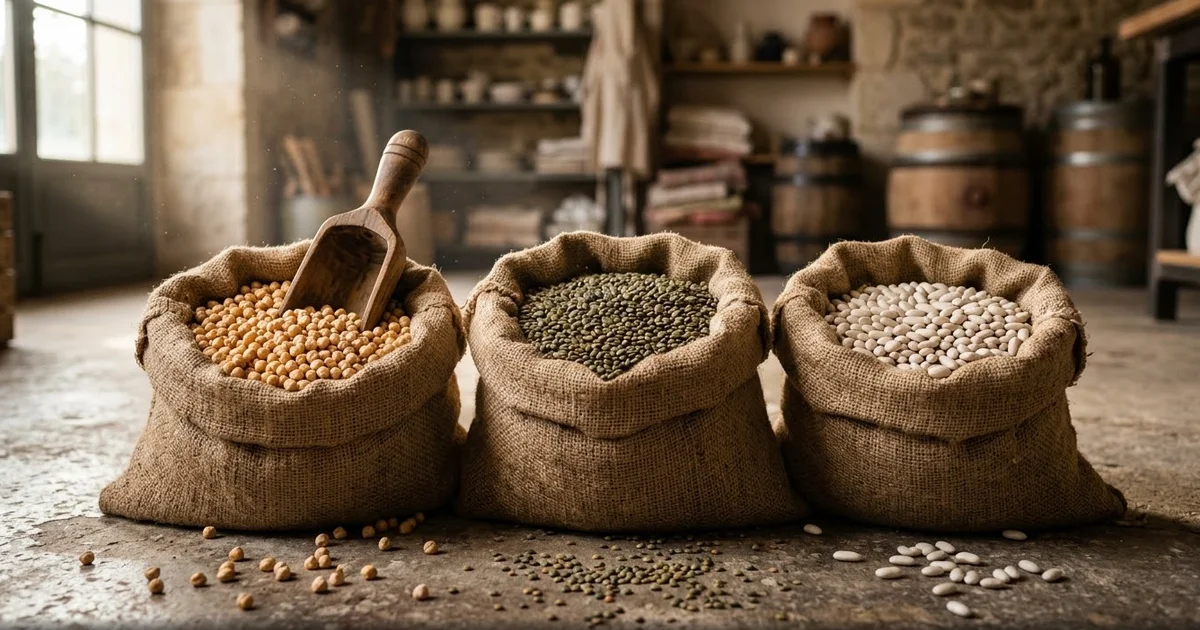
B2B dried vegetables wholesaler: chickpeas, lentils, beans
Bulk dried vegetables for foodservice: chickpeas, lentils, beans. Calibres, soaking, yield and 5 kg and 25 kg pack sizes.
The dried vegetables section is a cornerstone of the B2B food offer for any catering establishment, fine grocery or catering business. Chickpeas, lentils and dried beans are among the most ordered references by professionals, thanks to their price stability, long shelf life and culinary versatility. This article details the available families, the calibres to know, soaking and the yield from dry weight to cooked weight, cooking in collective catering, as well as storage conditions and packaging formats suited to professional use.
The families of dried vegetables available from a professional food wholesaler
A specialised wholesaler offers several families of legumes, each with its varieties, calibres and specific culinary uses. Knowing these families well allows you to adjust orders according to the recipes served in professional kitchens.
- Chickpeas: available in several calibres expressed in millimetres (generally 7/8 mm, 8/9 mm and 9/10 mm), used in hummus, composed salads, stewed dishes or falafels.
- Green lentils: versatile, hold their shape when cooked, ideal as a side dish or warm salads in collective catering.
- Red lentils: no soaking required, quick cooking, used in purées, veloutés and oriental or Indian cuisines.
- Beluga lentils: small black calibre, firm texture, highly sought after in gastronomy and plate presentation in high-end foodservice establishments.
- White beans (lingot, coco): cassoulet, stews, traditional brasserie dishes.
- Red beans: chili con carne, Tex-Mex cuisine, composed salads.
- Coco beans: melting texture, used in soups and regional stewed dishes.
To discover the full range and detailed product sheets, consult the dried vegetables category in the Palimex professional catalogue.
Calibres of chickpeas and selection criteria for professional catering
The calibre of a chickpea or lentil directly affects soaking time, cooking stability and the final presentation on the plate. A professional must choose their calibre based on the intended culinary use.
| Product | Calibre / type | Indicative soaking time | Main culinary use |
|---|---|---|---|
| Chickpea 7/8 mm | Small calibre | 8 to 12 h | Hummus, flours, falafels |
| Chickpea 9/10 mm | Large calibre | 8 to 12 h | Salads, whole stewed dishes |
| Green lentil | Medium calibre | No soaking required | Side dish, warm salads |
| Red lentil | Hulled | No soaking required | Purées, veloutés, spiced cuisines |
| Beluga lentil | Small black calibre | No soaking required | Gastronomic presentation, garnish |
| White bean (lingot) | Large calibre | 10 to 12 h | Cassoulet, stews |
| Red bean | Medium calibre | 8 to 10 h | Chili, Mexican dishes |
These soaking indications are field benchmarks intended to guide planning in the kitchen; they may vary depending on the freshness of the batch and the hardness of the water used.
Soaking and yield from dry weight to cooked weight: a decisive data for your technical sheets
For a professional buyer, the yield from dry weight to cooked weight directly determines the calculation of food cost and the portion size served on the plate. A dried vegetable absorbs water during soaking and cooking, which multiplies its initial weight.
| Dried vegetable | Dry weight | Approximate cooked weight | Multiplication coefficient |
|---|---|---|---|
| Chickpea | 1 kg | 2.2 to 2.5 kg | x 2.2 to x 2.5 |
| Green lentil | 1 kg | 2.2 to 2.4 kg | x 2.2 to x 2.4 |
| Red lentil | 1 kg | 2.5 to 2.8 kg | x 2.5 to x 2.8 |
| White bean | 1 kg | 2.3 to 2.6 kg | x 2.3 to x 2.6 |
| Red bean | 1 kg | 2.2 to 2.5 kg | x 2.2 to x 2.5 |
This data is essential for establishing an accurate technical sheet, calculating portion cost and anticipating the quantities to order in bulk. A calculation error in yield directly impacts the margin of a dish on the menu.
At Palimex, we regularly observe that professional kitchens underestimate the swelling coefficient of legumes when calculating their technical sheets. Our recommendation: always test the yield on a received batch before finalising a technical sheet, as the origin and harvest season can slightly vary water absorption.
Cooking in collective catering: optimising production and consistency of dried vegetables
In collective catering, cooking dried vegetables must meet requirements for consistency, yield and production pace management. Here are the recommended points of vigilance for large-scale production.
- Perform group soaking the day before for chickpeas and beans, in a water volume at least three times greater than the volume of dried legumes.
- Change the soaking water if the duration exceeds 12 hours, to limit fermentation.
- Favour cooking in unsalted water at the start of cooking for beans, with salt added at the end of cooking to avoid hardening the skin.
- Use large-capacity cooking pots or production braising pans to homogenise cooking for large volumes.
- Plan a cooking time adapted to the calibre: large calibres of chickpeas and white beans generally require more time than small calibres.
- Quickly cool cooked legumes in case of advance production, in accordance with HACCP best practices for rapid cooling in collective catering.
To further explore volume preparation methods, also consult our article on olives in collective packaging, which addresses comparable production logics.
Storage of dried vegetables in a professional warehouse: weevils, humidity and stock rotation
Storing dried vegetables is a major challenge for fine groceries, wholesale distributors and professional kitchens. Poor humidity management or stock rotation can lead to weevil infestation or loss of organoleptic quality.
- Store dried vegetables in a dry place, away from direct light and significant temperature variations.
- Maintain a low humidity level to limit the development of insects such as weevils, which are particularly sensitive to humid environments.
- Use airtight containers after opening a bag or box, to limit contact with ambient air.
- Apply strict stock rotation according to the first in, first out (FIFO) method, based on the best-before date indicated on each package.
- Isolate any batch suspected of infestation and regularly check the condition of old stocks, particularly in summer when ambient humidity increases.
- Maintain traceability of received batches to meet the internal HACCP monitoring requirements of the establishment.
In the field, we recommend to our professional clients never to repack an opened box of dried vegetables in a non-airtight container, even for short-term storage. This is often when weevil contamination starts, which is difficult to control once established in a warehouse.
For more details on general conservation principles applicable to the entire dry catalogue, see our dedicated article on professional storage of dried fruits.
5 kg and 25 kg packaging formats: which choice for your professional activity
The choice of packaging format directly depends on the turnover volume, storage capacity and order frequency of your establishment. Palimex offers its dried vegetables in professional formats suited to each B2B buyer profile.
| Format | Suitable buyer profile | Main advantage | Point of vigilance |
|---|---|---|---|
| 5 kg | Independent restaurant, fine grocery, small-scale caterer | Order flexibility, lower storage commitment | Slightly higher cost per kilo compared to the 25 kg format |
| 25 kg | Central kitchen, collective catering, wholesale distributor, food industry | Optimisation of food cost, less handling per kilo delivered | Requires dry storage capacity and regular rotation |
For bulk orders, delivery in full pallets or free delivery is offered according to the order thresholds defined with your professional account. This logistics organisation ensures supply security while controlling transport costs.
- 5 kg format: suited to regular but measured consumption, limits the risk of stock-outs for low-turnover references.
- 25 kg format: recommended for high-turnover establishments, allowing unit cost smoothing over large volumes.
Find all available packaging on the bulk dried vegetables category sheet, as well as ordering procedures on our page dedicated to B2B orders and pallet delivery.
Sourcing and batch quality: what a professional must check before ordering
Beyond calibre and format, the quality of a batch of dried vegetables depends on several criteria that any professional buyer should check before confirming an order.
- The consistency of the calibre within the same batch, ensuring even cooking in the kitchen.
- The absence of foreign bodies, excessive broken grains or abnormal moisture traces.
- The harvest date or origin season, which influences cooking time and water absorption rate.
- The traceability of the batch, essential for the establishment's internal HACCP documentation.
- The consistency between the packaging (5 kg or 25 kg) and the actual turnover frequency in the kitchen, to avoid overstocking.
To explore the nutritional challenges of legumes in catering, you can consult the public resources of ANSES, which documents the contributions of legumes in the diet.
Summary: choosing your dried vegetables wholesaler for professional catering
Choosing a dried vegetables wholesaler relies on several combined criteria: the diversity of families offered (chickpeas, green, red and beluga lentils, white, red and coco beans), the precision of available calibres, the reliability of yield data from dry weight to cooked weight, and the ability to deliver in 5 kg and 25 kg professional formats with pallet logistics suited to kitchens and groceries. Rigorous storage management, particularly weevil prevention and humidity control, completes these criteria to ensure stable raw materials over time. By integrating these parameters into your technical sheets and purchasing planning, your establishment secures both its margin and the consistency of its culinary preparations.
Further reading
Frequently asked questions
Everything you need to know about this topic.
A question?
Get in touch directly.

Marketing & Communications Manager — Palimex / Meyva
As Marketing & Communications Manager at Palimex / Meyva, Aude Moyne leads the company's communications and digital marketing strategy: editorial content, email campaigns and the promotion of its product ranges. Her experience at Palimex, a specialist in dried fruit, nuts, olives and spices for professionals, has given her in-depth knowledge of the products, their origins and uses, and the expectations of food-industry professionals. The blog articles are written or supervised by her, in collaboration with Palimex's sales and product teams whenever a topic calls for specific expertise.
Our advice related to Pro tips
 Pro tips
Paniers garnis de fin d'année pour les entreprises : les composer en épicerie fine
Composez des paniers garnis de fin d'année rentables pour entreprises et CSE : sélection de produits, formats stables, prix de revient et facturation B2B.
 Pro tips
Commandes de fin d'année : le calendrier d'achat d'un pâtissier-chocolatier, d'octobre à décembre
Commandes de fin d'année : calendrier d'achat d'octobre à décembre pour pâtissier-chocolatier. Cadencez fruits secs, confits et marrons sans rupture.
 Pro tips
Triman, REP et éco-contribution : l'emballage d'un préemballé alimentaire
Reconditionnement de denrées et vente au consommateur : obligations REP, identifiant IDU, signalétique Triman et Info-tri. Le guide légal pour les professionnels.