
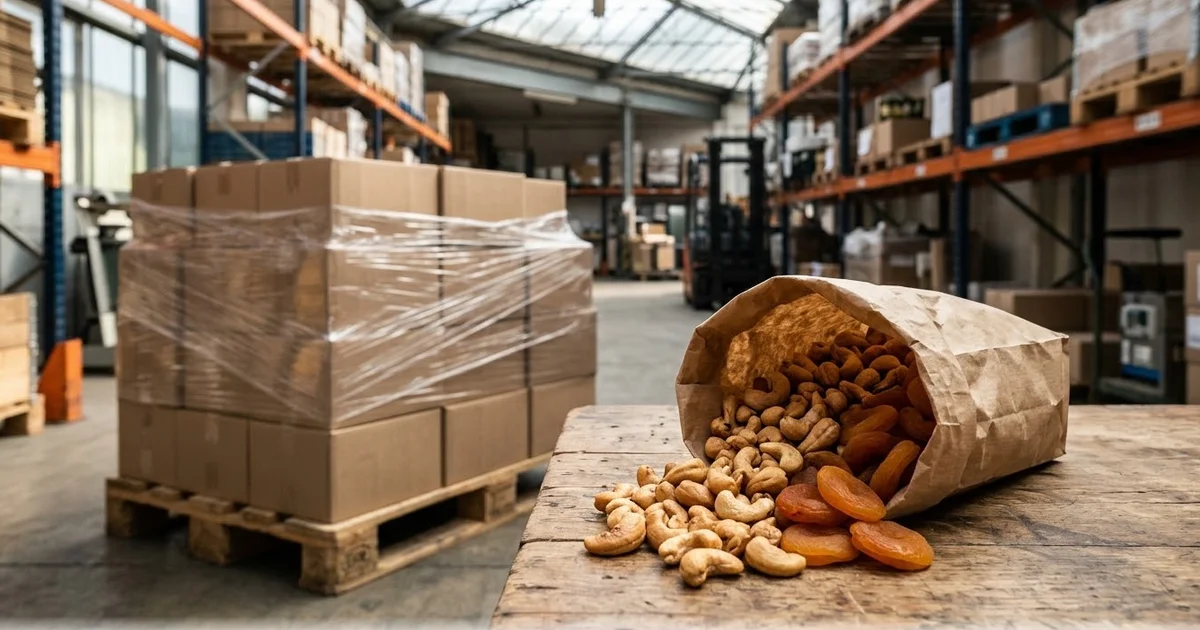
Free Delivery and Pallet Shipping: Bulk Order Guide
Free delivery, pallet shipping, order consolidation: how to structure your professional purchases to reduce logistics costs and secure receipt.
Placing a bulk order is not just about choosing the right references and the right sizes. A significant part of the final cost—and satisfaction upon receipt—depends on logistics: free delivery, shipping method, deadlines, and package inspection. For a professional ordering in cartons or pallets, understanding these mechanisms helps optimize each order, reduce the logistics cost per kilogram delivered, and avoid unpleasant surprises during unloading. This article details how free delivery works, reference consolidation, the specifics of pallet shipping, and best practices for receipt.
What is free delivery and why does this threshold exist in B2B food wholesaling
Free delivery refers to the order threshold from which shipping costs are covered by the supplier rather than billed to the customer. This mechanism is not arbitrary: it reflects the actual cost of shipping bulk goods, which depends on weight, volume, and the distance traveled by the carrier.
For a food wholesaler working with carton and pallet packaging, several reasons explain the existence of a free delivery threshold:
- Optimizing palletized shipping: a full truck or an optimized pallet costs proportionally less per kilogram than a small isolated package.
- Encouraging order consolidation: the threshold incentivizes professionals to consolidate their needs rather than multiply small orders.
- Securing the supplier's margin: without a threshold, each low-volume shipment would generate a disproportionate logistics cost relative to the order amount.
- Stabilizing carrier planning: consolidated orders allow for better route and delivery slot organization.
The exact amount of the free delivery threshold, as well as any variations based on the delivery zone, are specified in the general terms and conditions and on the quote provided when placing the order. This point is essential: rather than relying on an estimate, it is always necessary to verify the applicable threshold at the time of ordering, especially when price changes or specific delivery zones come into play.
How to calculate the free delivery threshold for your order
The free delivery threshold is generally based on a pre-tax order amount, sometimes combined with a weight or pallet volume criterion. For a professional buyer, it is useful to plan ahead rather than at the time of validating the cart.
Here is the method to follow to assess whether an order meets the free delivery threshold:
- Identify the cumulative pre-tax amount of all references added to the cart, including dried fruits, dehydrated fruits, spices, and olives ordered together.
- Check whether the threshold applies per order or per delivery, especially in the case of split orders to multiple addresses.
- Take into account any specific conditions related to the delivery geographical area (some areas may have a different threshold or terms).
- Consult the quote or order confirmation, which precisely indicates the remaining amount to reach to benefit from free delivery.
If in doubt about the threshold applicable to your sector (foodservice, fine grocery, pastry) or delivery zone, it is preferable to request a personalized quote rather than relying on a general estimate. This allows adjusting the order—in volume or references—before validation, and avoids last-minute changes that could delay shipment.
Consolidating orders and pooling references across product families
Pooling references is the most concrete lever to reach the free delivery threshold without overstocking a single category unnecessarily. Instead of ordering dried fruits, spices, and olives separately, it is often more cost-effective to consolidate these needs into a single order.
Some practical ways to structure this consolidation:
- Plan a monthly or bimonthly order rather than frequent small restocks, taking into account the actual stock rotation of each reference.
- Combine product families: pairing high-turnover dried fruits (almonds, nuts, raisins) with slower-moving spices or olives helps reach the threshold without excess stock on a single line.
- Coordinate needs across multiple points of sale within the same chain or purchasing group to consolidate a single pallet order rather than several split orders.
- Anticipate best-before dates (BBD) to avoid over-ordering a reference solely to reach the threshold, risking stock rotation issues.
To refine this approach, it is useful to consult the recommendations available on bulk packaging for dried fruits or on professional spice storage, to adjust the ordered quantities to the actual rotation of each reference.
At Palimex, we regularly observe that the most logistically efficient orders are those built across multiple product families rather than on a single reference artificially pushed to reach a threshold. A professional who consolidates dried fruits, spices, and olives in a single order optimizes both transport and cash flow, without disrupting stock rotation. Our field advice: build your order around your actual rotation schedule, not just the free delivery threshold.
Pallet shipping: tail lift, dock, appointment scheduling—what to anticipate
Once the free delivery threshold is met, the order is generally shipped on a pallet. This shipping method requires specific organization on the receiving end, different from a standard package delivery. Two main configurations exist depending on the delivery site's equipment.
| Shipping method | Required configuration | Points of attention |
|---|---|---|
| Dock delivery | Site equipped with a loading dock adapted to the truck's dimensions | Time slot to be confirmed with the carrier, heavy vehicle access to be checked in advance |
| Tail lift delivery | Site without a dock, unloading at ground level via tail lift | Requires clear access to the vehicle and sometimes additional handling time |
| Appointment scheduling | Time slot set in advance between the customer and the carrier | Essential for foodservice and city-center locations where heavy vehicle parking is restricted |
Some points to anticipate before delivery, especially for establishments in urban areas or with restricted access:
- Check the availability of a person authorized to receive and sign the delivery note when the carrier arrives.
- Confirm whether the site has a dock or requires a tail lift, information to be provided when placing the order.
- Prepare a temporary storage space near the unloading point to avoid double handling.
- Report any access constraints (pedestrian street, restricted delivery hours, limited parking) when validating the order.
This information allows the carrier to organize their route without on-site delays, reducing the risk of delivery postponement.
Bulk delivery deadlines: planning ahead without relying on general estimates
Delivery deadlines for professional orders depend on several factors: batch availability in stock, seasonality of certain references from sourcing, delivery distance, and chosen shipping method (full pallet, groupage, dedicated delivery). Rather than providing a standard deadline, it is recommended to always refer to the order confirmation or quote, which indicates the actual deadline applicable to the order placed.
Factors that affect bulk delivery deadlines:
- Immediate or delayed availability of the batch corresponding to the ordered reference, especially for seasonal products.
- The order volume: a full pallet may require different transport organization than a partial order.
- The delivery geographical area, with some areas served on fixed delivery days.
- Access constraints reported by the customer (dock, tail lift, mandatory appointment).
For an urgent order or stock replenishment before a busy period (end-of-year holidays, summer season in foodservice), it is advisable to contact the sales department directly to obtain a precise deadline rather than a general range. This approach avoids stock rotation issues, particularly for high-demand references discussed in our article on anticipating stock rotation.
Receipt inspection and notes on the delivery note: the reflex that protects your stock
Receiving a pallet order is a step that should not be treated as a formality. A thorough inspection at this stage protects the establishment in case of transport anomalies, breakage, or quantity discrepancies, and determines the possibility of making a subsequent claim.
Here are the steps to follow systematically when receiving a bulk delivery:
- Check the number of packages or cartons delivered against the delivery note before signing.
- Inspect the visual condition of the pallet and cartons (intact stretch film, no signs of moisture or impact).
- Verify the correspondence between the ordered references, quantities, and batch numbers indicated on the cartons to ensure HACCP traceability.
- Check the best-before dates (BBD) affixed to the packaging, especially for slow-moving products.
- If any anomalies are found (missing package, damaged carton, reference discrepancy), write a precise and handwritten note directly on the delivery note before the carrier's signature.
- Take a photo of the disputed items and keep a copy of the delivery note with the note.
- Report the anomaly to customer service as soon as possible after receipt, attaching the annotated delivery note.
A vaguely worded note ("subject to unpacking") has limited value in case of a dispute. It is preferable to detail the anomaly precisely: number of missing packages, affected reference, nature of visible damage. This documentary rigor facilitates the processing of any compensation or reshipment request.
For establishments subject to regular health inspections, this receipt inspection step is also part of the traceability process required by health authorities. Detailed resources on hygiene and traceability best practices in commercial catering are available on the website of the ministry responsible for agriculture.
To further explore document management related to batches and post-receipt storage, also consult our article on batch traceability in a professional environment.
Summary: structuring your order to reduce logistics costs
Optimizing a bulk order is not just about selecting references in a cart. It requires understanding how free delivery works, precisely calculating the applicable threshold via the quote, pooling product families to consolidate a single pallet delivery, and anticipating unloading constraints (tail lift, dock, appointment). Finally, thorough receipt inspection, with precise notes on the delivery note in case of anomalies, remains the best protection for the purchasing establishment.
If in doubt about a threshold, deadline, or specific delivery method for your geographical area, the most reliable approach is to request a personalized quote rather than relying on a general estimate. This ensures an adjusted order, controlled logistics costs, and a hassle-free receipt.
Further reading
Frequently asked questions
Everything you need to know about this topic.
A question?
Get in touch directly.

Marketing & Communications Manager — Palimex / Meyva
As Marketing & Communications Manager at Palimex / Meyva, Aude Moyne leads the company's communications and digital marketing strategy: editorial content, email campaigns and the promotion of its product ranges. Her experience at Palimex, a specialist in dried fruit, nuts, olives and spices for professionals, has given her in-depth knowledge of the products, their origins and uses, and the expectations of food-industry professionals. The blog articles are written or supervised by her, in collaboration with Palimex's sales and product teams whenever a topic calls for specific expertise.
Our advice related to Pro tips
 Pro tips
Paniers garnis de fin d'année pour les entreprises : les composer en épicerie fine
Composez des paniers garnis de fin d'année rentables pour entreprises et CSE : sélection de produits, formats stables, prix de revient et facturation B2B.
 Pro tips
Commandes de fin d'année : le calendrier d'achat d'un pâtissier-chocolatier, d'octobre à décembre
Commandes de fin d'année : calendrier d'achat d'octobre à décembre pour pâtissier-chocolatier. Cadencez fruits secs, confits et marrons sans rupture.
 Pro tips
Triman, REP et éco-contribution : l'emballage d'un préemballé alimentaire
Reconditionnement de denrées et vente au consommateur : obligations REP, identifiant IDU, signalétique Triman et Info-tri. Le guide légal pour les professionnels.