
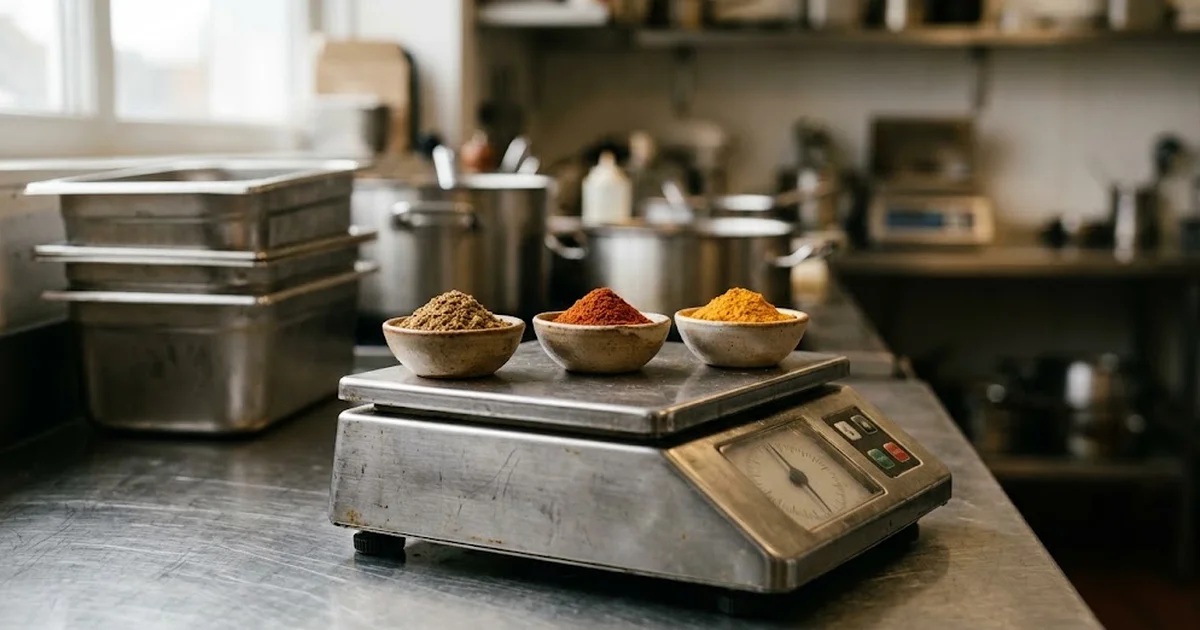
Doser les épices en cuisine collective : grammage par portion
Spice weight guidelines for 200 covers: portion-based dosing, volume scaling, spiciness, bitterness, and standardisation. Practical guide for large-scale catering.
In large-scale catering and contract catering kitchens, spice dosing is not a matter of approximation. A recipe that works perfectly for 6 or 10 covers can become unrecognisable—too spicy, too bland, or outright bitter—once scaled up by twenty or thirty for a 200-cover service. This article is aimed at professionals in large-scale catering, event caterers, and central kitchen chefs who purchase spices in bulk and must ensure consistent flavour across large volumes, batch after batch, service after service.
Why portion-based weight is everything in large-scale catering
Portion-based weight is the only reliable unit of measurement when working with professional volumes. Unlike a home recipe where spices are measured “by eye” or “by the spoonful,” large-scale catering requires a reproducible method that can be passed on to an entire team and applied consistently from one production day to the next.
Portion-based weight allows you to:
- Guarantee a consistent taste experience regardless of which chef is on duty that day;
- Accurately forecast procurement needs and bulk orders;
- Reduce waste from systematic over-dosing as a precaution;
- Simplify the calculation of food cost per dish, a key factor in large-scale catering;
- Ensure traceability of batches used, a central requirement in HACCP procedures.
Without stabilised portion weights, each volume increase becomes a gamble. This is precisely where the most common risk lies for caterers transitioning from artisanal kitchens to mass production: they maintain proportions designed for small quantities without accounting for the fact that the organoleptic behaviour of spices does not scale linearly with volume.
Scaling from a homemade recipe to a 200-cover service: what’s at stake
Transposing a recipe designed for a small group to a 200-cover service is not as simple as applying a basic multiplication factor. Several physical and sensory phenomena come into play when preparation volumes increase: extended cooking times, different thermal mass, altered evaporation surface, and, most importantly, uneven dilution or concentration of aromatic compounds depending on the dish’s texture.
A common example among event caterers: a curry or tagine prepared in a 5-litre pot for a tasting test, then reproduced in an 80-litre vat for the actual service. The longer simmering time in large volumes concentrates certain aromas while diminishing others, particularly the volatile notes of freshly ground spices.
- Fine ground spices (chili, turmeric, paprika) release their compounds more quickly in large liquid volumes: the spiciness may seem more pronounced after long cooking.
- Whole seed spices (cumin, coriander, mustard) require longer contact time to properly infuse a large preparation mass.
- Blends containing tannins or peels (cinnamon sticks, cloves) risk bitterness if cooking time is extended without adjusting the initial weight.
The golden rule in large-scale catering is to always conduct an intermediate scaling test—for example, at 50 covers—before finalising the weight for 200 covers, rather than extrapolating directly from a 10-portion recipe.
Reference weight table by spice family and portion count
Below is an indicative weight table per portion for the most commonly used spice families in large-scale catering. These values are starting points to be adjusted based on the recipe, cooking method, and desired spice level in your establishment.
| Spice family | Indicative weight per portion | Equivalent for 50 covers | Equivalent for 200 covers |
|---|---|---|---|
| Ground cumin | 0.5 to 1 g | 25 to 50 g | 100 to 200 g |
| Sweet or smoked paprika | 0.5 to 1.5 g | 25 to 75 g | 100 to 300 g |
| Ground turmeric | 0.3 to 0.8 g | 15 to 40 g | 60 to 160 g |
| Mild or hot chili (powder) | 0.2 to 0.5 g | 10 to 25 g | 40 to 100 g |
| Ground cinnamon | 0.3 to 0.6 g | 15 to 30 g | 60 to 120 g |
| Ras-el-hanout-style blend | 1 to 2 g | 50 to 100 g | 200 to 400 g |
These weights should be verified and adjusted during your production tests, particularly based on the type of dish (liquid sauce, dry marinade, stuffing) and the profile of your regular diners. For corresponding orders, the bulk packaging available in our catalogue covers multiple services without stockouts, with a format tailored to large-scale catering volumes.
Spiciness, bitterness, aroma: how volume distorts perception
A well-known phenomenon among central kitchen chefs but often underestimated by less experienced teams: the perception of spiciness and bitterness does not scale linearly with preparation volume. Several factors explain this non-linearity.
First, the contact surface between the spice and fat or liquid changes with production scale. In large volumes, the capsaicinoids responsible for chili’s spiciness have more time and surface area to diffuse into the fat, which can intensify the perceived sensation at the end of cooking compared to a small-scale test with the same cooking time.
Next, the bitterness of certain spices—peels, whole toasted seeds, some blends based on turmeric or fenugreek—becomes more pronounced when cooking is extended, which is frequently the case in large-scale catering where dishes simmer longer to achieve even cooking temperatures across large quantities.
- Systematically conduct a tasting midway through cooking during scaling tests, not just at the end of preparation.
- Reduce the weight of spices high in bitter compounds by 10 to 15% when cooking time exceeds 45 minutes in large volumes.
- Add the most volatile spices (freshly ground pepper, certain chili powders) at the very end of cooking to preserve their aromatic intensity rather than just residual spiciness.
- Document each adjustment in a production technical sheet to build on experience from one service to the next.
At Palimex, we regularly receive questions from caterers reporting that a spice blend “worked very well in the test kitchen but becomes too strong once scaled up to production vats.” Our field feedback, after multiple discussions with our foodservice and event catering clients: never finalise a weight based on a single small-scale test. Scaling up alters the perception of spiciness and bitterness, and only an intermediate test at 50 or 80 covers can secure the dosage before a 200-cover service or more.
Standardising a spice blend for large-scale catering
Standardisation is the step that moves beyond trial and error to ensure reproducibility from one service to the next. It involves fixing a spice blend in set proportions, packaged and labelled uniformly, rather than composing each blend on the fly in the kitchen.
For central kitchens and caterers producing regular volumes, using a pre-prepared blend offers several concrete advantages:
- Reduces preparation time in the kitchen by avoiding individual weighing of each spice for every service;
- Lowers the risk of dosing errors during peak activity or staff rotation;
- Guarantees consistent flavour across multiple production sites using the same batch;
- Simplifies stock management, with a single product to order instead of six or seven separate SKUs.
When working with standardised bulk blends, it is essential to retain the composition sheet and batch number for each supply to trace information in case of reported taste variations from kitchen teams. This practice aligns directly with HACCP traceability requirements applicable to all large-scale catering. Our dedicated range for bulk spices for bakers and artisans offers packaging designed for this standardisation approach, with homogeneous batches delivered on pallets.
Storage, stock rotation, and HACCP traceability for bulk spices
Precise dosing only makes sense if the spices used retain their aromatic profile from one service to the next. However, storing spices in bulk packaging presents specific challenges not encountered with small-quantity purchases: prolonged air exposure, temperature variations in storage areas, and sometimes slow stock rotation for less frequently used SKUs.
To preserve the aromatic intensity of your spices from order receipt to kitchen use, a few simple principles should be systematically applied:
- Store ground spices in airtight containers, away from direct light and the humidity of the dishwashing area;
- Follow the FIFO (first in, first out) method to prevent an old batch from lingering at the back of storage while new deliveries are used first;
- Systematically check the best-before date indicated on each package upon goods receipt and include it in your HACCP traceability log;
- Avoid repackaging spices in unlabelled containers, which complicates information tracking in case of non-compliance detected in a dish;
- Plan orders based on the actual rotation of each SKU, rather than maintaining uniform stock across the entire catalogue.
Stock rotation directly impacts the quality of the final dosage: a spice stored too long loses aromatic intensity, often leading kitchen teams to instinctively increase the weight to compensate—risking unbalancing the standardised recipe. For regular large-scale catering volumes, it is generally preferable to order smaller quantities more frequently than to build up dormant stock. Our guide to storing spices in large-scale catering details these best practices step by step.
From a regulatory standpoint, the general hygiene principles applicable to large-scale catering, particularly regarding raw material traceability, are available from the relevant health authorities, for example on the website of the French Agency for Food, Environmental and Occupational Health & Safety.
Organising bulk orders to secure dosing over time
Once the standardised weight is validated, the next challenge is to secure procurement to maintain consistent flavour in your dishes throughout the season. In large-scale catering, a stockout of a key spice often forces last-minute substitution with a different SKU, disrupting the established weight and introducing a noticeable variation for diners.
A few recommendations for organising bulk spice orders in line with your production needs:
- Establish an order schedule based on your actual average monthly consumption, spice by spice;
- Prioritise pallet/free delivery for high-turnover SKUs to minimise logistics costs per kilo;
- Maintain a safety stock margin equivalent to one to two weeks of production, without exceeding available airtight storage capacity;
- Group orders for multiple spice families to optimise free delivery on the same shipment.
For event caterers whose volumes vary significantly from month to month depending on bookings, it is advisable to anticipate orders as soon as a contract for over 100 covers is confirmed, rather than waiting until the week before the event. Our team regularly supports professionals in the sector with this type of bulk order planning for foodservice.
Summary: mastering spice dosing, from test kitchen to 200-cover service
Dosing spices in large-scale catering is never just a mechanical multiplication of a starting recipe. Portion-based weight must be established progressively, validated through intermediate scaling tests, and adjusted to account for the evolution of spiciness and bitterness specific to large cooking volumes. Standardising blends, combined with rigorous storage and stock rotation management, ensures the consistent flavour essential to any central kitchen or event catering operation. Finally, logistics tailored to bulk orders—packaging, pallet delivery, needs anticipation—remains the final critical link to ensure that this carefully calculated weight translates, service after service, into a dish that meets your diners’ expectations.
Further reading
Frequently asked questions
Everything you need to know about this topic.
A question?
Get in touch directly.

Marketing & Communications Manager — Palimex / Meyva
As Marketing & Communications Manager at Palimex / Meyva, Aude Moyne leads the company's communications and digital marketing strategy: editorial content, email campaigns and the promotion of its product ranges. Her experience at Palimex, a specialist in dried fruit, nuts, olives and spices for professionals, has given her in-depth knowledge of the products, their origins and uses, and the expectations of food-industry professionals. The blog articles are written or supervised by her, in collaboration with Palimex's sales and product teams whenever a topic calls for specific expertise.
Our advice related to Pro tips
 Pro tips
Paniers garnis de fin d'année pour les entreprises : les composer en épicerie fine
Composez des paniers garnis de fin d'année rentables pour entreprises et CSE : sélection de produits, formats stables, prix de revient et facturation B2B.
 Pro tips
Commandes de fin d'année : le calendrier d'achat d'un pâtissier-chocolatier, d'octobre à décembre
Commandes de fin d'année : calendrier d'achat d'octobre à décembre pour pâtissier-chocolatier. Cadencez fruits secs, confits et marrons sans rupture.
 Pro tips
Triman, REP et éco-contribution : l'emballage d'un préemballé alimentaire
Reconditionnement de denrées et vente au consommateur : obligations REP, identifiant IDU, signalétique Triman et Info-tri. Le guide légal pour les professionnels.