
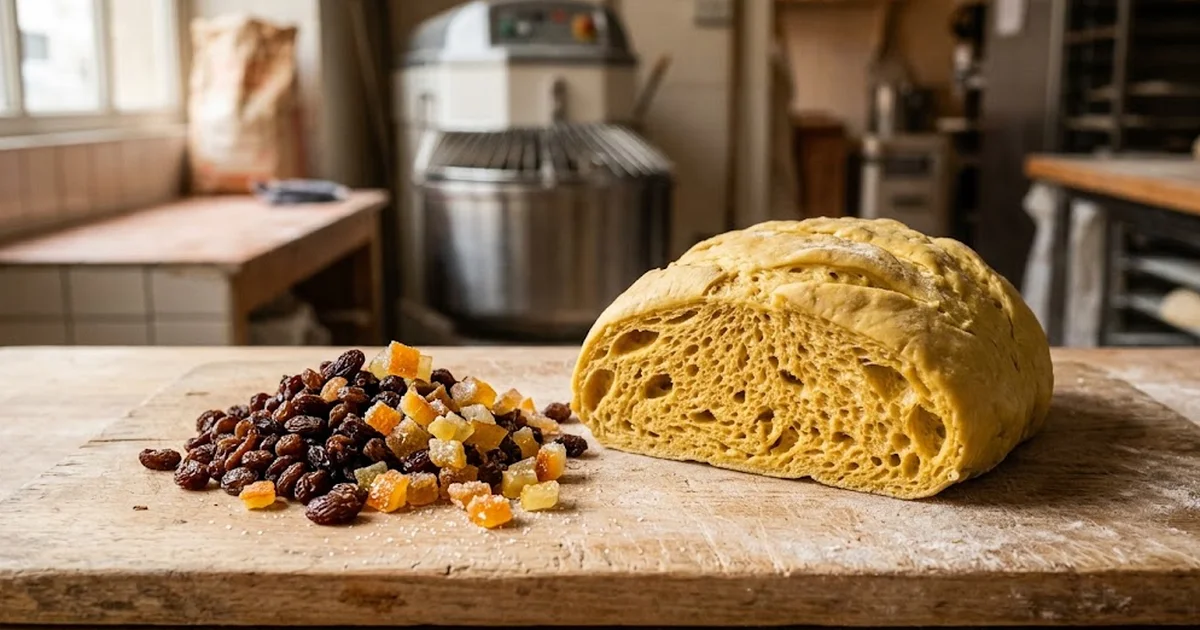
Boulangerie : raisins et écorces confites en pâte levée
Rehydration, dosage, timing of addition, and sugar's effect on yeast: a technical guide to incorporating dried and candied fruits into leavened dough without disrupting fermentation.
Achieving success with fruit bread, filled brioche, or viennoiserie with candied peel is not just about lamination or shaping: it hinges on the incorporation of dried and candied fruits into the leavened dough. A poorly rehydrated raisin, peel added too early, or an underestimated dosage of candied fruits can disrupt fermentation, slow proofing, or unbalance the final texture. This technical article is aimed at professional bakers working in volume who seek to secure their process, from receiving batches to oven output.
Why dried and candied fruits weaken fermentation in baking
Raisins, candied orange or lemon peel, and dehydrated fruits introduce sugar, variable residual moisture, and sometimes acidic compounds that directly interact with yeast activity. In leavened dough, this interaction is not neutral: it can locally accelerate fermentation around inclusions, create areas of over-hydration, or conversely dry out the dough if the fruits have not been sufficiently rehydrated before incorporation.
- Free surface sugar: candied fruits release sugar upon contact with the dough's moisture, which can locally inhibit yeast through osmotic pressure if the dosage is too high.
- Non-rehydrated dried fruits: overly dry raisins absorb water from the dough during kneading and the first proof, unbalancing overall hydration.
- Residual acidity: some candied peels or fruits dehydrated in syrup retain slight acidity that can slow gluten network development if not properly managed.
Understanding these mechanisms allows for process adjustments rather than enduring inconsistent results from one batch to another, a central issue for workshops using bulk dried fruits for baking.
Rehydrating raisins and candied peel: method and dosage before incorporation
Rehydration is the most frequently overlooked step in the workshop, yet it directly determines dough consistency and even distribution of fruits in the crumb. A properly rehydrated raisin will not draw water from the dough during proofing; well-drained candied peel will not introduce excess syrup that could over-hydrate the dough.
- Soak raisins in lukewarm water (30 to 35°C) for 15 to 20 minutes, never in hot water that would cook the skin.
- Drain thoroughly on a fine sieve, then pat dry with a clean cloth to remove excess surface moisture.
- For candied peels, prefer a quick rinse in lukewarm water followed by extended draining to remove surface syrup without completely desalting the fruit.
- Weigh fruits after rehydration, not before: the wet weight is what matters for calculating the dough's total hydration.
This protocol applies to both golden raisins and currants, available in cardboard or bulk packaging for pastry chefs and delivered in formats compatible with regular workshop production.
Timing of addition during kneading: preserving the gluten network and proofing
The order in which dried and candied fruits are incorporated during kneading directly impacts gluten structure and thus the dough's ability to retain carbon dioxide produced by fermentation. Adding fruits too early exposes the developing gluten network to repeated mechanical friction that weakens it; adding them too late can create uneven pockets.
"At Palimex, we systematically recommend to our bakery customers to incorporate raisins and candied peels at the very end of kneading, on low speed, once the gluten network is already developed. This simple adjustment prevents most issues with sticky dough or under-proofing reported by our foodservice and artisan clients."
In practice, this means:
- Knead the base dough (flour, water, yeast, salt, optional sugar) until a supple and elastic gluten network is achieved.
- Add rehydrated and drained fruits at the end of kneading, for a maximum of one to two minutes, on low speed.
- Avoid extended kneading after incorporation, which would crush the fruits and release their sugar uncontrollably into the dough.
Effect of sugar from candied fruits on yeast activity: understanding and compensating
Sugar serves as both a nutrient for yeast and, beyond a certain threshold, an osmotic barrier to its activity. Candied fruits, rich in free sugar, can create micro-zones of high sugar concentration in the dough, locally slowing fermentation even if the overall recipe remains within reasonable proportions.
| Type of fruit | Indicative sugar content | Effect on yeast | Recommended adjustment |
|---|---|---|---|
| Rehydrated raisins | Moderate, diluted by rehydration water | Limited effect if well drained | No major adjustment necessary |
| Candied orange peel | High, significant surface sugar | Possible local slowdown around pieces | Slightly reduce added sugar in the base recipe |
| Fruits dehydrated in syrup | Variable by batch | Effect depends on residual syrup level | Enhanced draining before incorporation |
| Whole candied fruits (cherries, angelica) | Very high on surface | Frequent areas of slowed fermentation | Cut into small pieces to distribute sugar |
For heavily filled recipes, a slight increase in yeast quantity or extended bulk fermentation time can compensate for this localized slowdown, without globally over-dosing yeast, which would alter the final taste of the fruit bread.
Recommended dosage by type of leavened dough: brioche, fruit bread, and viennoiserie
The dosage of dried and candied fruits directly depends on the type of leavened dough and its tolerance to inclusions. Brioche dough, rich in butter and eggs, generally supports a higher dosage than traditional bread dough, which is more sensitive to hydration imbalances.
- Brioche dough: up to 25 to 30% of flour weight in rehydrated dried and candied fruits, thanks to the fat content that limits dough drying.
- Fruit bread (filled country bread): maximum 15 to 20%, to preserve the alveolar structure and prevent collapse during baking.
- Filled laminated viennoiserie: incorporation as filling rather than in the dough, to avoid disrupting lamination and butter proofing.
These dosage guidelines can be adjusted according to homemade recipes but provide a reliable working base to secure workshop production, particularly when placing bulk orders with a cash & carry supplier.
Baking stability: preventing migration, burning, and collapse
Properly managed dosage and rehydration upstream are not enough if baking is not adapted. Dried and candied fruits, rich in sugar, burn faster than the surrounding crumb and can migrate toward the crust during final proofing if the dough is too hydrated or insufficiently shaped.
- Shape the dough to distribute fruits toward the center of the piece, avoiding surface exposure before baking.
- Slightly reduce baking temperature (5 to 10°C below the base recipe) for heavily filled products to prevent excessive caramelization of surface fruits.
- Monitor coloration at the end of baking and cover with foil if necessary to protect exposed fruits without compromising crumb baking.
- Cool on a rack to prevent residual fruit moisture from softening the crust after baking.
Well-conducted baking fully enhances upstream work on rehydration and dosage, ensuring production consistency essential for workshops supplying in volume.
Logistics, sourcing, and storage in professional baking
Beyond technical skill, the consistency of fruit bread or filled brioche also depends on the quality and traceability of raw materials used. Working with identified batches, with clear best-before dates and appropriate storage, helps anticipate variations in sugar content or moisture from one batch to another.
- Systematically check the best-before date of dried and candied fruits upon receipt, before workshop storage.
- Store candied and dehydrated fruits in a dry, light-protected area to limit moisture absorption that would distort dosages.
- Organize FIFO (first in, first out) stock rotation to ensure production consistency over time.
- Favor packaging adapted to actual production volume, in cardboard or bulk, to limit repeated openings of already started bags.
These logistical best practices align with a coherent HACCP approach and facilitate batch tracking for internal audits or traceability requested by foodservice clients. To further explore supplier selection criteria suited to professional volumes, also consult our page on palette delivery and free delivery for bakeries.
For general regulatory aspects, professionals may also refer to public resources available on the French economic administration's website dedicated to food hygiene and the HACCP method, useful for structuring batch tracking in the workshop.
Summary: securing the incorporation of dried and candied fruits in leavened dough
Successfully incorporating raisins and candied peels into leavened dough relies on a chain of controlled steps: appropriate rehydration, addition at the end of kneading, calibrated dosage by dough type, and baking adjusted to the sugar content of inclusions. Each of these steps affects yeast activity and the final product's consistency, and their collective mastery enables regular production, batch after batch, without disrupting fermentation or compromising crumb texture.
For workshops seeking to secure their supply of dried fruits, candied fruits, and peels suitable for professional production, a good understanding of available dried fruit and spice ranges for professionals remains a key lever for stabilizing recipes over time.
Further reading
Frequently asked questions
Everything you need to know about this topic.
A question?
Get in touch directly.

Marketing & Communications Manager — Palimex / Meyva
As Marketing & Communications Manager at Palimex / Meyva, Aude Moyne leads the company's communications and digital marketing strategy: editorial content, email campaigns and the promotion of its product ranges. Her experience at Palimex, a specialist in dried fruit, nuts, olives and spices for professionals, has given her in-depth knowledge of the products, their origins and uses, and the expectations of food-industry professionals. The blog articles are written or supervised by her, in collaboration with Palimex's sales and product teams whenever a topic calls for specific expertise.
Our advice related to Grocery & Recipes
 Grocery & Recipes
Épices de l'hiver : pain d'épices, vin chaud et pâtisserie de Noël, dosage et achat
Guide B2B des épices d'hiver pour boulangers, pâtissiers et CHR : dosages au kilo et au litre, mélanges vin chaud et pain d'épices, approvisionnement en gros.
 Grocery & Recipes
Nougat en meule : découpe à la coupe, conservation et vente au poids
Guide B2B pour épiceries et confiseries : réussir la découpe à la coupe du nougat en meule, limiter les pertes, maîtriser le stockage et l'affichage au poids.
 Grocery & Recipes
Seau d'olives entamé : durée de vie, saumure et gestion du reste
Comment conserver un seau d'olives entamé ? Rôle de la saumure, température, règles d'hygiène et gestion des tapenades : le guide professionnel Palimex.