
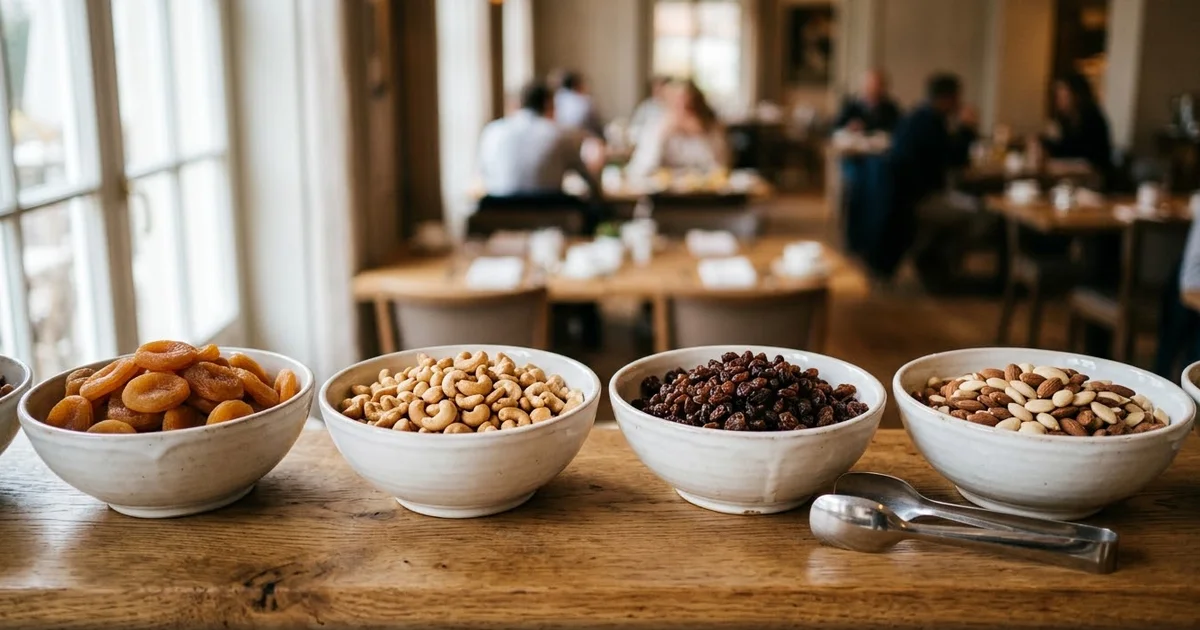
Hotel Breakfast Bar: Dried Fruits & Professional Portions
Creating a CHR breakfast bar: dried fruits, individual portions, allergen presentation, cost per cover, rotation, and waste management.
The breakfast is no longer a mere welcome formality: it has become a strategic element for hotels, high-end guesthouses, and para-hotel residences. Creating a professional breakfast bar with dried fruits, individual portions, and a careful presentation requires a rigorous method—from bulk purchasing to allergen management, including calculating the cost per cover. Here’s how to structure this offering for a CHR establishment.
Why breakfast is becoming a hotel rating criterion
Customer reviews on booking platforms now place significant importance on the quality and variety of breakfast. A poor or standardized buffet directly penalizes an establishment’s overall rating, while a well-crafted offering—high-quality dried fruits, clean individual portions, clear presentation—becomes a commercial differentiation argument.
This evolution pushes accommodation managers to professionalize their purchases and move away from supermarket logic to turn toward bulk supply, with batch traceability and regular deliveries.
- Measurable improvement in ratings on booking platforms
- Differentiation from standardized and low-quality offerings
- Commercial argument for half-board formulas and business stays
- Reduction in customer complaints related to undeclared allergens
Composing the breakfast bar offering: dried fruits, individual portions, jams, cereals, seeds
A coherent breakfast bar relies on a clear range structure, designed to cater to several customer profiles (business clientele, families, long stays) without multiplying unnecessary references.
For the dried and dehydrated fruits component, it is recommended to mix:
- Oilseed dried fruits in bulk for dispensers: almonds, nuts, hazelnuts
- Sweet dehydrated fruits: apricots, figs, raisins, cranberries
- Ready-to-serve trail mix blends for quick consumption
- Sunflower, pumpkin, flax, or chia seeds for adding to cereals or yogurts
- Jams and compotes in sealed individual portions
- Cereals in gravity dispensers to limit handling
The choice between bulk and individual portions depends on the service format. In an unsupervised self-service buffet, individual portions limit the risk of cross-contamination and facilitate allergen labeling. In a supervised buffet or table service, bulk in dispensers remains relevant for cost control. Find all the suitable references in the CHR Selection, specifically designed for these volume and packaging constraints.
Buffet presentation: dispensers, ramekins, and mandatory allergen labeling
Presentation influences both the image perceived by the customer and the buffet’s regulatory compliance. Two types of containers generally coexist in the same buffet, depending on the product type.
| Container | Suitable products | Advantages | Points of vigilance |
|---|---|---|---|
| Gravity dispenser | Cereals, seeds, bulk dried fruit mixes | Low cost per service, qualitative image, portion adjustable by the customer | Regular cleaning, controlled restocking, visible allergen label on the hopper |
| Individual ramekin | Premium dried fruits, sweet-salty appetizer mixes | Careful presentation, controlled portion, facilitates waste control | Longer handling, requires frequent renewal |
| Sealed individual portion | Jams, compotes, honey, butter | Maximum hygiene compliance, batch traceability, zero contact | Higher unit cost, more precise stock management |
Displaying allergens in a buffet is not an aesthetic option: it is a mandatory requirement that engages the establishment’s responsibility whenever food is offered in self-service or prepared on-site. An information medium must allow customers to identify the substances requiring mandatory declaration present in each bin or dispenser. For compliant implementation, it is useful to refer to official resources on allergen information in catering.
At Palimex, we regularly observe that the buffets with the poorest hygiene ratings are not those lacking variety, but those with incomplete or outdated allergen labeling. An unidentified bin of dried fruits generates more complaints than a reduced but perfectly documented range. We systematically advise our CHR clients to keep the allergen sheet for each delivered batch, directly accessible to dining staff.
Calculating the cost per cover: method and benchmarks for a breakfast buffet
The cost per cover is the central indicator for balancing perceived quality and breakfast profitability. It is calculated by dividing the total material cost of the buffet (dried fruits, individual portions, jams, cereals, seeds, beverages) by the number of covers actually served over a given period.
- List the purchase cost of each reference based on supplier invoices
- Estimate the average consumption per cover and per reference over several weeks
- Include the observed waste rate (unsold items, discarded opened portions)
- Divide the total material cost by the number of breakfasts served during the period
- Compare this ratio to the margin target set by the establishment’s management
Bulk purchasing, with packaging adapted to the establishment’s actual volume, significantly reduces this ratio compared to fragmented purchases in supermarkets. This is precisely the advantage of a B2B supplier working in batches and pallets, with boxes calibrated for catering rather than households.
Waste, prohibited repackaging, and surplus management
Waste management at the breakfast buffet follows specific rules that should be communicated to dining staff. A food item made available in self-service, even if not consumed, cannot be repackaged and offered again at another service: the break in traceability and contamination risk prohibit it.
To limit losses without compromising food safety, several levers can be used:
- Prioritize individual portions for sensitive products (jams, compotes)
- Adjust quantities placed in the buffet based on the actual occupancy rate
- Reserve bulk for the most stable products (dried fruits, seeds, cereals)
- Train staff in bin rotation using the first-in, first-out method
- Systematically document the best-before dates of received batches to anticipate deadlines
Unopened unsold items stored under compliant conditions can, however, be reintegrated into stock for kitchen use (pastry, snacking), provided the establishment’s internal batch traceability procedures are followed.
Stock rotation and bulk order planning for the breakfast buffet
Stock rotation is the key to managing an efficient breakfast bar. Understocking leads to visible shortages in the buffet, while overstocking ties up cash flow and increases the risk of depreciation for batches nearing their best-before date.
| Product type | Recommended ordering frequency | Recommended packaging |
|---|---|---|
| Oilseed dried fruits (almonds, nuts) | Monthly | 5 to 10 kg box |
| Sweet dehydrated fruits | Every 3 to 4 weeks | 5 kg box or bulk pallet |
| Jams and compotes in portions | Weekly to bi-weekly | Box of individual portions |
| Cereals and seeds | Monthly | Bag or box with free delivery |
To secure this rotation, it is advisable to establish an ordering schedule based on the establishment’s forecasted occupancy rate, rather than a fixed rhythm disconnected from actual activity. Establishments combining a breakfast bar and a daytime snack corner can also share certain references with the Snack & Aperitif Selection, optimizing the overall rotation of batches.
Sustainably structuring your establishment’s breakfast offering
A successful professional breakfast bar relies on three inseparable pillars: a balanced offering combining bulk and individual portions, compliant presentation in terms of allergen labeling, and precise cost-per-cover management supported by controlled stock rotation. These elements cannot be improvised and benefit from being managed with a B2B supplier capable of guaranteeing traced batches, packaging adapted to the establishment’s volume, and delivery regularity compatible with hotel constraints.
To further develop your range, also consult our resources on the CHR Selection and Snack & Aperitif, two complementary categories to cover all your establishment’s consumption moments, from breakfast to aperitif.
Further reading
Frequently asked questions
Everything you need to know about this topic.
A question?
Get in touch directly.

Marketing & Communications Manager — Palimex / Meyva
As Marketing & Communications Manager at Palimex / Meyva, Aude Moyne leads the company's communications and digital marketing strategy: editorial content, email campaigns and the promotion of its product ranges. Her experience at Palimex, a specialist in dried fruit, nuts, olives and spices for professionals, has given her in-depth knowledge of the products, their origins and uses, and the expectations of food-industry professionals. The blog articles are written or supervised by her, in collaboration with Palimex's sales and product teams whenever a topic calls for specific expertise.
Our advice related to Grocery & Recipes
 Grocery & Recipes
Épices de l'hiver : pain d'épices, vin chaud et pâtisserie de Noël, dosage et achat
Guide B2B des épices d'hiver pour boulangers, pâtissiers et CHR : dosages au kilo et au litre, mélanges vin chaud et pain d'épices, approvisionnement en gros.
 Grocery & Recipes
Nougat en meule : découpe à la coupe, conservation et vente au poids
Guide B2B pour épiceries et confiseries : réussir la découpe à la coupe du nougat en meule, limiter les pertes, maîtriser le stockage et l'affichage au poids.
 Grocery & Recipes
Seau d'olives entamé : durée de vie, saumure et gestion du reste
Comment conserver un seau d'olives entamé ? Rôle de la saumure, température, règles d'hygiène et gestion des tapenades : le guide professionnel Palimex.