
Halal Dried Meat Wholesale: Cecina, Sucuk and Cured Meats for Professionals
Cecina, sucuk, halal dried beef: B2B purchasing guide for grocers and foodservice. Origins, formats, storage, best-before dates and stock rotation.
Halal dried meat holds a distinctive position in the range of a fine grocery store or a foodservice operation: a high-value anchor product, it sells by the slice as much as by the case, keeps well when correctly stored, and builds loyalty among a clientele that rarely finds it by accident. The condition is knowing what you are buying. Between beef cecina, Turkish sucuk and the many regional names, formats, flavour profiles and storage constraints differ significantly.
This guide addresses professionals holding a registered business number: grocers, neighbourhood retailers, caterers, restaurateurs and foodservice operators who buy by the full case and think in terms of stock rotation rather than consumer units. It sets out the concrete benchmarks for building a coherent range, choosing between formats, and meeting your obligations on storage and traceability.
What halal dried meat covers at a wholesaler
The term covers two technically distinct families, and it pays not to confuse them when putting your order together.
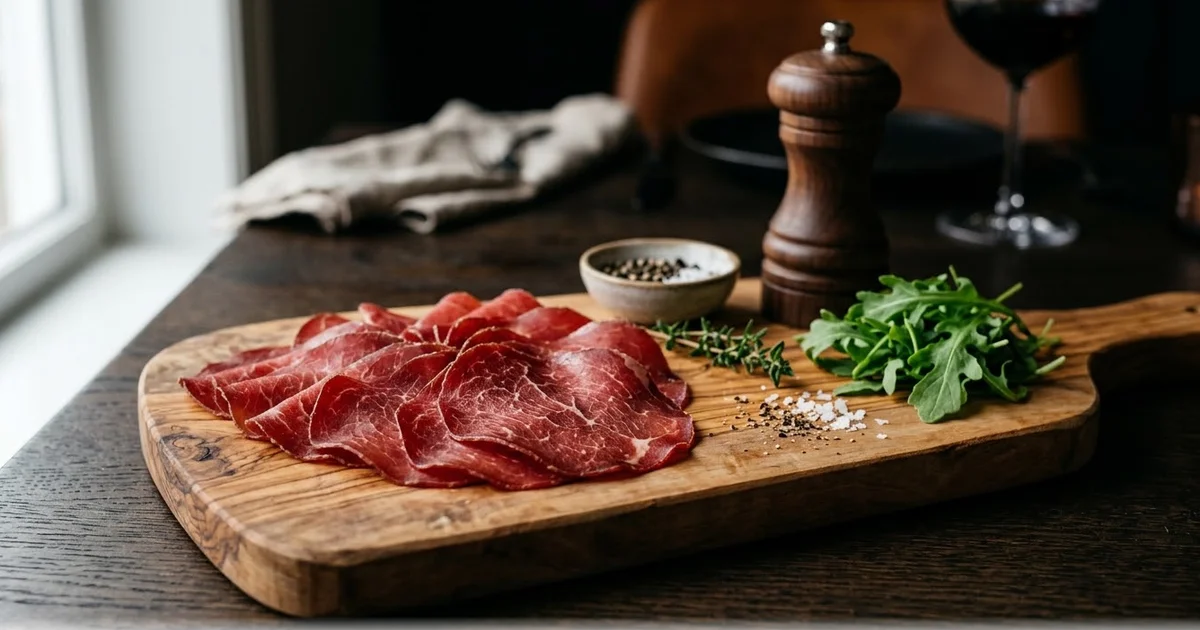
The first is that of whole cuts, salted then dried, of which cecina is the best-known representative. The muscle is salted, sometimes smoked, then matured in a drying room for several months. The result is a dense meat, finely sliced, whose texture and aromatic intensity come close to those of a dry-cured ham. It is a tasting product: served as is, in thin slices.
The second family is that of minced and stuffed cured meats, of which Turkish sucuk is the archetype. The meat is minced, blended with a spice mix, stuffed and then dried. The product is most often eaten cooked, pan-fried, grilled or folded into a hot preparation, and not raw.
This distinction is not cosmetic: it determines the section in which the product will be displayed, the storage method, the relevant purchase format and, above all, the sales pitch your team will deliver at the counter. Cecina sold as something to be cooked is a missed sale; sucuk served raw is a problem of another order entirely.
Beef cecina: characteristics, slicing and uses
Cecina traditionally refers to a salted and dried beef, a speciality originating in north-western Spain, where it holds a protected geographical indication under the name Cecina de Leon. The halal versions available on the professional market apply the same technical principle, salting, drying and maturing, within a production framework compliant with the requirements of the rite.
In the Palimex catalogue, the active reference is a halal dried beef cecina, sliced, under the Zahra / Rif label, packed in 12 trays of 100 g. This pre-sliced format carries a decisive operational advantage for a retail outlet: it removes the slicing step, and with it the slicer station, its cleaning and the cross-contamination risk that comes with it.
The most profitable uses observed at the point of sale are the following:
- Sharing board — served alone or alongside olives and dried fruits, cecina justifies premium positioning on the menu.
- Premium sandwich offer — a few slices are enough to upgrade a snacking range, with a controlled food cost thanks to the small weight per portion.
- Composed salad — replacing a pork charcuterie, it opens the menu to a clientele previously excluded from it.
- Takeaway tray — the 100 g format matches a consumer sales unit directly, with no repackaging.
A pre-sliced 100 g tray sells as it is: no slicer to clean, no trimming loss, no end-of-day markdown. On a product with a high value per kilo, that is often where the real margin is decided.
Sucuk: the Turkish dry sausage, mild or hot
Sucuk is a heavily seasoned dry sausage, a pillar of Turkish cuisine and widely spread across the whole Ottoman sphere. Its profile rests on a spice blend classically dominated by garlic, cumin, paprika and pepper. It is eaten cooked: sliced then pan-fried, it releases its aromas and its fat, which makes it an ingredient for breakfast, for pide or for scrambled eggs.
Two active references cover the two flavour profiles your customers will expect:
- Destan Sucuk Kangal — mild profile, packed in 9 x 1 kg. The term kangal traditionally denotes the ring shape.
- Destan Sucuk Parmak — hot profile, also in 9 x 1 kg. Parmak means finger and refers to the straight, stick shape.
Listing both profiles rather than one is almost always the right call. Sensitivity to chilli varies widely from one clientele to another, and a retailer stocking only the hot version mechanically forgoes part of its demand, the reverse being just as true. The 1 kg format also suits counter slicing as well as direct use in the kitchen.
For the exact composition, the allergen list and the regulatory statements, always refer to the product sheet and to the label on the batch delivered: these are the only enforceable sources.
Choosing the right format for your outlet
Packaging is not a logistical detail, it is a commercial decision. The table below sets out the benchmarks for choosing between the three references.
| Reference | Format | Profile | Consumption | Primary target |
|---|---|---|---|---|
| Halal beef cecina Zahra / Rif | 12 x 100 g pre-sliced | Salted, matured, dense | Raw, thinly sliced | Fine grocery, takeaway, foodservice board |
| Destan Sucuk Kangal | 9 x 1 kg | Mild | Cooked (pan-fried, grilled) | Restaurants, snacking, counter slicing |
| Destan Sucuk Parmak | 9 x 1 kg | Hot | Cooked (pan-fried, grilled) | Restaurants, customers who favour heat |
Three questions are usually enough to settle the matter. Do you have a compliant cutting station and the labour time that goes with it? What is your actual rate of sale, measured rather than estimated? And can your chilled display absorb the full case without breaking the cold chain? A case bought at the right price but sold too slowly costs more than more frequent replenishment.
This trade-off between volume, rotation and cash flow is the same one that structures the rest of your dry range: we set it out in our guide to diversifying a professional offer.
Storage, best-before dates and the cold chain
Sliced vacuum-packed cured meats, as well as dry sausages of the sucuk type, are chilled products. The rule is simple and admits no exception: observe the temperature stated on the label of the batch, and never substitute a remembered figure for the one printed on the pack, which alone binds the manufacturer.
A few stock-keeping principles apply across the whole category:
- Check on delivery — verify the product temperature on arrival, the integrity of the vacuum packs and the legibility of batch markings before accepting the pallet.
- Record the batch — keep upstream traceability, the condition of an effective recall and an expectation during any inspection.
- Separate the flows — store meat products apart from vegetables and dry goods, in line with your food safety management plan.
- Monitor the best-before date — on a slow-moving reference, it is managed week by week.
- Sell by age — the oldest batch leaves first, with no exception made for the convenience of shelf layout.
A vacuum pack whose seal has failed is not a degraded product to be sold quickly: it is a product to be withdrawn. The storage principles we set out for dry goods in our preservation guide apply here with an added level of demand, since the cold chain comes on top. The costliest storage mistakes are, in fact, almost always the same ones, and we have listed them in our article on the errors that ruin a stock.
Stock rotation and shelf profitability
On a product with a high value per kilo, margin is not decided when the purchase is negotiated but when the stock is sold through. A discount of a few points on one extra case is wiped out entirely by a single unsold tray.
The useful reasoning rests on three indicators: your actual weekly rate of sale, the remaining shelf life on delivery, and your available chilled storage capacity. A product turning over at less than one case a month has no business being ordered in depth, whatever the price advantage granted.
Conversely, a reference that sells well deserves a more generous facing and a permanent presence: running out of an identity product costs more than moderately overstocking it, because it sends the customer to a competitor for the whole basket, not merely for the missing line.
Sourcing and halal certification: what to verify
In France there is no single public halal certification: compliance with the rite is attested by private certifying bodies whose specifications vary. What does fall under general law, and therefore under inspection, is the fairness of the information given to the consumer, an area regulated and monitored by the administration, as set out by the DGCCRF, the authority responsible for food regulation.
In practice, three checks are called for before listing a brand for the long term:
- Is the certifying body explicitly identified on the packaging, rather than appearing only as a generic mention?
- Is upstream traceability documented and available on request from your supplier?
- Are the labelling statements — sales description, ingredient list, allergens, storage conditions — complete and in the local language?
Going through a specialist wholesaler simplifies this verification: a brand is listed once, upstream, and that listing holds for every batch delivered thereafter. It is one of the concrete contributions of a structured intermediary, which we develop in our article on the value of working with a wholesaler, and in our guide to choosing a B2B wholesaler.
Building a coherent range around dried meat
An isolated reference sells poorly. Halal dried meat delivers its full potential when it sits within a coherent purchasing universe, where the customer finds in a single visit the natural companions of the product: olives, spices, preserves and oriental grocery items.
This universe logic is the one that structures our range of oriental products for professionals, whose breadth we presented in our overview of the world flavours range. Pairing cecina with a selection of olives and spices is not decorative merchandising: it is what turns a sales line into an average basket.
Active since 1984, Palimex supplies grocers, neighbourhood retailers, caterers and foodservice operators holding a registered business number, with professional formats from retail bags sold by the case to bulk sacks, and pallet or carriage-paid delivery depending on the volume ordered.
Frequently asked questions
Everything you need to know about this topic.
A question?
Get in touch directly.

Marketing & Communications Manager — Palimex / Meyva
As Marketing & Communications Manager at Palimex / Meyva, Aude Moyne leads the company's communications and digital marketing strategy: editorial content, email campaigns and the promotion of its product ranges. Her experience at Palimex, a specialist in dried fruit, nuts, olives and spices for professionals, has given her in-depth knowledge of the products, their origins and uses, and the expectations of food-industry professionals. The blog articles are written or supervised by her, in collaboration with Palimex's sales and product teams whenever a topic calls for specific expertise.
Our advice related to Grocery & Recipes
 Grocery & Recipes
Épices de l'hiver : pain d'épices, vin chaud et pâtisserie de Noël, dosage et achat
Guide B2B des épices d'hiver pour boulangers, pâtissiers et CHR : dosages au kilo et au litre, mélanges vin chaud et pain d'épices, approvisionnement en gros.
 Grocery & Recipes
Nougat en meule : découpe à la coupe, conservation et vente au poids
Guide B2B pour épiceries et confiseries : réussir la découpe à la coupe du nougat en meule, limiter les pertes, maîtriser le stockage et l'affichage au poids.
 Grocery & Recipes
Seau d'olives entamé : durée de vie, saumure et gestion du reste
Comment conserver un seau d'olives entamé ? Rôle de la saumure, température, règles d'hygiène et gestion des tapenades : le guide professionnel Palimex.