
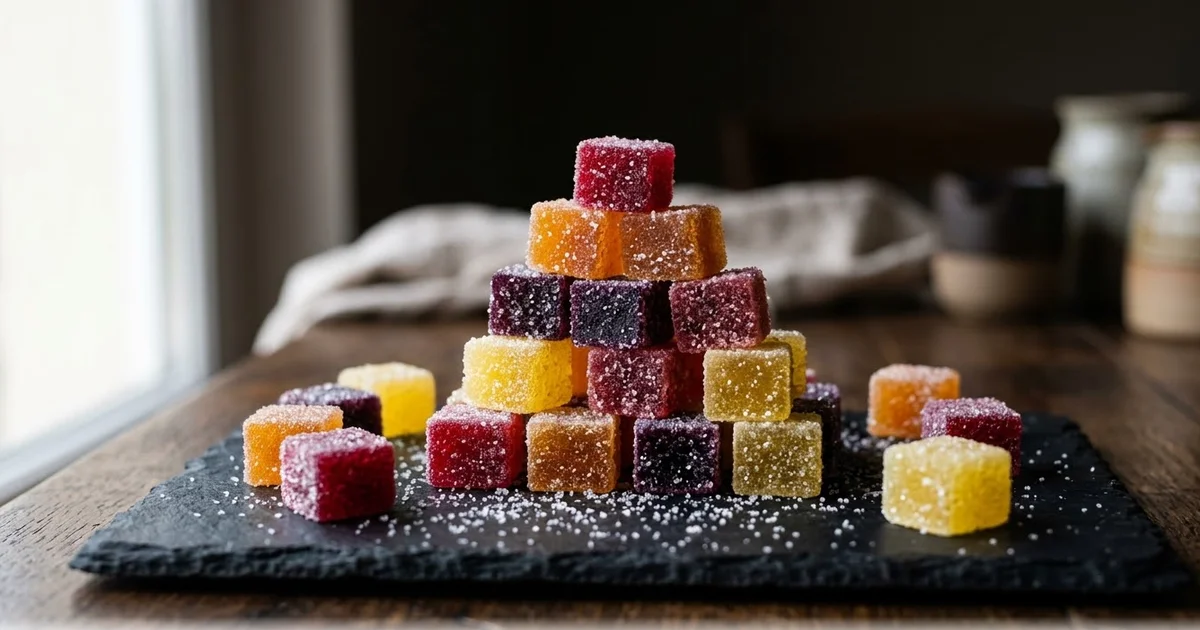
Fruit paste in bulk: B2B formats and storage
Fruit paste in bulk for fine grocery stores and caterers: flavours, formats, storage and presentation. Resale margin and gift trays.
Fruit paste ranks among the safe bets of sweet grocery: a product identified by the end consumer, comfortable margin, sustained turnover during holiday periods. For fine grocery stores, caterers and pastry chefs looking to structure their confectionery offering, bulk purchasing raises specific questions: which format to choose between bulk and pre-packaged, how to manage the coating sugar for storage, which presentation to favour in the display case or gift tray. This article reviews the key points for a reasoned professional purchase, with SIRET and packaging suited to resale.
Flavours and fruit paste ranges available in bulk
The flavour range directly influences shelf appeal. An assortment that is too limited restricts retail sales potential, while a range that is too broad complicates stock management and increases the risk of unsold items on the least in-demand references.
- Classic flavours: strawberry, raspberry, apricot, pear, apple — essential bases sought by a broad clientele.
- Citrus: orange, lemon, mandarin — appreciated during the holiday season for their freshness in the mouth.
- Exotic fruits: mango, passion fruit, pineapple — useful for standing out in fine grocery stores.
- Premium stone fruits and berries: mirabelle, blackcurrant, blueberry — high-end positioning.
- Mixed assortments: blends designed for gift trays and display cases.
To build a coherent assortment, it is advisable to combine classic ranges and differentiating references, based on sales history and seasonality. Our catalogue Sweet Grocery > Fruit paste presents all the flavours available in professional packaging.
Bulk or pre-packaged format: which choice for resale in fine grocery stores
The choice of purchase packaging largely determines the organisation of sales and the final margin achieved. Two approaches coexist, each suited to a different business model.
| Criterion | Bulk (bulk carton) | Pre-packaged (tray, sachet) |
|---|---|---|
| Main use | Display case, on-demand weighing, display stand | Self-service sales, gifts, quick resale |
| Sales flexibility | High — the customer chooses the quantity | Low — fixed quantity per unit |
| In-store handling | Weighing, bagging, manual use-by date labelling | No handling, direct shelf placement |
| Potential margin | Often higher thanks to per-weight sales | More stable but generally tighter |
| Storage after opening | Sensitive to air, requires close monitoring | Extended protection until opened |
In practice, many fine grocery stores combine both: bulk for display case animation and per-weight retail sales, pre-packaged for gift sections and quick sales during peak periods. The choice also depends on the expected turnover volume and the store's capacity to manage open stock.
Coating sugar and storage: key points to watch in-store
The crystallised sugar coating is not just an aesthetic element: it plays a direct role in protecting the product from drying out and ambient humidity. Its management in-store determines the commercial shelf life of fruit paste once the carton is opened.
- Store fruit paste away from direct heat and light, in a temperature-controlled room.
- Avoid humidity variations that cause the coating sugar to migrate and alter the texture.
- Carefully reseal opened cartons between services to limit drying out.
- Regularly check the condition of the sugar layer: a sticky or damp appearance signals unsuitable storage.
- Respect the rotation of batches using the first-in, first-out method, based on the use-by dates indicated on each carton.
At Palimex, we find that most in-store returns result from poor storage after opening the carton, not from a manufacturing defect. An opened carton that is not properly resealed quickly loses texture quality, even if the use-by date has not passed. Our advice: only open the quantity needed for the week's restocking and keep the rest of the batch sealed in a dry, temperature-controlled storage space.
Display case and gift tray presentation to maximise sales
Presentation strongly influences the conversion rate in-store. Fruit paste lends itself to two complementary display approaches depending on the period and target clientele.
Display stand
Per-weight bulk sales, presented in a compartmentalised stand by flavour, highlight the range's diversity and encourage mixed purchases. This works particularly well in fine grocery stores and pastry shops, where the customer creates their own assortment.
Gift trays
The gift tray format meets a different demand, more focused on holiday periods and gift occasions. A well-composed tray, combining several premium flavours, allows for a higher margin than classic retail sales while reducing shelf stocking time.
- Multi-flavour tasting trays for corporate gifts.
- Small individual formats for checkouts and impulse sales.
- Thematic assortments (berries, citrus, exotic) to segment the offering on the shelf.
To explore the logic of sweet merchandising in-store, our article on arranging confectionery sections in fine grocery stores details best practices for layout.
Seasonality and end-of-year holidays: anticipating bulk orders
Fruit paste experiences a marked demand peak during the end-of-year period, for gift trays, end-of-meal platters in catering and impulse purchases in fine grocery stores. This seasonality requires advance ordering to secure supply.
- Place orders in autumn to guarantee the availability of premium flavours, often out of stock in December.
- Plan additional volume for gift trays, whose demand far exceeds that of the rest of the year.
- Anticipate palette/free delivery logistics to avoid stockouts during peak activity.
- Plan a second restock in mid-December to cover last-minute purchases.
Outside of the holidays, demand remains steady but more diffuse, driven by regular retail sales and uses in catering (coffee accompaniment, dessert tray). Differentiated stock management between high and low seasons optimises cash flow without experiencing shortages at critical times. For the logistics of your bulk orders, consult our page palette delivery and free shipping.
Resale margin in fine grocery stores: building a coherent pricing policy
The profitability of a fruit paste range depends directly on the bulk purchase price, the chosen packaging format and the pricing strategy adopted in-store. A coherent margin policy relies on several combined levers.
| Lever | Impact on margin |
|---|---|
| Bulk purchase by carton rather than small packaging | Reduced unit purchase price, improved gross margin |
| Per-weight bulk sales | Pricing flexibility depending on the product mix |
| In-house composed trays | Higher perceived value, additional margin on assembly |
| Premium references (exotic fruits, blends) | Higher price positioning, reinforced unit margin |
| Rigorous batch and use-by date management | Reduction of losses, preservation of net margin |
Controlling losses due to poor storage or mismanaged batch rotation remains one of the most determining factors for the actual net margin, well before optimising the displayed selling price. A well-sized bulk order, combined with rigorous HACCP monitoring of sourcing and batches, secures this margin over time.
Professional packaging and bulk order logistics
Purchasing fruit paste for resale follows a strictly B2B logic, with packaging suited to professional volumes and not domestic needs.
- Packaging by the carton, suited to resale in fine grocery stores and catering.
- Delivery by palette or free shipping depending on the ordered volume, to optimise logistics costs.
- Complete sourcing and batch traceability, essential for HACCP controls in-store.
- Professional labelling indicating use-by date and batch number on each carton.
For any questions on ordering, invoicing or professional account conditions, our page professional account creation details the access terms to our B2B catalogue. For additional information on the professional uses of bulk sweet products, the official information on HACCP food hygiene can usefully complement your internal stock management policy.
Summary: building a profitable and well-managed fruit paste offering
Purchasing fruit paste in bulk for resale relies on a balance between flavour diversity, judicious choice between bulk and pre-packaged, vigilance on storage related to coating sugar, and anticipation of end-of-year holiday seasonality. A coherent margin policy is based as much on the purchase price as on loss control and batch rotation. By structuring orders according to these criteria, fine grocery stores or professional caterers secure both their profitability and the quality perceived by their clientele. Discover our full range on Sweet Grocery > Fruit paste.
Further reading
Frequently asked questions
Everything you need to know about this topic.
A question?
Get in touch directly.

Marketing & Communications Manager — Palimex / Meyva
As Marketing & Communications Manager at Palimex / Meyva, Aude Moyne leads the company's communications and digital marketing strategy: editorial content, email campaigns and the promotion of its product ranges. Her experience at Palimex, a specialist in dried fruit, nuts, olives and spices for professionals, has given her in-depth knowledge of the products, their origins and uses, and the expectations of food-industry professionals. The blog articles are written or supervised by her, in collaboration with Palimex's sales and product teams whenever a topic calls for specific expertise.
Our advice related to Grocery & Recipes
 Grocery & Recipes
Épices de l'hiver : pain d'épices, vin chaud et pâtisserie de Noël, dosage et achat
Guide B2B des épices d'hiver pour boulangers, pâtissiers et CHR : dosages au kilo et au litre, mélanges vin chaud et pain d'épices, approvisionnement en gros.
 Grocery & Recipes
Nougat en meule : découpe à la coupe, conservation et vente au poids
Guide B2B pour épiceries et confiseries : réussir la découpe à la coupe du nougat en meule, limiter les pertes, maîtriser le stockage et l'affichage au poids.
 Grocery & Recipes
Seau d'olives entamé : durée de vie, saumure et gestion du reste
Comment conserver un seau d'olives entamé ? Rôle de la saumure, température, règles d'hygiène et gestion des tapenades : le guide professionnel Palimex.