
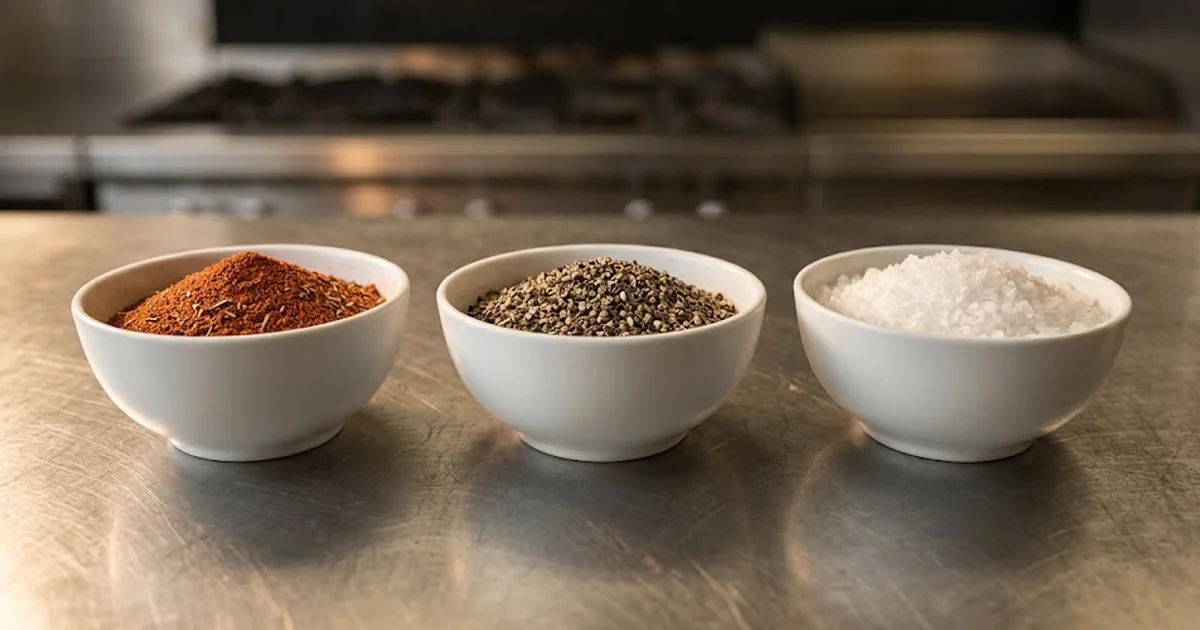
Épices grill Espig : gamme et usages en CHR
Professional guide to Espig grill spices for foodservice: blends, 1 kg and 500 g catering formats, dosages per kilogram and marinade techniques for meats and vegetables.
Technical characteristics and composition of Espig grill spices
In a professional restaurant kitchen, gustatory consistency and speed of execution at the hot station depend directly on the ingredients made available to the chefs de partie. The grill spice blend from the Espig brand was formulated to meet the operational constraints of the collective and commercial foodservice sector (CHR). Its technical composition combines selected aromatics for their resistance to high temperatures and balanced spices that provide a warm, rounded, and slightly spicy flavour profile without masking the original texture of meat or vegetable products.
From an organoleptic and functional standpoint, this blend relies on a structure of complementary dehydrated ingredients:
- Sweet paprika: provides the characteristic amber-red colouring of seared meats as well as a sweet and fruity note that caramelises under heat without turning bitter.
- Dehydrated garlic and onion in semolina: release the sulphur compounds essential for developing aromatic juices, with a particle size designed to prevent premature burning upon direct contact with the grill.
- Selected aromatic herbs (thyme, rosemary, oregano): ensure the retention of fresh and resinous herbal notes throughout the searing process on charcoal or plancha.
- Crushed black pepper and hot spices: provide a lively finish and clear aromatic persistence that enhances cooking fats.
- Calibrated refined salt: allows for homogeneous osmotic diffusion on the surface of treated pieces without causing excessive drying of the protein matter.
The overall particle size of the blend has a semi-fine to crushed texture. This specific grinding is calibrated to limit the presence of volatile dust that could carbonise upon contact with direct heat, while avoiding overly coarse pieces that would detach during handling with serving tongs.
The Palimex catalogue lists Espig spice and aromatic blends dedicated to roasting and grilling stations in several complementary variations to cover all brigade needs:
| Product reference | Unit packaging | Form and grind | Dominant aromatic profile | Main culinary use |
|---|---|---|---|---|
| Espig Grill Blend | Catering box 1 kg | Semi-fine grind with herb flakes | Sweet paprika, garlic, onion, aromatic herbs | Beef ribs, flank steaks, pork loins, kebabs |
| Espig Roasting & Poultry Blend | Catering box 1 kg | Homogeneous fine powder | Paprika, turmeric, herbes de Provence, fine salt | Roast chickens, turkey legs, pork ribs |
| Espig Fish & Shellfish Grill Blend | Sprinkler box 500 g | Light flakes and crushed seeds | Dill, fennel, white pepper, lemon zest | Salmon fillets, cod loins, grilled prawns |
| Espig Crushed Black Pepper | Catering box 500 g | Regular mignonnette size | Frankly spicy black pepper with woody notes | Steak marking, pepper crusts, plancha finishes |
| Espig Sweet Chili / Extra Paprika | Catering box 1 kg | Silky fine powder | Mild, fruity flavour with intense colouring power | Marinade bases for white meats and vegetables |
| Espig Grill Blend Pratic Format | Dosing bottle 250 g | Ready-to-use semi-fine grind | Balanced traditional grill spices | Quick-service stations, food trucks, snacking |
Professional formats and packaging ergonomics for foodservice
The fast pace of a commercial foodservice operation requires containers that preserve the organoleptic integrity of spices while ensuring quick and seamless handling for kitchen staff. The packaging offered by Espig and selected by Palimex meets these field requirements with rigorous dimensional and mechanical characteristics.
The professional 500 g and 1 kg boxes are made from opaque, rigid high-density polyethylene, a material that is neutral for food contact and effectively protects powders from light and water splashes on a stainless-steel work surface. The large top opening allows easy insertion of a dosing spoon or standard measuring ladle, facilitating quick weighing during large-volume marinade preparations before the rush.
For on-the-fly seasoning on the grill, the dual-function pouring cap is an undeniable operational asset:
- A calibrated sprinkler side: designed to evenly and aerially disperse the blend over meat cuts spread in gastronorm trays or directly on the work surface.
- A wide pouring side with controlled flow: allowing larger volumes to be scooped or poured directly into a binding oil to create a quick emulsion.
- A snap-lock hermetic closure: ensuring mechanical locking of the container between service phases to act as a barrier against hot vapours and ambient moisture inherent in professional kitchens.
The 250 g bottle packaging is particularly popular in confined workstations, such as food truck kitchens, snack counters, or plating tables where floor and wall shelf space must be minimised. These compact formats also promote faster stock rotation, preventing aromatic powders from remaining open too long on stations exposed to stove heat.
Technical dosages and ratios per kilogram of product
The precision of grill spice blend dosage determines the profitability of the portion served and the final balance of the dish. Under-dosing results in discolouration and a bland sensation on high-fat meats, while over-dosing saturates the diner’s palate and can accelerate superficial pyrolysis of spices upon contact with an intense heat source.
In restaurant kitchens, the basic rule is to express quantities in grams per kilogram of trimmed raw material. This calculation method allows for precise and reproducible technical sheets for all commis and chefs in the brigade, regardless of the day’s production volume.
Recommended ratios by product type
Moisture, collagen, and lipid content vary significantly across food categories, dictating a methodical adjustment of applied spice quantities:
- Red meats (beef and lamb – flank steak, sirloin, rib, sliced leg): apply between 12 and 15 grams of grill blend per kilogram of meat. The muscle density and aromatic power of red meat juices absorb the spiced profile without masking the inherent flavour of the meat breed.
- White meats and pork (poultry escalopes, pork loin, ribs, tenderloin): dose 15 to 18 grams per kilogram. White meats require stronger seasoning and a more pronounced colour boost to compensate for their natural paleness after searing.
- Sausages, merguez, and minced preparations: incorporate 10 to 12 grams per kilogram during the kneading process, accounting for the salt content already present in the initial recipe.
- Firm fish and seafood (swordfish, tuna, monkfish, cuttlefish, whole prawns): reduce the ratio to 8 or 10 grams per kilogram. The spice blend should merely enhance the delicacy of the seafood without overpowering its subtle flavours.
- Grilled vegetables (courgettes, peppers, aubergines, button mushrooms): use 8 to 12 grams per kilogram, always pre-mixed with 25 to 30 millilitres of vegetable oil to facilitate surface coating and prevent dry aromatics from settling at the bottom of the gastronorm tray.
Portion cost control and reproducibility
Using a ready-to-use blend like Espig’s eliminates the time spent individually weighing half a dozen different spices by kitchen staff. Based on 15 grams per kilogram, a 1-kilogram package can treat approximately 66 kilograms of trimmed meat, equivalent to over 300 individual 200-gram portions. This standardisation ensures a precisely controlled seasoning cost down to the cent per plate served.
Application timing and professional cooking protocols
The timing of applying grill seasoning to a product destined for direct heat directly influences the Maillard reaction, the tenderness of the piece, and the absence of burnt flavours. Three major techniques coexist in professional settings, each addressing specific setup constraints.
Pre-dry marinade (Dry Rub)
The dry rub involves massaging meat or poultry pieces with the grill spice blend without immediate liquid addition, then storing the products in a covered tray at a positive cold temperature between 0 and 3 degrees Celsius. This protocol is particularly recommended for thick cuts, pork ribs, or poultry pieces with skin.
During this resting period of 1 to 4 hours depending on the cut size, the salt in the blend extracts a small fraction of surface moisture through osmosis. This moisture dissolves the spice powders and forms a concentrated brine that is reabsorbed by the muscle fibres. This mechanism allows for deep flavouring while superficially drying the piece, a prerequisite for achieving a crispy, well-marked crust from the first seconds of searing.
Oily coating for plancha and rotisserie
For fast-paced services like brasseries or grill houses where orders flow continuously, a quick oil-based coating provides maximum responsiveness. The spices are mixed into a neutral high-temperature vegetable oil (refined sunflower or rapeseed oil) at a ratio of approximately 150 grams of blend per litre of oil.
At the pass or on the hot line, the chef brushes the piece with a silicone brush or quickly dips skewers into this emulsion before placing them on the cooking surface. The fats act as an immediate heat conductor and a natural solvent for the liposoluble aromatic principles of paprika and herbs, while creating a protective film that limits meat adhesion to the hot metal.
Post-cooking finishing application
For premium red meat cuts (aged beef rib, marbled entrecôte) seared at very high heat or glowing charcoal, applying paprika-rich spices before cooking carries a carbonisation risk if the grill temperature exceeds 200 degrees Celsius. In this scenario, seasoned chefs prefer marking the meat with a simple turn of the pepper mill or neutral sea salt.
The grill spice blend is then lightly sprinkled immediately after grilling, during the resting phase under a cloche or on a draining rack. The residual heat of the meat and the rising cooking juices are sufficient to hydrate the spices, releasing their aromatic bouquet without any thermal degradation.
"In foodservice, the main pitfall observed at grilling stations is the direct exposure of paprika and dehydrated herbs to excessive contact temperatures. When the heat exceeds 220 degrees Celsius, the natural sugars in paprika burn instantly and turn bitter. At Palimex, we systematically advise brigades to adjust their heat zone or coat the blend with an oil film to preserve the vibrancy of colours and the appeal of aromas."
— The Palimex technical team
Storage protocols, hygiene, and stock management in foodservice
Dehydrated spices are non-perishable in the strict regulatory sense, but their organoleptic potential is highly sensitive to physical storage conditions. Prolonged exposure to water vapour, ambient air, or excessive heat degrades volatile essential oils and causes irreversible caking of powders.
Storage rules in the storeroom and production area
To maintain consistent quality throughout the product’s shelf life, storeroom organisation must adhere to strict parameters:
- Maintain dry and light-free conditions: store closed boxes in a dry area at an ambient temperature ideally between 12 and 20 degrees Celsius. Direct light alters the natural pigments of paprika and dulls the visual appearance of the blend.
- Avoid sprinkling over open flames: it is strongly discouraged to shake an open spice box directly over a smoking pan, fryer, or bain-marie. Rising steam instantly penetrates the dosing sieve perforations, causing compact agglomerates that clog nozzles and promote surface mould growth.
- Use intermediate containers: for daily service, measure the required amount for a shift into a stainless-steel sprinkler dedicated to the workstation, keeping the main 1 kg packaging hermetically sealed in the storage unit.
- Strict FIFO rotation: apply the First In, First Out principle by systematically checking the minimum durability date on the packaging upon receiving cartons delivered by Palimex.
Operational summary for chefs and foodservice managers
Integrating the Espig grill spice range into the standardised procedures of a professional kitchen provides a measurable triple advantage for foodservice establishment managers. In terms of culinary consistency, it guarantees customers a uniform taste across all grilled cuts, reinforcing customer loyalty around signature dishes like homemade burgers, caramelised ribs, or mixed grills.
In terms of productivity, the time saved during morning setup eases the workload for commis and reduces the risk of dosage errors during intense rushes. Finally, financially, the precise control of ratios per kilogram and the availability of professional packaging tailored to the Palimex catalogue ensure a perfectly calibrated ingredient ratio, essential for the economic profitability of a modern foodservice operation.
You may also like
A question?
Get in touch directly.

Marketing & Communications Manager — Palimex / Meyva
As Marketing & Communications Manager at Palimex / Meyva, Aude Moyne leads the company's communications and digital marketing strategy: editorial content, email campaigns and the promotion of its product ranges. Her experience at Palimex, a specialist in dried fruit, nuts, olives and spices for professionals, has given her in-depth knowledge of the products, their origins and uses, and the expectations of food-industry professionals. The blog articles are written or supervised by her, in collaboration with Palimex's sales and product teams whenever a topic calls for specific expertise.
Our advice related to Grocery & Recipes
 grocery
Seau d'olives entamé : durée de vie, saumure et gestion du reste
Comment conserver un seau d'olives entamé ? Rôle de la saumure, température, règles d'hygiène et gestion des tapenades : le guide professionnel Palimex.
 grocery
Huile de friture : point de fumée, cycles et fin de vie
Maîtrisez le point de fumée de vos huiles de friture, optimisez la durée de vos cycles de cuisson et gérez la fin de vie selon les règles de la restauration pro.
 grocery
Snacks and Kebab: The Dry Grocery Staples That Keep Service Running
B2B dry grocery wholesaler for snacks and kebabs: semolina, oils, spices, sauces, and foodservice canned goods. Bulk procurement by the case or pallet for SIRET-registered businesses.