
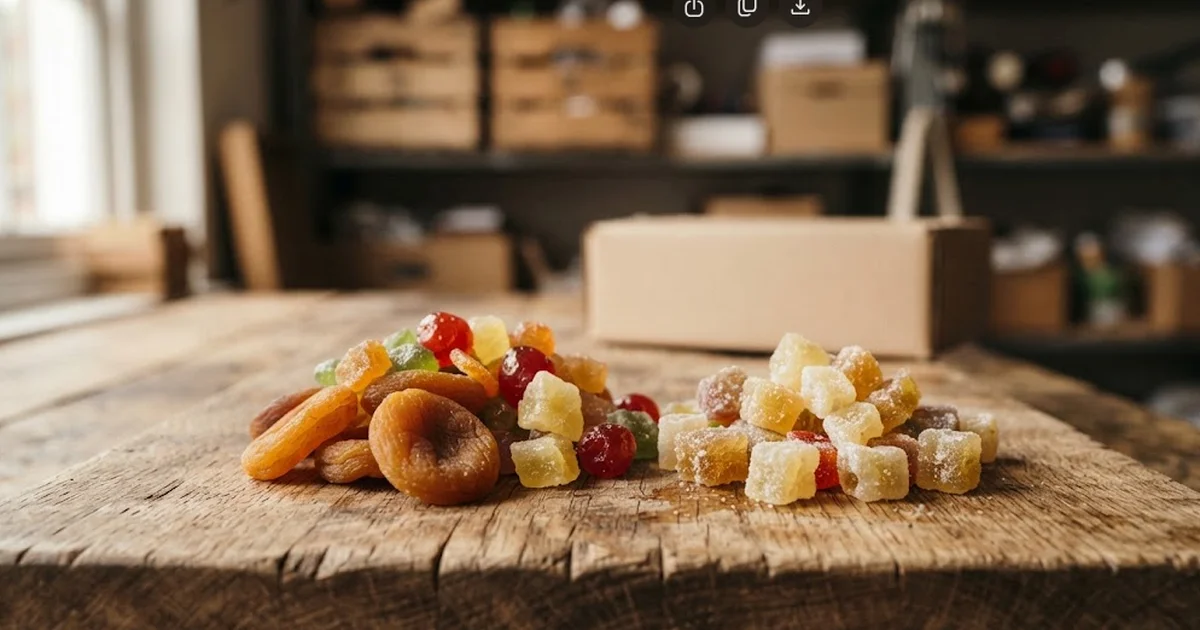
Additifs en fruits secs et confits : ce qui doit figurer sur l'étiquette
Preservatives, anti-caking agents, coating agents: how to read a supplier technical sheet for dried and candied fruits. Guide for professional buyers.
On a supplier technical sheet for dried fruits, dehydrated fruits, or candied fruits, the “ingredients” line often contains more useful information than the rest of the document. Preservatives, anti-caking agents, coating agents: these families of additives frequently appear in dried fruit ranges, sweet grocery products, and bulk bakery supplies. This article complements our dedicated analysis on sulphured vs. unsulphured dried apricots by expanding the topic to all additives encountered by professional buyers in these products and how to identify them on a label or specification sheet.
Why additives appear on technical sheets for dried and candied fruits
A dried fruit, dehydrated fruit, or candied fruit is not always a “plain” product. Depending on the manufacturing process—drying, partial rehydration, candying, glazing—certain technological ingredients may be used to stabilise colour, prevent clumping during storage, or facilitate preservation between production and wholesale distribution. These ingredients appear in the ingredients list on the technical sheet, just like the fruit itself.
For a foodservice, gourmet grocery, or artisanal bakery buyer, this information is not a mere administrative detail: it determines the product’s use in cooking, compatibility with specific recipes (confectionery, dry pastries, additive-free preparations claimed to the end customer), and how your own customers will interpret it if you resell the product as-is.
- A dried apricot treated with sulphur dioxide behaves differently in long cooking than an untreated apricot.
- A candied fruit with a coating may react differently to heat during glazing or oven baking.
- An aperitif mix containing an anti-caking agent maintains a homogeneous texture longer in an opened packet.
Preservatives, anti-caking agents, coating agents: the three key families to know
In dried fruit, dehydrated fruit, candied fruit, and sweet grocery ranges, three main families of technological additives recur most often. Knowing them helps you read a technical sheet more effectively and ask the right questions to a supplier.
Preservatives
Used to extend product stability between production and consumption, they are particularly common in light-coloured dried fruits (apricots, figs, some dehydrated fruits). They appear in the ingredients list under their name or code, depending on the manufacturer’s editorial choice.
Anti-caking agents
They are used in powdered or small-piece products—crushed dried fruits, spices, some aperitif mixes—to prevent clumping during storage in bags or cartons. Their role is purely physical: they do not alter the nature of the fruit or spice but facilitate handling in professional kitchens and dosing during repackaging.
Coating agents
Common in candied fruits, some coated or glazed dried fruits, and part of the sweet grocery range, they create a thin surface film. This film can provide shine, protect against ambient moisture, or reduce sticking between pieces—a critical point for bakers displaying products or preparing them in advance.
Name or E number: how to read a supplier ingredients list
The same substance may be declared in two ways on a label or technical sheet: by its full name (“citric acid”, “sulphur dioxide”) or by its code, consisting of the letter E followed by three or four digits (“E330”, “E220”). Both formulations refer to the same substance and are, in practice, interchangeable depending on the manufacturer’s or importer’s editorial habits.
For a wholesale buyer, a few reading habits help avoid surprises upon receipt:
- Check whether the ingredients list consistently uses names or E numbers—a mix of both styles on the same document may indicate a sheet copied from multiple sources.
- Verify that each listed additive is linked to a clear technological function (preservative, anti-caking agent, coating agent, acidity regulator, etc.), as this function indicates the product’s intended use.
- Compare the technical sheet with the received sample: any discrepancy (mention of an unlisted additive, or vice versa) should be reported to the supplier before stocking.
- When in doubt about an E number, request the full name directly from the supplier rather than relying on an unverified source.
For buyers who wish to independently explore the E number nomenclature, the European Union’s public database lists all authorised additives and their functions: European Commission’s food additives database.
Summary table: additive families and relevant products in dried and candied fruits
This table does not replace the product’s technical sheet—it provides a general reference for identifying where, in the catalogue, each additive family is most commonly found.
| Additive family | Declared function | Relevant products in the catalogue | Most common display format |
|---|---|---|---|
| Preservatives (including sulphur dioxide and sulphites) | Colour stability and extended shelf life | Light-coloured dried fruits (apricots, figs), some dehydrated fruits | Full name or E number, depending on the manufacturer |
| Anti-caking agents | Prevent clumping during storage | Crushed dried fruits, ground spices, aperitif mixes | E number, less frequently full name |
| Coating agents | Shine, moisture protection, reduced sticking | Candied fruits, coated dried fruits, part of the sweet grocery range | Most often full name |
| Acidity regulators | Adjust product pH | Some candied fruits and fruit-based preparations | E number or full name |
What a professional buyer should verify on a supplier technical sheet
Beyond the simple ingredients list, a comprehensive technical sheet contains several elements that a wholesale buyer should systematically cross-check, particularly when ordering by pallet or carton for regular stock rotation.
- The complete ingredients list, with explicit mention of each technological additive used.
- The batch number, which links a delivered product to its original technical sheet for any subsequent questions.
- The best-before date or minimum durability date, to align with planned stock rotation in grocery or professional kitchens.
- The size and packaging format, which, while unrelated to additives, determine the product’s final use (bulk bakery, foodservice format, wholesale carton).
- The declared origin, when specified by the supplier, without overinterpreting beyond what is explicitly stated on the document.
One point of caution concerns generic technical sheets, sometimes forwarded as-is by an intermediary without batch-specific updates. In case of doubt, requesting a recent technical sheet specific to the delivered batch remains the most reliable practice.
At Palimex, we regularly receive questions from buyers who encounter an E number on a technical sheet and want to understand if it’s a problem. Our position is straightforward: an additive listed on a technical sheet is neither an anomaly nor a cause for concern in itself—it’s information to read and incorporate into your own communication with your customers. What we consistently recommend is comparing the received sheet with the delivered product, batch by batch, rather than relying on an old generic sheet. This cross-check, more than the presence or absence of an additive, prevents surprises in the kitchen or on the shelf.
Traceability, batches, and stock rotation: the link with technological additives
For a wholesaler as for a professional buyer, the question of additives is never addressed in isolation from batch management. A product containing a preservative or coating agent must be tracked with the same rigour as a product without added additives: batch number, best-before date, recommended storage conditions.
A few practical best practices for integrating this reading into B2B stock management:
- File technical sheets by batch, not by generic product reference, to quickly retrieve the exact composition of a given shipment.
- Retain technical sheets at least until the corresponding batch is fully depleted, including for products sold in repackaged bulk.
- Notify your foodservice or retail customers of any composition changes observed between batches, particularly for recurring SKUs.
- Adjust stock rotation based on product sensitivity: a candied fruit with a coating agent and a dried fruit without additives may not follow the same consumption pace in the kitchen.
This documentary rigour aligns with the same logic already presented for storing dried fruits in warehouses or for packaging olives in cash & carry: a technical sheet is only useful if it is actually read, filed, and cross-checked with the physical product.
Additives and culinary uses: what changes in professional kitchens
Beyond regulatory compliance, the presence of a technological additive can directly influence the product’s behaviour in professional kitchens. A baker glazing candied fruits must account for the existing coating agent, which may affect the adherence of a topping. A caterer preparing a large batch of crushed dried fruit mix benefits, conversely, from the anti-caking agent for more consistent dosing during service.
These practical effects justify why reading the technical sheet should not be limited to the procurement team but shared with kitchen or production teams, particularly for recipes sensitive to texture or the final product’s colour. On this point, our article on bulk bakery and artisanal packaging details the most suitable packaging formats for this type of upstream control.
- Check the compatibility of a coating agent with planned cooking or glazing.
- Anticipate slight colour variations between a preserved batch and one without preservatives, particularly for dried apricots.
- Test a new batch on a small volume before integrating it into full-scale production.
Summary: reading a dried and candied fruit label as a professional buyer
Additives in dried fruits, dehydrated fruits, and candied fruits belong to a limited number of families—preservatives, anti-caking agents, coating agents, acidity regulators—which appear, as full names or E numbers, on any serious supplier technical sheet. For a B2B buyer, the challenge is not to judge the presence of a given additive but to know how to identify it, understand its technological function, and link it to the precise delivered batch to ensure reliable traceability through to resale or use in the kitchen. Careful reading of the ingredients list, cross-referenced with the batch number and best-before date, remains the best tool for integrating this information into professional stock management without approximation.
Further reading
Frequently asked questions
Everything you need to know about this topic.
A question?
Get in touch directly.

Marketing & Communications Manager — Palimex / Meyva
As Marketing & Communications Manager at Palimex / Meyva, Aude Moyne leads the company's communications and digital marketing strategy: editorial content, email campaigns and the promotion of its product ranges. Her experience at Palimex, a specialist in dried fruit, nuts, olives and spices for professionals, has given her in-depth knowledge of the products, their origins and uses, and the expectations of food-industry professionals. The blog articles are written or supervised by her, in collaboration with Palimex's sales and product teams whenever a topic calls for specific expertise.
Our advice related to Grocery
 grocery
Replacing Almond Powder in Professional Pastry | Palimex
Hazelnut, sunflower, flour: when to replace almond powder in the workshop, impact on taste, texture, shelf life, cost — and where substitution fails.
 grocery
Catering: Aperitif Tray Weight and Cost per Guest
Portion size per guest, salty/sweet balance, products that withstand waiting times, and cost-per-person calculation: the caterer's guide to bulk aperitif trays.
 grocery
Praline and Dried Fruit Pastes in Confectionery Coating: Dosage and Yield
Praline dosage, cold stability, overrun, cost per litre: the professional guide to pure paste vs sweetened preparation for B2B ice cream makers and pastry chefs.