
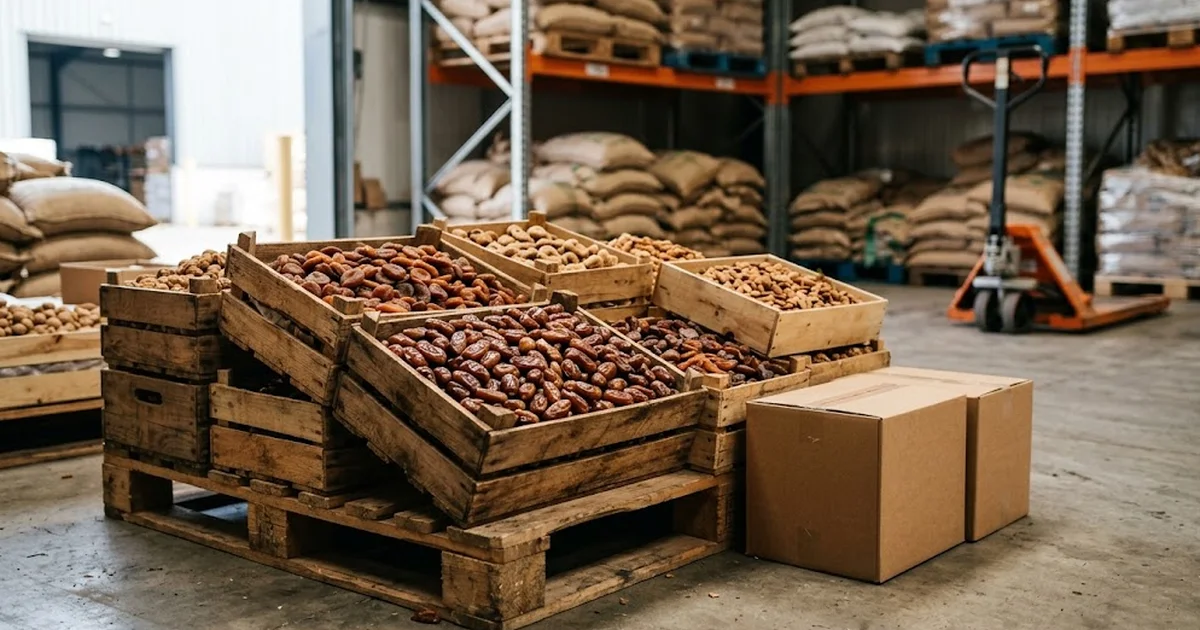
Ramadan : calendrier d'achat et volumes
Ramadan procurement timeline for grocers, HoReCa, and caterers: when to order, which products sell out first, and how to avoid stockouts and dead stock.
Ramadan represents one of the most intense sales peaks of the year for gourmet grocery stores, HoReCa businesses, and event caterers in the categories of dried fruits, dehydrated fruits, candied fruits, and spices. Poorly anticipated, this peak results in either a stockout during the sacred month—the worst commercial scenario—or costly dead stock once Eid is over. This article provides a concrete purchasing retro-planning, volume benchmarks by category, and mistakes to avoid to secure your wholesale supply while managing your cash flow.
Why Ramadan disrupts the usual purchasing rhythm of professionals
Unlike end-of-year holidays, which have fixed dates, Ramadan follows the Hijri lunar calendar and shifts back by about ten to eleven days each year compared to the previous year. This variability requires recalculating the starting point of your orders each season rather than mechanically replicating last year’s schedule.
Demand is not distributed linearly over the four to five weeks of the month: it starts gradually in the days leading up, surges during the first week, stabilises at a high plateau, then experiences a second peak just before Eid al-Fitr, driven by purchases of pastries and gourmet gift boxes.
- Weeks 1 and 2 of Ramadan: ramp-up on dates and dried fruits for breaking the fast (iftar).
- Weeks 3 and 4: stabilisation, with a growing share of spices and candied fruits for pastry-making.
- Final week and Eid: peak on candied fruits, calibrated nuts, and gift boxes for Middle Eastern pastries.
Purchasing retro-planning: key milestones to meet before the first day of fasting
A reliable retro-planning is built backward from the start date of Ramadan, taking into account wholesale order lead times, the available packaging formats, and B2B logistics constraints such as pallet delivery/free delivery.
| Period before Ramadan | Purchasing action | Priority products | Indicative volume |
|---|---|---|---|
| W-8 to W-6 | Placement of the annual framework order | Dates, dried fruits, dehydrated fruits | Full pallet volume on historical SKUs |
| W-6 to W-4 | Confirmation of batches and best-before date (BBD) check | Spices (cinnamon, cardamom, cumin), candied fruits | Cartons in multiples of 5 to 10 kg based on usual turnover |
| W-4 to W-2 | Anticipated replenishment order | Calibrated nuts, aperitif and snacking mixes | +30% compared to reference volume |
| W-2 to D0 | Reception, storage, and FIFO rotation | Entire Ramadan catalogue | Safety buffer stock established |
| Week 1 of Ramadan | Daily stock movement monitoring | Dates, iftar dried fruits | Urgent replenishment if turnover exceeds forecast |
| Final week / Eid | Targeted supplementary order for pastry-making | Candied fruits, flaked almonds, shelled pistachios | One-off peak, volume based on previous year’s data |
To refine this schedule based on your actual volumes from last year, our guide on stock management for gourmet grocery dried fruits details the replenishment calculation method by SKU.
Which products sell out first: ranking by turnover speed
Not all categories in the catalogue experience the same sales rhythm during Ramadan. Identifying fast-moving SKUs allows you to prioritise initial orders and avoid stockouts on the most in-demand products from the first days.
- Dates (Medjool, Deglet Nour, bulk): an essential product for breaking the fast, selling out immediately from the first day of Ramadan.
- Mixed dried fruits (almonds, nuts, pistachios, hazelnuts): daily consumption throughout the month, steady and sustained turnover.
- Dehydrated fruits (apricots, figs, raisins): used as accompaniments to sweet-and-savoury dishes, consistent turnover.
- Spices (cinnamon, cardamom, cumin, ras-el-hanout): stable demand that rises sharply at the end of the month for festive preparations.
- Candied fruits: gradual increase, marked peak during the final week before Eid, for Middle Eastern pastries.
- Olives and spreads: supplementary products for the iftar table, moderate but regular turnover.
Gourmet grocery stores and caterers preparing gourmet gift boxes should secure candied fruits and calibrated nuts from the framework order, as these SKUs often face supply tensions at the end of the season in the wholesale market.
Calculating volumes without ending up with dead stock after Eid
Professional packaging and pallet delivery require reasoning in volumes consistent with your sales area and turnover history, not on an ad-hoc basis. Overstocking candied fruits or spices after Eid ties up cash flow and occupies valuable storage space for the next season.
At Palimex, we observe the same pattern every year in the Rungis market: businesses that place a single order based on last year’s volume, without a replenishment margin, are the first to call us urgently in the second week of Ramadan. Our field recommendation is simple: split your order into two or three waves, with a firm base and an adjustable top-up based on actual sales observed in-store.
To size this firm base, rely on three simple indicators:
- The volume sold during the same period last year, adjusted for your customer base growth.
- The number of days of autonomy desired between deliveries, considering collection schedules and your delivery frequency.
- The share of slow-moving products (candied fruits outside the final week) to order in measured quantities rather than full pallets.
Logistics, packaging, and storage during the high-demand period
The Ramadan period concentrates significant order flows over a short window, making collection and storage logistics particularly sensitive. Compliance with HACCP storage best practices remains essential even during high turnover periods, especially for dried and dehydrated fruits, which must be kept away from moisture.
| Category | Typical packaging | Storage vigilance point |
|---|---|---|
| Dates | 5 to 10 kg carton, bulk or trays | Temperature-controlled storage, BBD check on each batch received |
| Dried fruits / nuts | 5 kg+ bag or carton | Dry storage, strict FIFO rotation to limit rancidity |
| Candied fruits | 5 kg carton, bulk pastry formats | Avoid prolonged exposure to heat before use |
| Spices | Professional-format sachet or box | Airtight seal after opening, away from light |
Our detailed recommendations on warehouse storage are available in our dedicated article on dried fruit storage in professional warehouses, as well as in our guide on bulk packaging for HoReCa professionals.
Common mistakes to avoid to secure your Ramadan supply
Each season, the same pitfalls recur for businesses experiencing stockouts or, conversely, costly overstock. Identifying them early allows you to adjust your retro-planning before it’s too late.
- Ordering based on last year’s fixed calendar date without accounting for the lunar shift, which disrupts your entire supply chain.
- Underestimating first-week demand for dates and dried fruits, a period when stock movements are often two to three times higher than a normal month.
- Over-ordering candied fruits too early, as their peak occurs mainly in the final days before Eid.
- Neglecting BBD checks on large-volume batches, exposing you to unsold stock or non-compliance.
- Not planning an emergency replenishment window with your wholesaler during high-turnover weeks.
A useful complementary read to structure your purchasing calendar for the entire year can be found in our article on the purchasing calendar for holiday periods in gourmet grocery. To accurately track Hijri calendar dates from one year to the next, you can also consult a general reference such as the reference article on Ramadan.
Organising wholesale orders: free delivery, pallets, and a single point of contact
For grocery stores, HoReCa businesses, and caterers preparing for the Ramadan season, logistical simplification comes from a single point of contact capable of delivering full pallets with free delivery and offering packaging suited to the actual turnover of the sales point.
Here are the key questions to ask your supplier before finalising your framework order:
- What is the lead time between order and pallet delivery during the high-demand period?
- Can the supplier guarantee partial replenishment during the month without waiting for a full pallet?
- Do the delivered batches have a sufficient BBD to cover the entire Ramadan period and the post-Eid window?
- Is there a direct contact for urgent orders during peak weeks?
These points are all the more critical as collection schedules at a site like Rungis (Monday to Thursday from 6:30-14:30, Friday from 6:30-13:30) require anticipating your pickup slots during the busiest weeks.
Summary: building a reliable Ramadan purchasing plan, season after season
The success of a Ramadan season for a food professional relies on three pillars: a retro-planning aligned with the actual lunar date, a prioritisation of products by turnover speed, and a split in orders to avoid both stockouts and dead stock. Dates and dried fruits kick off the season from the first days, while candied fruits and calibrated nuts take over at the end of the month for pastries and Eid gift boxes.
By leveraging your turnover data each year and adjusting your framework order accordingly, you turn this high-demand period into a controlled revenue driver rather than a logistical strain.
Further reading
Frequently asked questions
Everything you need to know about this topic.
A question?
Get in touch directly.

Marketing & Communications Manager — Palimex / Meyva
As Marketing & Communications Manager at Palimex / Meyva, Aude Moyne leads the company's communications and digital marketing strategy: editorial content, email campaigns and the promotion of its product ranges. Her experience at Palimex, a specialist in dried fruit, nuts, olives and spices for professionals, has given her in-depth knowledge of the products, their origins and uses, and the expectations of food-industry professionals. The blog articles are written or supervised by her, in collaboration with Palimex's sales and product teams whenever a topic calls for specific expertise.
Our advice related to Pro tips
 Pro tips
Paniers garnis de fin d'année pour les entreprises : les composer en épicerie fine
Composez des paniers garnis de fin d'année rentables pour entreprises et CSE : sélection de produits, formats stables, prix de revient et facturation B2B.
 Pro tips
Commandes de fin d'année : le calendrier d'achat d'un pâtissier-chocolatier, d'octobre à décembre
Commandes de fin d'année : calendrier d'achat d'octobre à décembre pour pâtissier-chocolatier. Cadencez fruits secs, confits et marrons sans rupture.
 Pro tips
Triman, REP et éco-contribution : l'emballage d'un préemballé alimentaire
Reconditionnement de denrées et vente au consommateur : obligations REP, identifiant IDU, signalétique Triman et Info-tri. Le guide légal pour les professionnels.