
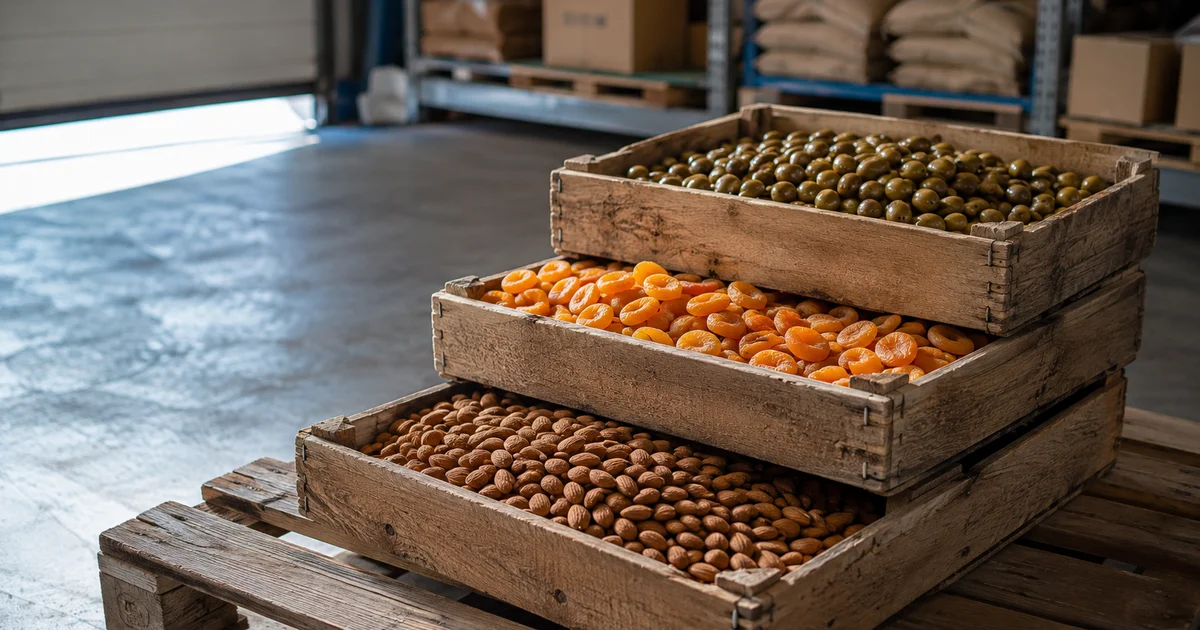
Fournisseur unique ou multi-sourcing : arbitrer pour un CHR
Single supplier or multi-sourcing for your foodservice business: advantages, dependency risks, logistics costs, and decision-making criteria based on establishment size.
Choosing between a single supplier and a multi-sourcing strategy is a structuring decision for any HoReCa establishment, gourmet grocery store, or bakery purchasing bulk dried fruits, dehydrated fruits, spices, or olives. This question goes beyond the simple purchase price: it impacts supply security, the administrative time spent on orders, shelf-life management, and the ability to handle a peak in activity. This article details the advantages and blind spots of each option, with decision criteria tailored to the size of your establishment.
Single supplier or multi-sourcing: the core issues for HoReCa
Before making a decision, it is essential to identify the criteria that truly matter in the daily operations of a restaurant, caterer, or gourmet grocery store. The question is not just “who offers the best price per kilogram” but “who guarantees reliable stock rotation, achievable free delivery thresholds, and complete batch traceability.”
- Supply security: ability to deliver even in case of supply chain tension for a specific origin or size.
- Logistics cost: number of deliveries, free delivery thresholds, and pallet transport consolidation.
- Administrative time: number of purchase orders, invoices, technical data sheets, and HACCP checks to process each month.
- Commercial dependency: exposure to a supply disruption, unilateral price increase, or change in terms.
- Product range consistency: a single point of contact for dried fruits, spices, olives, and bulk bakery products simplifies internal procurement.
These five criteria consistently feature in the decision-making process of the professionals we support, whether it’s a neighbourhood bistro or a regional purchasing centre.
The advantages of a single supplier for a restaurant or caterer
Consolidating purchases of dried fruits, spices, olives, and spreads with a single food wholesaler offers concrete benefits, particularly for mid-sized establishments without a dedicated procurement team.
- Simplified free delivery: a single order threshold to meet for free pallet delivery, instead of splitting volumes across multiple supplier accounts.
- Centralised traceability: one batch number, one shelf life, and one technical data sheet per SKU, accessible from a single point of contact in case of HACCP inspections.
- Easier negotiation: consolidated volume enables more favourable pricing terms or payment deadlines.
- Less administrative time: one purchase order, one invoice, and one delivery tracking process per week or month.
- Trust-based relationship: a supplier familiar with your culinary practices can better anticipate your seasonal needs (candied fruits during the holiday season, olives for summer aperitifs, etc.).
For a gourmet grocery store or restaurant placing modest but regular orders, this simplicity often outweighs a few pence difference per kilogram between suppliers.
The blind spots of a single supplier: dependency and stockouts
The trade-off for simplicity is a dependency risk that must be assessed before centralising all purchases with one partner. An establishment relying on a single wholesaler for all its dried fruits, spices, and olives exposes itself to difficult situations during peak season.
At Palimex, we regularly see HoReCa businesses entrusting us with their entire supply of dried fruits and spices, which makes sense for most of the references in our catalogue. However, our recommendation remains to maintain a second identified supplier, even if mostly inactive, for references most sensitive to seasonality, such as candied fruits or single-origin spices. An untested backup plan can prove more costly than keeping a supplier account on standby when needed.
- Supply disruption: a climatic or logistical issue affecting a specific origin can impact a reference without an immediate alternative.
- Asymmetric bargaining power: a supplier aware of being the sole provider may be less inclined to adjust terms.
- Sensitivity to minimum order quantities: if the usual format no longer suits a temporary drop in activity, you need to be able to switch to a smaller pack to adjust.
- Logistical side effects: a delivery incident (strike, transport issue) affects the entire product range instead of just a portion.
These blind spots do not disqualify the single-supplier model, but they require verifying the chosen wholesaler’s reliability upfront: track record, storage capacity, diversity of their own upstream sourcing, and batch transparency.
Multi-sourcing: securing supply at the cost of administrative complexity
Splitting purchases across multiple food wholesalers limits dependency on a single player, but this strategy comes with organisational costs that must be anticipated, particularly for small establishments.
- Multiple free delivery thresholds: each supplier has its own free delivery threshold, which can negate the benefit of free delivery for split orders.
- Dispersed batch and shelf-life tracking: more references, more technical data sheets, and more checks to cross-reference during internal HACCP audits.
- Increased administrative time: multiple purchase orders, invoices, and points of contact to chase in case of delays.
- Quality inconsistency: two suppliers may offer different sizes or origins for the same reference, complicating recipe standardisation.
In return, multi-sourcing provides genuine resilience: if one supplier faces a disruption, operations continue with another. This is a relevant option for establishments whose purchase volume justifies the additional management time or for references critical to the menu (a signature spice, a key dried fruit in a flagship recipe).
Comparison table: single supplier vs. multi-sourcing based on establishment size
The following table summarises the decision criteria to cross-reference with your establishment’s profile, from a small independent restaurant to a multi-site purchasing centre.
| Criteria | Single supplier | Multi-sourcing |
|---|---|---|
| Administrative time | Low: one purchase order, one invoice | High: tracking multiple accounts and technical data sheets |
| Logistics cost | Optimised if the free delivery threshold is regularly met | Risk of losing free delivery on small split orders |
| Supply security | Depends on the single supplier’s reliability | Better resilience in case of disruption with one partner |
| Commercial dependency | High | Low, with bargaining power distributed |
| Product range consistency | Strong, one catalogue to manage | Variable depending on respective product ranges |
| Recommended establishment | Independent restaurant, small gourmet grocery store, growing caterer | Multi-site group, purchasing centre, high-volume HoReCa |
How to decide based on the size and profile of your establishment
The right answer rarely follows a single rule: it is built according to the volume ordered, the number of sites to supply, and the criticality of each reference in your menu or product range.
- Independent restaurant or caterer, single site: prioritise a single supplier capable of covering all product ranges (dried fruits, spices, olives, bulk bakery products) to simplify administrative time and easily meet the free delivery threshold.
- Gourmet grocery store with several sensitive references: maintain a primary supplier but identify a second contact for the two or three references most exposed to seasonality or size variations.
- Multi-site group or purchasing centre: consider structured multi-sourcing, with a primary supplier for the majority of volume and one or two complementary suppliers to secure peak activity and urgent orders.
- Seasonal HoReCa (coastal, mountain): anticipate order peaks several weeks in advance with the primary supplier and negotiate upfront a backup option with a second provider for the high season.
In all cases, the quality of the packaging and pallet delivery offered by your primary supplier remains a decisive factor: a regularly achievable free delivery threshold often makes more difference than a marginal price difference.
Logistics best practices to secure your supply of dried fruits, spices, and olives
Regardless of the model chosen, certain practices reduce the risk of disruption and streamline daily administrative tracking, particularly for meeting the food sector’s traceability requirements.
- Anticipate orders for high-seasonality references (candied fruits, single-origin spices) rather than ordering on a just-in-time basis.
- Retain technical data sheets and batch numbers for each delivery to facilitate internal HACCP checks and shelf-life traceability.
- Verify your supplier’s delivery days and times to align with your own stock rotation cycles, especially at logistics hubs like Rungis where collection windows are tight.
- Periodically test a second supplier with a small order, even without immediate switching plans, to have an operational contact in case of emergencies.
- Monitor free delivery threshold changes and adjust order frequency to avoid paying for unconsolidated transport.
For establishments new to bulk ordering from a specialised food wholesaler, these habits are quickly adopted after the first few pallet deliveries. The general principles of traceability and hygiene applicable to food professionals are also available on the Ministry of the Economy’s website, useful for understanding your internal administrative obligations.
Summary: which strategy to adopt for your HoReCa establishment
The single-supplier model appeals for its administrative simplicity, easily achievable free delivery, and consistent product range across dried fruits, spices, olives, and spreads. However, it exposes businesses to dependency, which must be offset by rigorous vetting of the chosen supplier’s reliability. Multi-sourcing secures supply and distributes bargaining power but increases administrative time and may negate free delivery benefits on small orders. The right choice depends primarily on your establishment’s size, the number of sites to supply, and the criticality of each reference to your operations. For most single-site HoReCa businesses, a solid primary supplier, supplemented by a backup contact for sensitive references, offers the best balance between simplicity and supply security.
Further reading
Frequently asked questions
Everything you need to know about this topic.
A question?
Get in touch directly.

Marketing & Communications Manager — Palimex / Meyva
As Marketing & Communications Manager at Palimex / Meyva, Aude Moyne leads the company's communications and digital marketing strategy: editorial content, email campaigns and the promotion of its product ranges. Her experience at Palimex, a specialist in dried fruit, nuts, olives and spices for professionals, has given her in-depth knowledge of the products, their origins and uses, and the expectations of food-industry professionals. The blog articles are written or supervised by her, in collaboration with Palimex's sales and product teams whenever a topic calls for specific expertise.
Our advice related to Pro tips
 Pro tips
Paniers garnis de fin d'année pour les entreprises : les composer en épicerie fine
Composez des paniers garnis de fin d'année rentables pour entreprises et CSE : sélection de produits, formats stables, prix de revient et facturation B2B.
 Pro tips
Commandes de fin d'année : le calendrier d'achat d'un pâtissier-chocolatier, d'octobre à décembre
Commandes de fin d'année : calendrier d'achat d'octobre à décembre pour pâtissier-chocolatier. Cadencez fruits secs, confits et marrons sans rupture.
 Pro tips
Triman, REP et éco-contribution : l'emballage d'un préemballé alimentaire
Reconditionnement de denrées et vente au consommateur : obligations REP, identifiant IDU, signalétique Triman et Info-tri. Le guide légal pour les professionnels.