
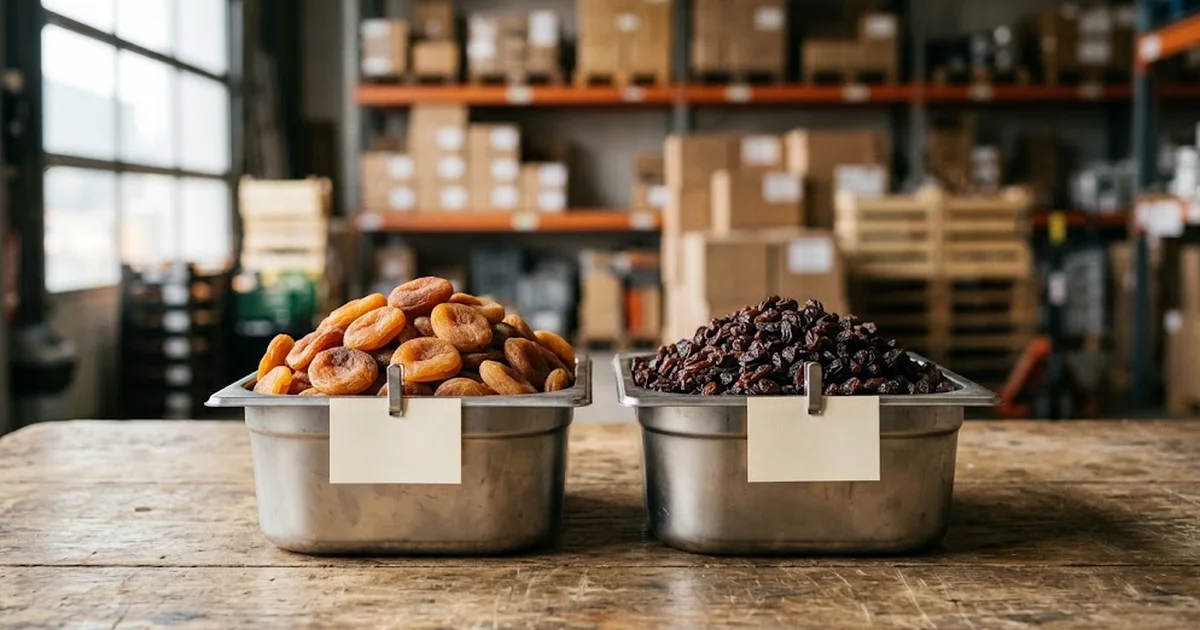
Bio : ce que le cahier des charges change au sourcing et au prix
How a supplier specification sheet impacts sourcing, storage, and pricing for foodservice and grocery businesses. A concrete analysis for professional buyers.
A supplier specification sheet is not just a list of requirements signed when opening an account. It redefines the entire supply chain: sourcing, transport, storage, documentary traceability, and thus the final price. For a professional purchasing in bulk—gourmet grocery, restaurant, pastry chef, or caterer—understanding what these requirements entail behind the scenes allows for smart decision-making between standard, well-traced sourcing and a supply chain under a reinforced framework, depending on the clientele and the establishment’s positioning.
What a reinforced framework actually imposes upstream in the supply chain
Before even discussing price, it’s essential to look at what changes at the source. Sourcing dried fruits, spices, or olives under a stringent framework means securing batches where cultivation, harvesting, and initial packaging comply with strict standards, from the field to the trader. This mechanically reduces the number of available suppliers and complicates decision-making in the event of climatic disruptions or shortages from a given origin.
- Dedicated plots: producers must isolate the relevant crops from others, limiting available volumes from certain origins.
- Enhanced documentation: every link—producer, exporter, importer, wholesaler—must justify its status, adding weight to procurement files.
- Less flexibility on substitutions: in case of shortages from one origin, it’s impossible to switch to an equivalent batch outside the framework without losing the certification.
- Regular controls: supply chain operators undergo periodic audits, incurring a structural cost reflected in the purchase price.
These constraints are not trivial for a wholesaler: they reduce the available product range and sometimes extend lead times, a sensitive issue for those managing tight stock rotation in professional kitchens.
Separate storage and batch traceability: the logistics a specification sheet imposes behind the scenes
Sourcing is only the first step. Once goods are received, a reinforced framework requires physical and documentary segregation that directly impacts warehouse organisation and HACCP procedures.
In practice, this means distinct storage areas, separate handling flows to prevent cross-contamination, and batch numbering tracked throughout the product’s lifecycle—from receipt to delivery at the point of sale. For a warehouse already managing dozens of SKUs in bulk, cardboard, and foodservice formats, adding a parallel traceability line represents a real organisational investment, not just an administrative one.
- Receipt with specific documentary checks for each batch.
- Storage in a dedicated location, isolated from other SKUs.
- Handling with sequenced cleaning procedures or equipment to prevent mixing.
- Tracking the batch number through to invoicing for full downstream traceability.
This logistical rigour explains why some wholesalers prefer to focus on impeccable standard traceability—known origin, controlled shelf life, consistent sizing—rather than multiplying parallel supply chains in an already extensive catalogue.
The price gap is not a margin—it’s a structural cost
A professional comparing two prices—standard sourcing and a supply chain under a reinforced framework—for the same dried fruit or spice often sees a significant difference depending on the SKU. It’s tempting to view this as an opportunistic commercial margin. In reality, this gap reflects real costs accumulated at every stage of the supply chain, not an arbitrary markup applied at the point of sale.
| Cost item | Standard traced sourcing | Supply chain under reinforced framework |
|---|---|---|
| Agricultural yield | Optimised, regular volumes | Often reduced, more climate-dependent |
| Number of available suppliers | Broad, flexible origins | Limited, fewer fallback options |
| Storage and handling | Shared flows | Dedicated zones and flows, additional logistical cost |
| Documentation and audits | Batch-documented traceability | Compliance checks at every link |
| Unit purchase volume | Possible bulk purchasing | Smaller batches, higher unit cost |
This table shows that the price gap is built long before products reach the shelf or kitchen. For a professional buyer, this changes the question: it’s not “why is this more expensive,” but “can my business justify this premium to my end customers.”
When a reinforced framework is commercially justified for foodservice or gourmet grocery
The question isn’t whether a certification is “better,” but whether it’s commercially relevant to your positioning. Some businesses can absorb the premium and leverage it with their clientele; others will lose competitiveness if they apply it across their entire menu.
- High-end gourmet grocery: a clientele sensitive to origin and willing to pay a higher price may justify a targeted selection on a few flagship SKUs.
- Restaurant with a short menu and stated commitment: incorporating one or two SKUs into signature dishes allows for communication without weighing down the entire procurement process.
- Event catering with demanding clientele: the premium can be directly passed on in a custom quote without impacting day-to-day margins.
- High-volume catering or fast-casual dining: the premium is harder to absorb on large volumes and constrained selling prices.
In all cases, the decision should be guided by the ability to pass the cost on to the average spend, not by a general belief about perceived quality.
At Palimex, we’ve observed for years that the real criterion for a professional’s choice isn’t the label, but consistency: a constant sizing, controlled shelf life, and origin traced batch by batch. Many of our foodservice and gourmet grocery clients tell us they prefer to invest in rigorous sourcing, with clear traceability and stable pricing, rather than managing a dual range they can’t always leverage in the kitchen.
How to decide between traced sourcing and additional certification on your menu
Before integrating a SKU under a specific framework into your offering, it’s useful to ask a few concrete questions rather than following a general market trend.
- Does my clientele explicitly demand this certification, or is it an assumption on my part?
- Can I pass on the premium without undermining my competitiveness on the rest of the menu?
- Is my purchase volume compatible with the available packaging in this supply chain, given the professional formats on offer?
- Do I have the logistical capacity to manage separate storage if I multiply the number of SKUs involved?
For many foodservice and gourmet grocery operators, the most cost-effective answer remains a rigorous selection of well-documented batches rather than a full range shift. It’s also a way to secure your sourcing strategy without relying on a single type of supply chain.
What Palimex prioritises: traceability, sizing, and consistency for every batch
Our catalogue is built on rigorous batch traceability, consistent sizing, and reliable supply tailored to the needs of professionals purchasing in bulk. This approach allows us to offer stable prices on large volumes while guaranteeing a documented origin for every SKU.
For professionals looking to build a commercial argument around origin or sourcing quality without relying on a specific certification, several levers remain available:
- Highlight the sizing and visual consistency of dried fruits or olives, a very concrete criterion for pastry chefs and artisans.
- Emphasise freshness and controlled shelf life through optimised stock rotation.
- Communicate the precise origin of the batch when known and documented in the product sheet.
- Leverage consistent supply to reassure foodservice clients about the continuous availability of a product.
Key takeaway: decide based on your business model, not trends
A reinforced specification sheet imposes real constraints at every stage—limited sourcing, separate storage, enhanced documentation—which explain a structural price gap, not an opportunistic margin. For a foodservice or gourmet grocery professional, the relevant question isn’t “which certification to display,” but “can I leverage it with my clientele and integrate it without complicating my logistics.” A targeted selection, reserved for a few high-perceived-value SKUs, often remains more cost-effective than a full range shift. In all cases, consistency, batch traceability, and sizing stability remain the criteria that make a daily difference in professional kitchens.
For more information on the regulatory framework applicable to labelling and claims in the food sector, you can consult the public resources of the DGCCRF — food regulation.
Further reading
Frequently asked questions
Everything you need to know about this topic.
A question?
Get in touch directly.

Marketing & Communications Manager — Palimex / Meyva
As Marketing & Communications Manager at Palimex / Meyva, Aude Moyne leads the company's communications and digital marketing strategy: editorial content, email campaigns and the promotion of its product ranges. Her experience at Palimex, a specialist in dried fruit, nuts, olives and spices for professionals, has given her in-depth knowledge of the products, their origins and uses, and the expectations of food-industry professionals. The blog articles are written or supervised by her, in collaboration with Palimex's sales and product teams whenever a topic calls for specific expertise.
Our advice related to Pro tips
 Pro tips
Paniers garnis de fin d'année pour les entreprises : les composer en épicerie fine
Composez des paniers garnis de fin d'année rentables pour entreprises et CSE : sélection de produits, formats stables, prix de revient et facturation B2B.
 Pro tips
Commandes de fin d'année : le calendrier d'achat d'un pâtissier-chocolatier, d'octobre à décembre
Commandes de fin d'année : calendrier d'achat d'octobre à décembre pour pâtissier-chocolatier. Cadencez fruits secs, confits et marrons sans rupture.
 Pro tips
Triman, REP et éco-contribution : l'emballage d'un préemballé alimentaire
Reconditionnement de denrées et vente au consommateur : obligations REP, identifiant IDU, signalétique Triman et Info-tri. Le guide légal pour les professionnels.