
Retrait-rappel : la procédure quand un lot part en RappelConso
Targeted by a RappelConso notice? Blocking, batch identification, customer notification, display, return: the complete procedure for wholesalers and foodservice professionals.
When a supplier, manufacturer, or health authority initiates a product recall or withdrawal on an item you have received, stored, or already delivered to your professional clients, every hour counts. For a food wholesaler or fine grocer stocking dried fruits, spices, olives, or dehydrated fruits, the question is not whether this could happen one day, but how to respond when it does. This article details the operational procedure to follow as a professional: physical blocking, identification by batch number, notification of served clients, in-store display, and then return or destruction of the affected product.
Understanding product withdrawal and recall and the RappelConso procedure for professionals
A withdrawal involves stopping the sale of a product before it reaches the end consumer; a recall occurs when units have already been sold or delivered and need to be retrieved upstream in the supply chain. The official RappelConso platform centralises notices published in France and serves as the reference to consult regularly for any food distribution professional, regardless of size.
- Withdrawal: The product is blocked in the warehouse, at the point of sale, or with the distributor before any handover to the end customer.
- Recall: The product has already left the professional’s direct control circuit and must be identified at the served clients’ premises, then retrieved or handled on-site.
- RappelConso notice: An official publication listing the product reference, the affected batch number(s), the reason (contamination, foreign body, undeclared allergen, etc.), and the required action.
In both cases, the underlying logic remains the same: define the exact scope of the batch, prevent any further release, and relay the information both upstream (supplier, manufacturer) and downstream (served clients).
Immediate physical blocking: isolate the affected batch in the warehouse
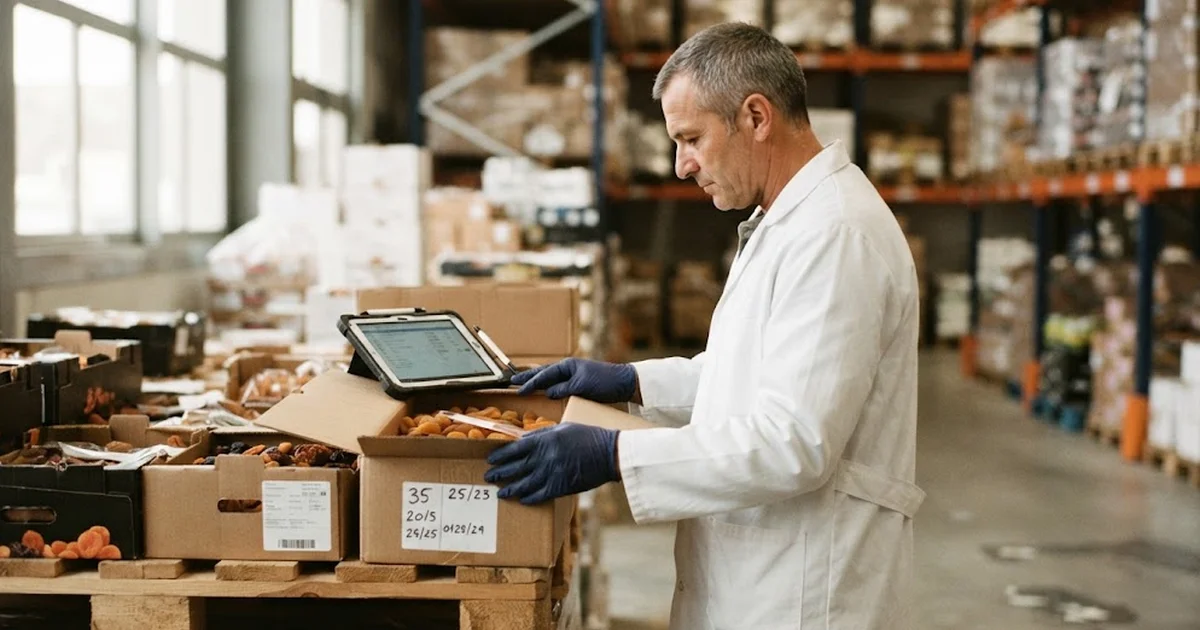
The first action, upon receiving a supplier alert or a RappelConso notice, is to physically block any quantity of the batch still present in your premises, even before understanding the recall details. The objective is simple: no unit of the targeted batch should be able to leave for order preparation, shelving, or delivery while verification is underway.
- Physically isolate the affected cartons, bags, or drums in a designated area, away from the regular preparation flow.
- Suspend any new release of the product reference, including non-targeted batches, while verifying they are not affected.
- Apply a visible label to the blocked pallets or containers without waiting for written confirmation from the supplier.
- Check ongoing and already validated but not yet dispatched orders for the same reference.
- Record the time and date of the blocking: this information will be required in case of an inspection or supplier request for justification.
- Compile the complete list of delivered clients from delivery notes and order history.
- Contact each client via the fastest available channel (phone, professional email) specifying the reference, batch number, and reason for the recall.
- Clearly state the required action: immediate blocking of remaining stock, non-use in preparation, return or destruction as per agreed terms.
- Confirm the notification in writing to have a record of the date and time of the alert.
- Follow up with each client to ensure the message was received and understood, particularly for businesses that may be temporarily closed (foodservice, artisans).
- The exact date and quantity of each supplier batch received.
- The storage location occupied by the batch during its time in the warehouse.
- The complete list of clients who received part of the batch, with quantity and dispatch date.
- The link between the supplier batch number and your own outgoing delivery notes.
- The remaining shelf life (BBD) at the time of each dispatch.
This blocking must remain in place until explicit confirmation that the batch is outside the recall scope or until instructions for destruction or return are received. The rigour of this step determines the reliability of all subsequent actions: a poorly isolated batch may continue to circulate in error, significantly complicating crisis management.
Identification by batch number: precisely define the recall scope
The batch number is the cornerstone of any withdrawal or recall procedure. It allows distinguishing, within the same product reference, the affected units from those that are not. Effective crisis management relies on the ability to quickly cross-reference this number with your own reception records and outgoing delivery notes.
| Information to collect | Where to find it | Use in the procedure |
|---|---|---|
| Exact batch number | Carton label, bag, supplier delivery note | Precisely isolate the affected units without unnecessarily blocking other batches of the same reference |
| Reception date | Reception register, incoming delivery note | Verify the total quantity received for this batch and associated stock movements |
| Best-before date (BBD) / Date of minimum durability (DMD) of the batch | Product label or internal article sheet | Confirm that the recalled batch matches the durability stated in the official notice |
| Quantity shipped per client | Outgoing delivery notes, order history | Establish the exact list of clients who received all or part of the batch |
| Reason for recall | RappelConso notice or supplier correspondence | Adapt the notification message sent to served clients |
This identification must be exhaustive before any communication with clients: transmitting incomplete or approximate batch number information creates confusion and may lead a client to mistakenly block stock that is not affected.
Notifying served clients: the wholesaler’s duty to alert downstream
Once the batch scope is confirmed, the next step is to promptly notify each professional client who received all or part of the affected batch. This notification must be direct, preferably named, and not limited to a simple reference to the RappelConso notice.
For a professional end client—restaurateur, pastry chef, fine grocer—this downstream alert is essential: it allows them to check their own stock and, if necessary, inform their diners or customers. The information chain does not stop at the first link.
Display, return, or destruction: possible outcomes based on the sales channel
Once the batch is blocked and clients are informed, the final fate of the product must be determined. The procedures differ depending on whether the batch is still in the warehouse, in a cash & carry outlet, or already delivered to an end client.
| Batch location | Required action | Key consideration |
|---|---|---|
| Stock still in warehouse, not shipped | Blocking, quarantine, return or destruction as per supplier instructions | Never return the batch to circulation before written confirmation of release |
| Batch on display in a cash & carry outlet | Immediate removal from shelves, display of a notice for visiting professionals | The notice must clearly state the reference and affected batch number |
| Batch already delivered to a professional client | Client alert, organisation of return or on-site destruction as per mutual agreement | Retain proof of return or destruction (return note, certificate) |
On-site destruction, when chosen, must be documented: date, quantity destroyed, method. When return to the supplier is possible, it must be accompanied by a return document stating the batch number to close the case verifiably for all parties.
What your upstream traceability must enable in a crisis
The withdrawal and recall procedure is only the visible part of a system built upstream, daily, through the maintenance of reception, storage, and dispatch records. Without this foundation, no rapid batch identification is possible when an alert occurs.
At Palimex, we observe that the most swiftly resolved recall cases are those where the professional client has consistently maintained the link between reception, storage, and dispatch. A batch number jotted down on a misplaced notebook costs more than a well-kept register: the time lost reconstructing the history translates into stress and uncertainty for your own clients.
This organisation aligns with the principles already detailed in our article on HACCP traceability in day-to-day management: the crisis procedure described here relies entirely on the rigour of this daily record-keeping. Without reliable records, the blocking and batch identification phase becomes much longer, increasing the risk of allowing an affected unit to circulate.
Summary: secure each step of the withdrawal and recall to protect your professional clients
A well-managed withdrawal or recall relies on a simple but rigorous sequence: immediate physical blocking of the batch, precise identification by batch number from your records, prompt notification of each served client, then display, return, or destruction based on the product’s location. Each of these steps depends on the quality of your upstream traceability, maintained daily and not improvised during a crisis. For professionals who order in bulk—fine grocers, foodservice, pastry chefs, and artisans—this rigour protects both your business and that of your served clients. It is part of a broader approach to packaging and stock rotation management, appropriate storage in the warehouse, and bulk order logistics, all areas where daily vigilance makes all the difference when an incident occurs. To follow official notices in real time, regularly consulting the RappelConso platform remains the basic reflex for any food distribution professional.
Further reading
Frequently asked questions
Everything you need to know about this topic.
A question?
Get in touch directly.

Marketing & Communications Manager — Palimex / Meyva
As Marketing & Communications Manager at Palimex / Meyva, Aude Moyne leads the company's communications and digital marketing strategy: editorial content, email campaigns and the promotion of its product ranges. Her experience at Palimex, a specialist in dried fruit, nuts, olives and spices for professionals, has given her in-depth knowledge of the products, their origins and uses, and the expectations of food-industry professionals. The blog articles are written or supervised by her, in collaboration with Palimex's sales and product teams whenever a topic calls for specific expertise.
Our advice related to Pro-tips
 pro-tips
Safety Stock and Reorder Point in Foodservice Wholesale
Safety stock and reorder point in foodservice wholesale: the formula, a step-by-step numerical example, and how packaging impacts the calculation.
 pro-tips
Cycle Counting: Counting Without Halting B2B Operations
Cycle counting method for grocery and foodservice: segmentation by product family, frequency based on turnover, acceptable discrepancies, and handling recurring variances.
 pro-tips
Origin and Provenance: Mandatory B2B Disclosures
Origin, provenance, processed products: what a B2B buyer must verify on product datasheets and traceability documents before making any claims.