
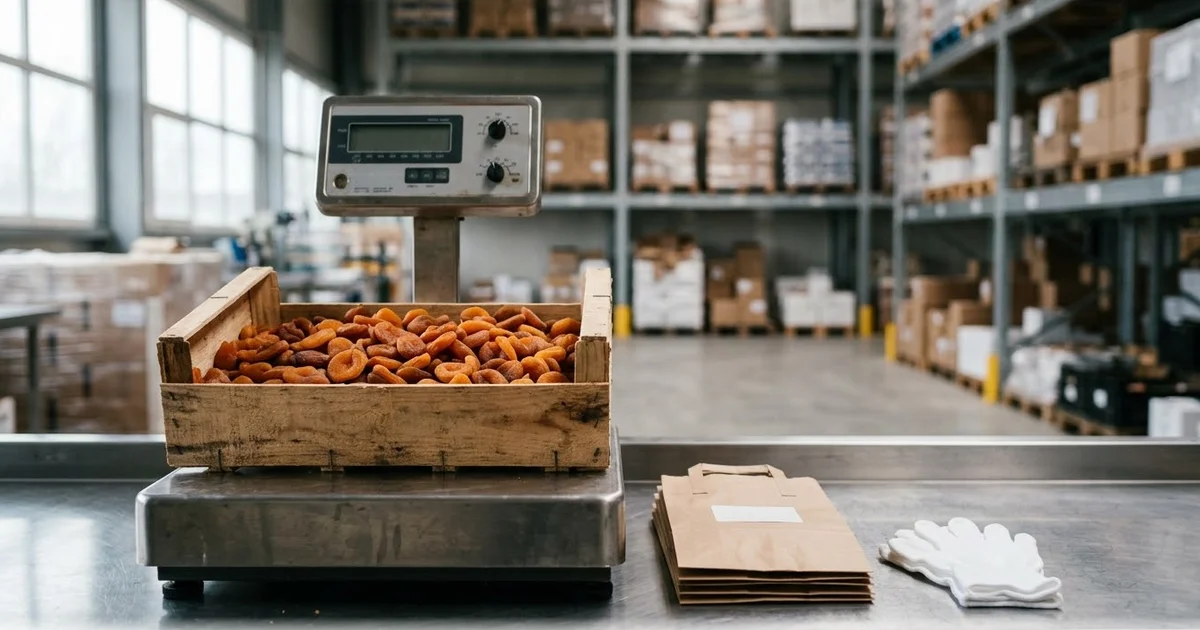
HACCP Dried Fruits: Best-Before Date, Traceability, Reception
HACCP dried fruits: reception control, best-before date vs use-by date, batch traceability, FIFO storage, and allergens. The reference guide for professionals.
For a food wholesaler as well as for their professional clients — gourmet grocery stores, restaurateurs, pastry chefs, caterers — mastering the HACCP chain does not stop in the kitchen. It begins as soon as goods are received and continues through to storage, labelling, and batch traceability. Dried fruits, dehydrated fruits, spices, and olives follow specific logics, different from those of fresh products, but just as demanding in terms of documentary rigour and storage conditions. This article reviews the professional best practices to know in order to secure your supplies and meet your own obligations towards your clients.
Reception control: the first step in sanitary compliance
Every delivery of dried fruits or spices in professional packaging must undergo a systematic check before being accepted into stock. This control aims to ensure that the goods match the order, that they have not suffered during transport, and that the documents accompanying the packages are consistent with the delivered content.
In practice, a structured reception control relies on several simultaneous checks:
- Visual check of package integrity: boxes not torn, no signs of moisture, pallets properly wrapped, bags or bulk without tears.
- Verification of the vehicle and product temperature upon arrival, particularly for dehydrated fruits sensitive to ambient humidity during loading breaks.
- Compliance of the delivery note with the initial order: product references, quantities, batch numbers, announced best-before dates.
- Olfactory and visual control by sampling a few units: absence of mouldy, rancid, or fermented odours.
- Presence of mandatory labelling information on boxes or bags: denomination, origin, allergens, batch number.
Any anomaly detected must be recorded in writing — note on the delivery note, photograph, letter to the supplier — in order to keep usable evidence in case of dispute or proven non-compliance. This documentary rigour is also what allows, if needed, to quickly trace the origin of a problem.
Best-before date or use-by date: why dried fruits follow a different logic
Confusion between the best-before date (date of minimum durability, formerly known as best-before date or “best before”) and the use-by date remains common, even among experienced professionals. It deserves clarification as it structures the entire stock management of a wholesaler of dry products.
The use-by date applies to microbiologically perishable foodstuffs, which may pose a health risk after a given date: fresh products, dairy products, meats, preparations based on fresh ingredients. After the use-by date, the product must no longer be sold or consumed.
The best-before date, on the other hand, applies to products whose organoleptic characteristics may change over time — loss of crispness, lipid oxidation, fading of aromas — without this constituting an immediate health risk when storage conditions have been respected. Dried fruits (almonds, nuts, hazelnuts, pistachios), dehydrated fruits (apricots, figs, raisins, dates), and most spices fall into this category, precisely because their low water content greatly limits microbial development under correct storage conditions.
| Criterion | Use-by date | Best-before date |
|---|---|---|
| Nature of risk after the date | Potential health risk | Qualitative change, no direct danger if storage is correct |
| Products concerned | Fresh and perishable foodstuffs | Dried fruits, dehydrated fruits, spices, oilseeds |
| Sale after the indicated date | Prohibited | Regulated, under the professional's responsibility |
| Mention on packaging | “Use by” | “Best before” |
| Determining factor | Microbial load | Storage conditions (humidity, temperature, light) |
This distinction, however, does not exempt from vigilance: an exceeded best-before date does not authorise indiscriminate sale. It is up to the professional to assess, based on an organoleptic check, whether the product retains the qualities expected by the end customer. The precise regulatory text governing these obligations is available from the DGCCRF, which remains the official reference on the matter.
Batch traceability and recall obligation
Traceability is the cornerstone of any serious HACCP approach. For a wholesaler as well as for a professional client purchasing in 5 kg cartons or bulk, being able to associate each sold unit with a precise batch number is what allows, in case of a health alert, to quickly circumscribe the scope of a potential recall or withdrawal.
An operational traceability system relies on a few simple but non-negotiable principles:
- Systematically record the supplier's batch number upon reception, linked to the date and corresponding delivery note.
- Retain this information for a period consistent with the product's best-before date, plus a safety margin.
- Be able to reconstruct, at any time, the path of a batch from its origin to its exit from stock (client, quantity, date).
- Have a written recall procedure, even simplified, specifying who alerts whom and how the affected clients are recontacted.
- Physically isolate any batch suspected of non-compliance, rather than leaving it mixed with the rest of the stock.
This ability to trace a batch in a few minutes, rather than several days, often makes the difference between a managed incident and a crisis that spreads to the entire stock. It is also a criterion that CHR clients and gourmet grocery stores increasingly evaluate when choosing their wholesaler.
At Palimex, every received batch is recorded even before it is placed in the storage area. Our field experience has taught us that approximate traceability always comes at a cost when it is most needed, that is, in an emergency. We prefer to invest administrative time upfront rather than lose it in crisis management.
Professional storage: humidity, temperature, and FIFO rotation
Dried fruits and dehydrated fruits are sensitive to ambient humidity, which accelerates mould development and alters product texture. A professional warehouse must therefore be designed to maintain stable conditions, protected from direct light and sudden temperature variations, with sufficient ventilation to avoid condensation points.
Stock rotation according to the FIFO (First In, First Out) principle remains the reference method for limiting unnecessary ageing of products on shelves or in reserve. It applies to both bulk and palletised cartons.
- Storage away from moisture: avoid areas near water sources, poorly insulated loading docks, or floors susceptible to capillary rise.
- Physical separation by product family: highly aromatic spices should not be stored in direct contact with dried fruits to avoid odour transfer.
- Elevated palletisation rather than floor storage, to limit moisture rise and facilitate visual inspection.
- Visible labelling of dates and batch numbers on each pallet or carton, to apply FIFO without misinterpretation.
- Periodic checks of the condition of the oldest stocks, even when commercial rotation is fast.
Rigorous storage management also helps avoid the most common mistakes in this area. We detail the most frequent pitfalls in our article 5 mistakes that cause your dried fruits to mould, which usefully complements the principles discussed here. For more details on precise conditions by product family, also consult our guide on professional storage of dried and dehydrated fruits.
Pests and dried fruits: constant vigilance in the warehouse
Dried fruits, dehydrated fruits, and oilseeds are prime targets for certain warehouse pests, particularly stored product insects. An infestation, even localised, can compromise an entire batch and engage the responsibility of the professional who allowed it to develop.
Prevention relies primarily on a combination of structural and organisational measures:
- Regular inspection of storage areas, particularly hard-to-reach corners and long-standing pallets.
- Installation of detection traps to identify pest presence before it becomes an infestation.
- Immediate isolation of any carton or bag showing suspicious signs (perforations, dust, threads).
- Systematic cleaning of storage areas between two receptions, with removal of floor residues.
- Staff training in recognising the first signs of infestation, for quick reporting.
This vigilance is part of a continuous prevention logic rather than curative treatment, the latter always being more costly and time-consuming to implement once an infestation is already established.
Allergen labelling: tree nuts and sulphites
Allergen labelling is a particular point of vigilance for dried fruits and dehydrated fruits, two categories directly concerned by two major allergen families: tree nuts (almonds, nuts, hazelnuts, pistachios, cashews) and sulphites, frequently used as preservatives on certain dehydrated fruits (apricots, raisins in particular).
For a wholesaler, the challenge is twofold: ensuring that the information passed on to professional clients is complete and accurate, and enabling these clients to correctly relay this information to their own end customers, whether it is a restaurateur displaying their menu or a pastry chef labelling their preparations.
| Allergen | Palimex products concerned | Professional point of vigilance |
|---|---|---|
| Tree nuts | Almonds, nuts, hazelnuts, pistachios, cashews | Risk of cross-contamination in case of shared storage with other families |
| Sulphites | Dried apricots, raisins, some treated dehydrated fruits | Mandatory mention once a presence threshold is reached |
| Tree nuts and sulphites combined | Aperitif mixes, dried fruit and nut blends | Check the complete ingredient list of each component in the mix |
Each carton and each product sheet must clearly indicate the presence of these allergens, in accordance with current requirements, the regulatory details of which are available on the DGCCRF website. We recommend that our professional clients keep the technical sheets provided with each order, in order to present them in case of inspection or a query from an end customer. To delve deeper into this topic, our dedicated article on allergen labelling for dried and dehydrated fruits details the most frequently encountered specific cases.
From order to customer service: securing the entire supply chain
Beyond isolated control points, it is the consistency of the entire chain — sourcing, reception, storage, labelling, traceability — that ensures the reliability of a supply of dried fruits, dehydrated fruits, spices, and olives for professional use. Each link depends on the previous one, and a weakness at any single level can undermine the entire process.
A few reflexes help to secure this chain durably:
- Choose a supplier capable of clearly communicating their own control and traceability practices, rather than just opting for a competitive price.
- Formalise internal reception control procedures in writing, even briefly, to ensure their systematic application by the entire team.
- Document every anomaly, even minor, to build a useful history in case of recurrence.
- Regularly train reception and storage staff in the basics of food hygiene applicable to dry products.
- Anticipate order peaks (seasons, holidays) by verifying that storage capacities remain compatible with proper FIFO rotation.
This comprehensive approach aligns with the principles we ourselves apply as a wholesaler since 1984: demanding sourcing, packaging adapted to professional uses, and traceability designed to quickly answer any question from our clients.
Summary: key points for reliable HACCP management of dried fruits
Sanitary control of dried fruits, dehydrated fruits, spices, and olives relies on a sequence of simple but rigorous best practices: systematic reception control, a clear understanding of the best-before date logic specific to dry products, operational batch traceability under all circumstances, controlled storage in terms of temperature and humidity, constant vigilance against pests, and flawless allergen labelling. None of these points works in isolation: it is their combined application that ensures the reliability of a professional supply over time. For the precise regulatory text governing each of these obligations, the DGCCRF remains the reference source to consult.
Further reading
Frequently asked questions
Everything you need to know about this topic.
A question?
Get in touch directly.

Marketing & Communications Manager — Palimex / Meyva
As Marketing & Communications Manager at Palimex / Meyva, Aude Moyne leads the company's communications and digital marketing strategy: editorial content, email campaigns and the promotion of its product ranges. Her experience at Palimex, a specialist in dried fruit, nuts, olives and spices for professionals, has given her in-depth knowledge of the products, their origins and uses, and the expectations of food-industry professionals. The blog articles are written or supervised by her, in collaboration with Palimex's sales and product teams whenever a topic calls for specific expertise.
Our advice related to Pro tips
 Pro tips
Paniers garnis de fin d'année pour les entreprises : les composer en épicerie fine
Composez des paniers garnis de fin d'année rentables pour entreprises et CSE : sélection de produits, formats stables, prix de revient et facturation B2B.
 Pro tips
Commandes de fin d'année : le calendrier d'achat d'un pâtissier-chocolatier, d'octobre à décembre
Commandes de fin d'année : calendrier d'achat d'octobre à décembre pour pâtissier-chocolatier. Cadencez fruits secs, confits et marrons sans rupture.
 Pro tips
Triman, REP et éco-contribution : l'emballage d'un préemballé alimentaire
Reconditionnement de denrées et vente au consommateur : obligations REP, identifiant IDU, signalétique Triman et Info-tri. Le guide légal pour les professionnels.