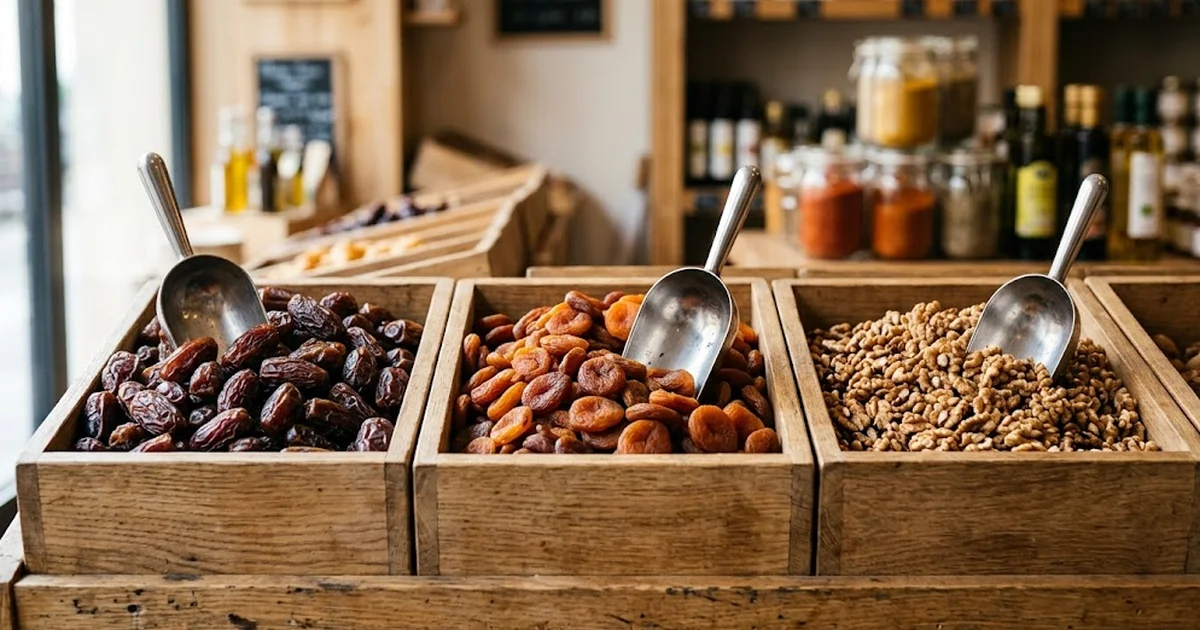
Key takeaways for professionals
- Transparent sourcing: require batch-by-batch analyses from your supplier
- Stable storage: 12 to 18 °C with 50 to 60 % relative humidity
- Strict FIFO: labelling with 3 dates (intake, production, best-before)
- Repacking: vacuum-sealed or nitrogen-flushed depending on volume
- Quality control: hygrometer + organoleptic testing on every delivery
Whether you are a greengrocer, a fine grocer or a supermarket manager:
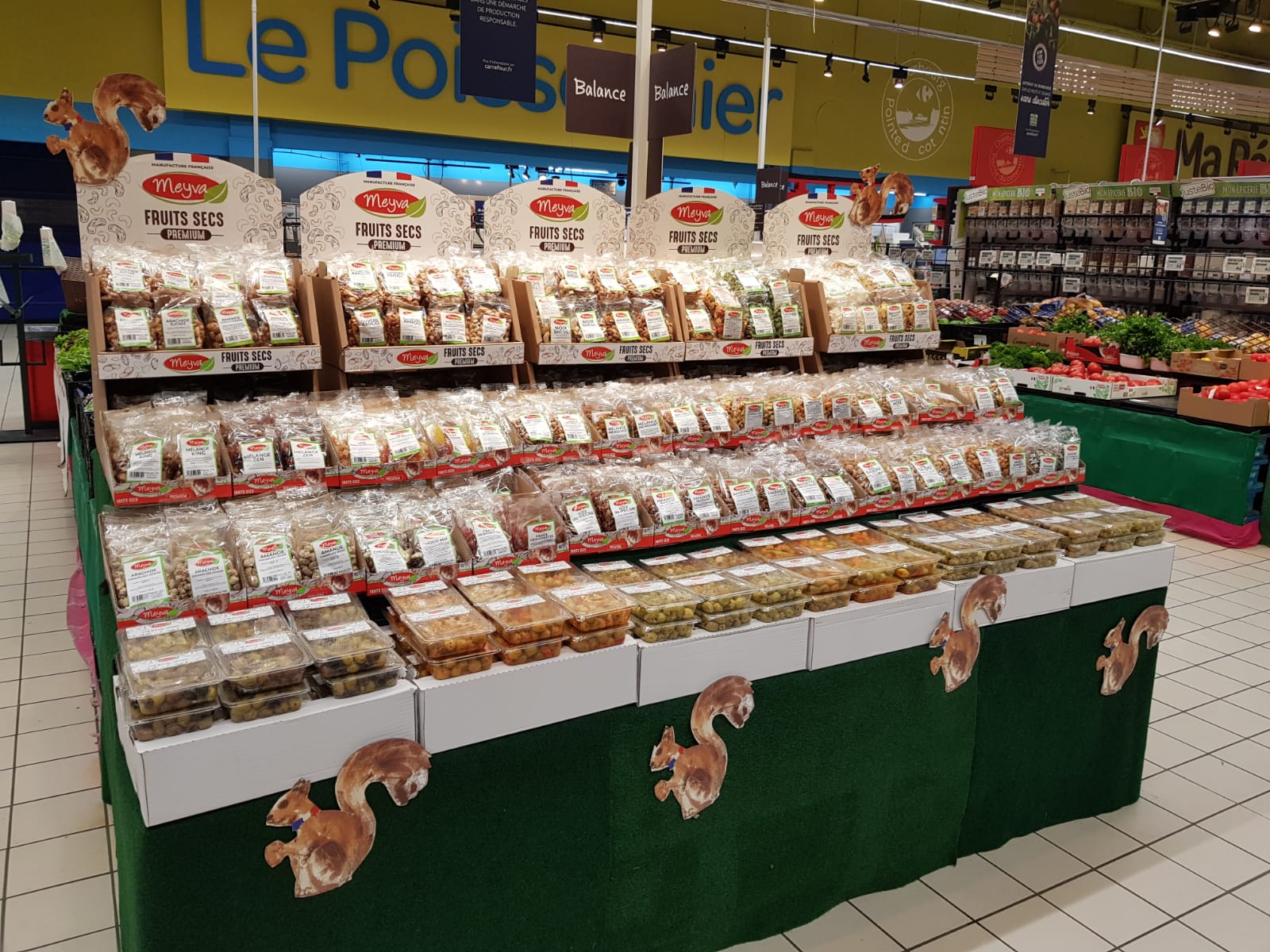
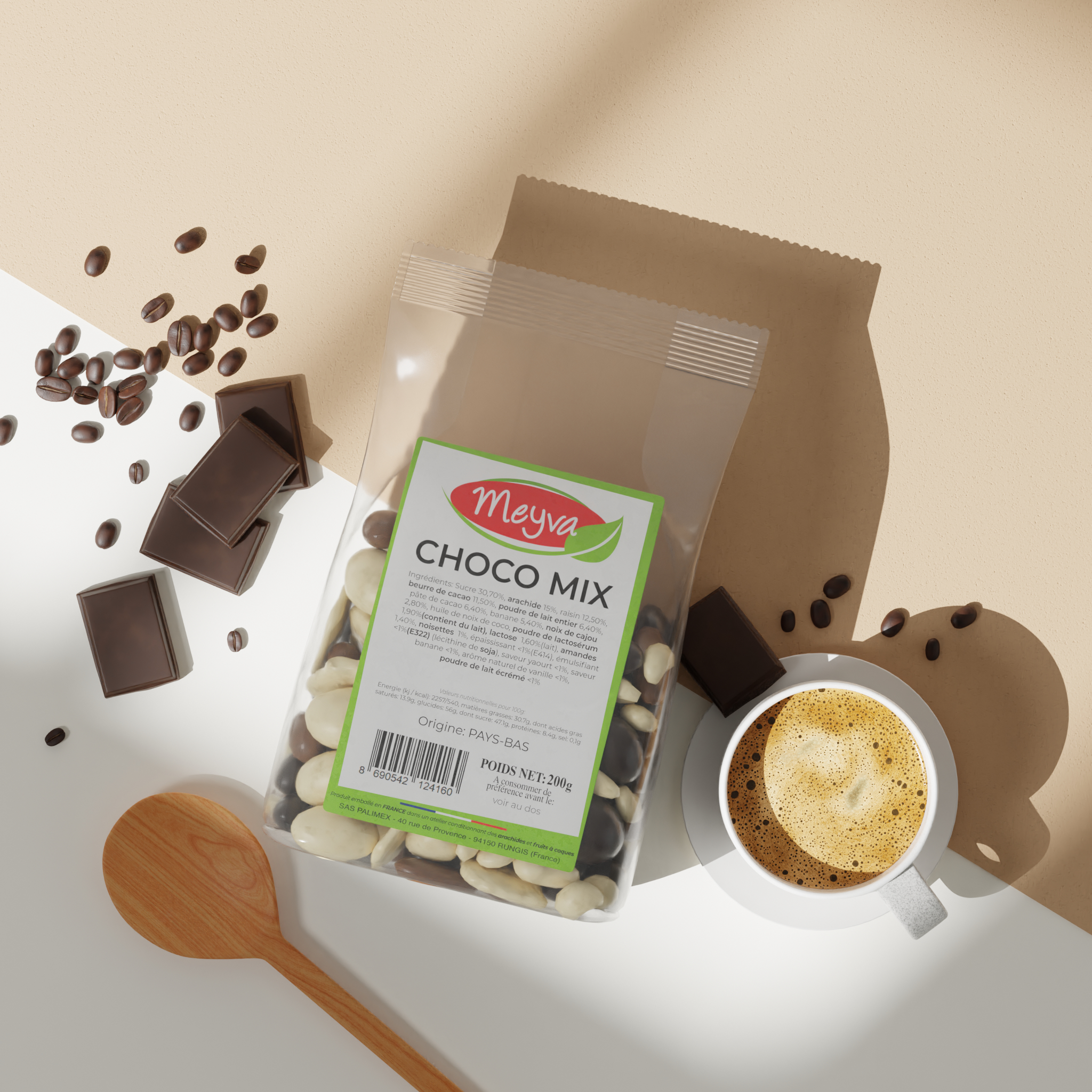
Every reason to choose #meyva_fruitsecs dried fruits in wood-cellulose bags #OKHOMECOMPOST
-
Fruit quality : Meyva dried fruits are known for their quality. They are made from carefully selected fruit and dried in a way that preserves their natural flavour, their texture and their nutrients.
-
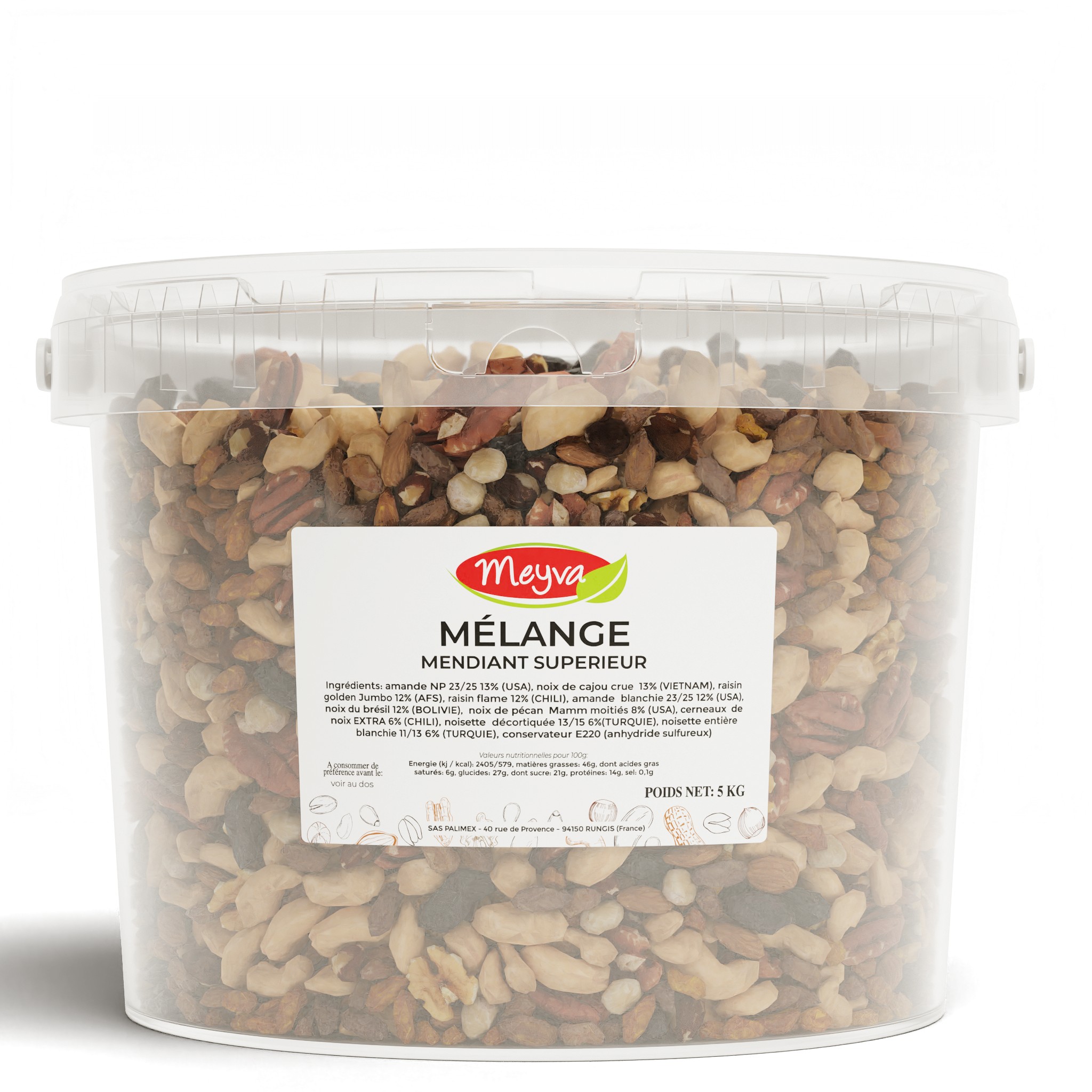
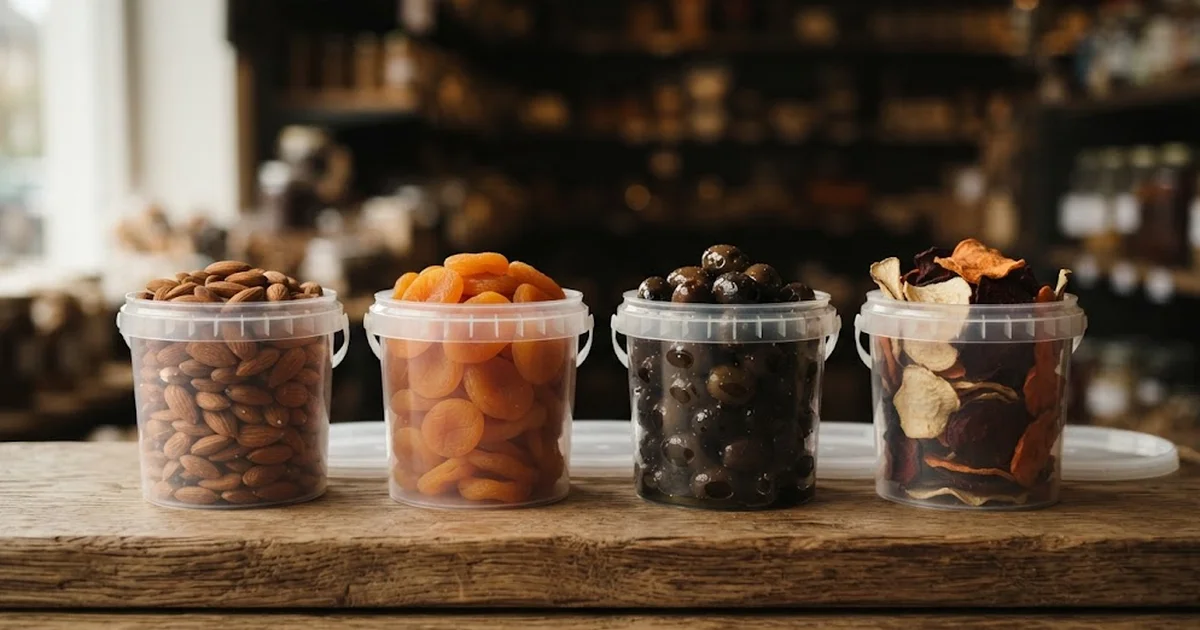
A wide choice: Meyva dried fruits offer an extensive range. Their bags hold many different kinds of dried fruit, such as almonds, dried apricots, dried figs, hazelnuts and many more. That variety caters to a broad span of tastes and preferences.
-
Freshness and shelf life: Meyva dried fruit bags are designed to keep the fruit fresh. They are hermetically sealed to preserve quality and flavour. Dried fruits are also known for their long shelf life, which means they can be enjoyed over an extended period.
-
Nutrients and health benefits: Meyva dried fruits are a natural source of health-promoting nutrients. They contain fibre, vitamins, minerals and antioxidants. Dried fruits are also valued for the energy they provide and their ability to quickly satisfy a small hunger.
-
Versatility: Meyva dried fruits can be eaten on their own as a healthy snack, added to cereals, used in pastry recipes or worked into savoury dishes. Their culinary versatility makes them easy to bring into a wide range of meals and preparations.
No colourings
No preservatives
No added oil
Craft roasting at the Palimex manufactory in Rungis
And you? How do you like our dried fruits best?
Superior-quality dried fruits, for premium positioning.
Selecting the finest dried fruits starts with choosing the best varieties, grades and origins, along with the largest calibres.
Our manufactory at the Rungis wholesale market – Listening to you, at your service
In 2020 we developed a dedicated dried-fruit roasting operation and a specific seasoning process. Mastery, quality and innovation are so many strengths that set us apart.
Our dedicated packing lines, our responsiveness and our flexibility allow us to meet every request for bespoke products and packaging.
MEYVA, your health partner!
« For iron-clad health ».
We invite you to step away from mass-market products and discover, through our range, authentic dried fruits with a soul.
Summary table of B2B standards
| Criterion | B2B standard | Best practice |
|---|
| Sourcing | Traced origins (Morocco, Tunisia, Iran, California) | Samples + batch-by-batch analyses |
| Quality | Moisture < 6 %, aflatoxin below the EU threshold | Hygrometer + ISO 712 |
| Storage | 12-18 °C, 50-60 % ambient humidity | Vacuum or nitrogen for high-fat products |
| Packaging | Multilayer bags, INCO labelling | Allergens + supplier traceability |
| Logistics | Strict FIFO, 15-day stocktake on sensitive lines | 3 legible dates per container |
Practical advice for professionals
For wholesalers, greengrocers and caterers, the stakes lie in the daily routine — rigorous supplier selection, quality control on every delivery and documented traceability. Operators who structure these processes achieve a product consistency that keeps their end customers loyal.
Going further
Further reading on our blog:
B2B context and sector best practice
In a B2B market where quality requirements keep rising — traceability, food safety, end-customer expectations — mastering these fundamentals is a tangible, measurable competitive advantage. Operators who secure their supply chain upstream protect their net margin downstream, and that is often what separates a wholesaler who holds his order book over 5 years from one who watches his customers leave for the first cheaper competitor. The 2024-2026 period saw an 18 % rise in DDPP inspections across the dried-fruit sector in France, a sign that regulation is tightening in step with consumer expectations. Penalties for non-compliance can quickly amount to several months of gross margin, without counting the reputational damage.
For a wholesaler, a greengrocer or a caterer, turning these standards into a weekly operational routine is what separates a reliable supplier from a fragile one. The best practices described in this article apply whatever your volume — from 50 kg a week to several pallets a day — with proportional adjustments in equipment and investment, but with the same methodological rigour. Quality does not move down-market because volume moves up; on the contrary, it becomes an even more strategic matter. This is exactly the philosophy that sets the leaders of the French professional dried-fruit market apart.
On the commercial side, B2B customer satisfaction rests largely on consistency — a dried fruit must taste, feel and look the same from one batch to the next. It is precisely that consistency which is undermined by common storage and stock-management mistakes. Investing in training for the teams in the receiving and storage areas usually pays back more than a new piece of equipment, at far lower cost. The bakers, pastry chefs, caterers and restaurateurs who are your end customers are not buying a price — they are buying a guarantee of consistency, and they are willing to pay 10 to 15 % more to get it.
The systemic approach remains the best one: audit your warehouse twice a year, measure your losses as a percentage of stock, and compare those metrics against sector standards (3-4 % for a well-run wholesaler, 1-2 % for the best operators). Bringing these figures to light immediately reveals the real levers for improvement and makes it possible to prioritise investment. Many operators focus on purchase price when the largest savings are hidden in reducing storage losses and downstream logistics losses. A quick calculation: if you buy 200 tonnes a year at 8 €/kg and lose 5 % in storage, that is 80,000 € going into the bin every year — far more than a well-chosen 10,000 € equipment investment costs over 5 years.
Upstream sourcing also plays a decisive role: a supplier who is transparent about delivery moisture, drying times and aflatoxin controls gains you several weeks of commercial shelf life. Favour supply chains that agree to share their batch-by-batch analyses over those that make do with a generic certificate. That difference in transparency translates directly into margin over 12 months of operation. The Moroccan, Tunisian, Turkish and Iranian supply chains are today among the best structured on these matters, provided you choose the right contact — a broker and a direct importer are not equivalent in terms of access to traceability information.
On the regulatory front, DGCCRF and DDPP inspections focus on traceability chains, allergen labelling (tree nuts having been mandatory declarations since regulation INCO 1169/2011) and the compliance of packaging with migration standards. Non-conformities on dried fruits are generally due to an incomplete label rather than a product defect. An internal audit of your labelling process every six months eliminates 80 % of regulatory risk at almost no cost. Fines can rise to 1,500 € per non-compliant batch, and the publicity around a customer recall generally costs far more in lost trust than the fine itself.
To go further, talk regularly with your peers in the sector through the professional federations (FIAC, ANIA, FNDPA, FFCD depending on your trade). Experience shared between operators is often worth more than formal training, and it lets you calibrate your practices against concrete, up-to-date benchmarks. WhatsApp and LinkedIn groups dedicated to B2B dried fruits are also a mine of freely available information. Trade fairs such as SIRHA, ProSweets and Marca Bologna remain the essential dates for keeping watch on the market and benchmarking your practices against European leaders.
Finally, do not overlook the human dimension: a trained, autonomous team in the storage area spots anomalies within 24 hours where an untrained team lets them pass for weeks. The cost of two days of training per operator per year is amply repaid by fewer customer disputes and better outgoing product quality. It is probably the highest return on investment in the sector, and yet the most neglected by operational management. Since staff turnover is naturally high in food logistics, a structured onboarding programme with a daily checklist becomes a real competitive asset over the medium term.
Recent developments in the European market are driving accelerated consolidation: mid-sized operators (5 to 30 million in turnover) are the most exposed, caught between the very large players (Frutarom, Tate & Lyle, Olam) and the agile artisans who capture the premium segment. To stay in the race you must either grow fast through acquisition or specialise in a defensible niche — premium origins, organic, halal, IFS QS, kosher depending on your clientele. The middle ground without strong differentiation erodes year after year; that is simple arithmetic.