

Available products
11 references



Looking for a wholesale dried fruit supplier?
I'm Jessica, your dedicated wholesale account manager.
Direct sourcing — Rungis and Bordeaux.
- ✓Direct sourcing from producers
- ✓Quality controlled (shelf-life, calibre, origin)
- ✓Next-day delivery in Île-de-France
- ✓Bulk, custom packaging, co-packing
- ✓B2B account with pricing tiers
Shipping & pickup
Rungis pickup
Pick up your order at our Rungis market depot. By appointment Monday through Friday.
Nationwide delivery
Delivery within mainland France and major European cities. Indicative lead time 24-48h.
Careful packaging
Reinforced cardboard, anti-shock padding, traceability labels.
Frequently asked questions
About this category
The kernel is the edible part of the walnut: this fleshy core, removed from its shell, that the pastry chef slips into a tart, the cheesemonger lays on a goat-cheese board and the caterer crumbles over a salad. For professionals working with volumes, mastering the grade, calibre and packaging makes the difference between steady production and a product that spoils in the lab.
From husk to kernel: understanding the fruit
The walnut is made of three successive layers. The husk, the fleshy, inedible outer covering, protects the fruit on the tree. Once removed, it reveals the shell, the woody wall that is cracked open. Inside sit the kernels, the seeds that are eaten. The in-shell walnut is sold whole, for tasting or retail resale; the kernel, already shelled, suits productions where preparation time matters.
This distinction shapes usage: a ready-to-use kernel goes straight into a dough, a filling or a garnish, while the in-shell walnut favours extended freshness and a visual impact on the counter.
Varieties and terroirs: Franquette, Chandler, Lara
The walnut tree comes in several varieties, each marked by its growth, appearance and flavour. The Franquette, a historic French variety, is prized for its blond kernel and fine taste; it remains a classic of French orchards. The Chandler, a later variety, offers a large, light kernel sought after for its yield. The Lara, an early variety, stands out for an easy-to-open shell and an abundant kernel. Other varieties, such as the Marbot, round out the range depending on the production basins.
In France, some terroirs benefit from official recognition: the walnuts of Grenoble and Périgord, grown in defined areas, are protected by an appellation of origin. The INAO, the institute in charge of quality signs, publishes the specifications and geographical areas of these products. On the sourcing side, Palimex works two complementary origins: France (Quercy) for terroir walnuts and kernels, and Chile for regular-calibre Extra Light kernels.
Grades, calibres and packaging
A kernel's grade describes its presentation and visual consistency; an in-shell walnut's calibre, its diameter. The table below sums up the formats most requested by our catering clients.
| Product | Grade / calibre | Packaging | Typical trade use |
|---|---|---|---|
| French kernels | Extra | 3 kg tray / 12.5 kg box | Fine pastry, garnish, cheese |
| French kernels | Broken | 3 kg tray / 15 kg box | Filling, cooking, controlled portion cost |
| Chilean kernels | Extra Light | 10 kg vacuum | Laboratory, steady production |
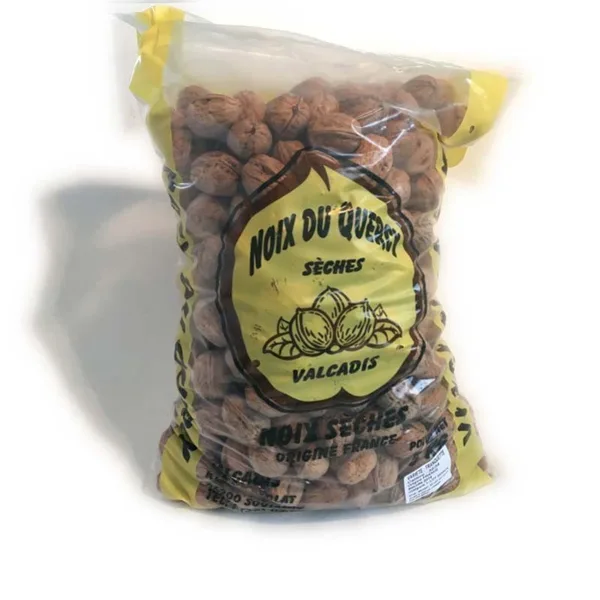
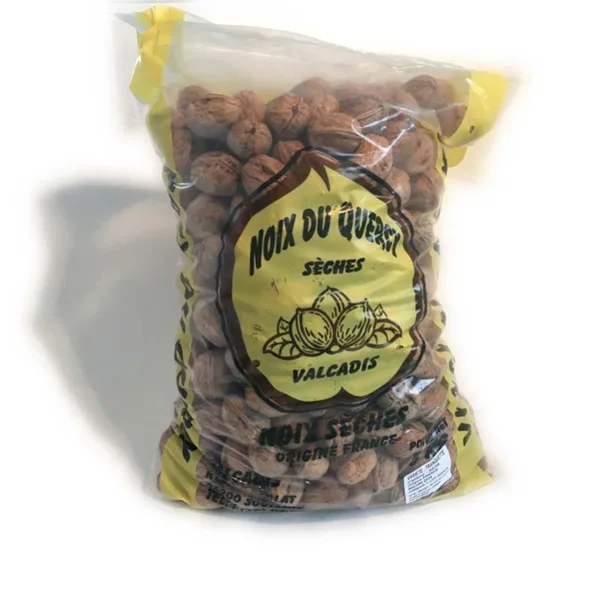
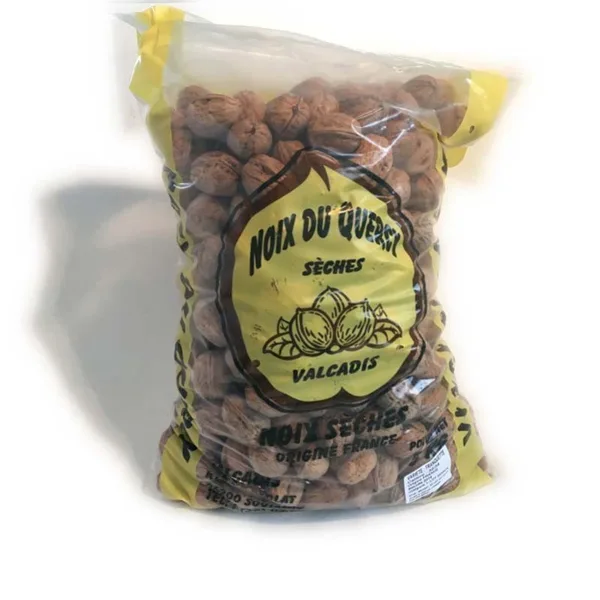
| In-shell Franquette | 30+ to 36+ | 5 kg bag | Tasting, retail, platter |
| French hazelnut kernel | Whole | 4 × 4 kg | Praliné, filling, snacking |
These formats cover the needs of pastry, cheesemongers, charcuterie and fine food. For larger volumes or specific calibres, we adapt sourcing on request.
Storage and kernel quality
The kernel, rich in lipids, oxidises in the air: exposed too long, it goes rancid and takes a bitter note. Vacuum packaging, chosen for the Chilean Extra Light kernels, slows this oxidation and preserves freshness until opening. The in-shell walnut keeps longer: the shell acts as a natural barrier, provided the bags are stored dry and away from heat.
We select our batches by origin, grade and calibre consistency, and we pass on the traceability information professionals need: origin, batch and best-before date accompany every order. An irregular-looking but sound kernel — the Broken grade — offers the same taste as an Extra, at a portion cost more exposed to waste.
For buyers managing production rates, planning orders against the best-before date prevents both shortages and surpluses: the kernel is ordered close to need, the in-shell walnut stores more easily.
Ordering wholesale: what Palimex provides
Our walnut and kernel range is aimed at food professionals: pastry chefs, chocolatiers, cheesemongers, charcutiers, caterers and fine-food retailers. To prepare an efficient order, several points are worth anticipating.
- Grade by use: Extra for presentation, Broken for filling and portion cost, vacuum Extra Light for production.
- Calibre of the in-shell walnut: 30+ to 36+ depending on the display and the calibre sought on the counter.
- Packaging by pace: 3 kg tray for retail, 12.5/15 kg box or 10 kg vacuum for the laboratory.
- Origin: France (Quercy) for terroir, Chile for Extra Light kernel consistency.
- Traceability: origin, batch and best-before date are supplied with every order for your hygiene records.
Grade and calibre are best reasoned from your trade and your presentation: an Extra kernel wasted in a filling costs more than a Broken well used.
Find our full range of nuts, walnuts, hazelnuts and pastry ingredients in our bulk pastry catalogue, designed for catering buyers who want a single contact for their sourcing.